 |
| |||||||||||||||

| ||||||||||||||||


| Similar | 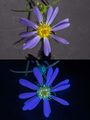  |
  |
  |
  |
  |
| |||||||||||||||||||||||||||
| |||||||||||||||||||||||||||
| 1996 1997 1998 1999 2000 2001 2002 2003 2004 2005 2006 2007 2008 2009 2010 2011 2012 2013 2014 2015 2016 2017 2018 2019 2020 2021 2022 2023 2024 2025 2026 | |||||||||||||||||||||||||||
| New version Slide Show Most Popular Full List Statistics Technical Details Home Page | |||||||||||||||||||||||||||
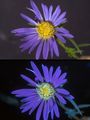
The top image shows a purple aster flower with yellow stamen illuminated by regular daylight. The bottom image is the same flower, but it was illuminated by UV-A light from a blacklight and it appears more blue than purple due to its natural fluorescence. This image showcases the unique property of some flowers to fluoresce under ultraviolet (UV) light. This phenomenon is known as photoluminescence or bioluminescence in plants, which involves the production of light through a chemical reaction, without consuming any energy from an external source. In this case, the UV-A radiation excites the molecules within the petals, causing them to emit longer wavelengths of light that are visible to humans. The phenomenon is not exclusive to asters; other flowers like orchids and pansies also exhibit this property, although their fluorescence may be less pronounced or more subtle. The ability of certain plants to fluoresce under UV light is likely an adaptation for attracting pollinators, such as bees and butterflies, which are sensitive to specific wavelengths of light. Overall, the image highlights the fascinating interaction between light and biological systems in nature, demonstrating how even seemingly ordinary objects can hold extraordinary secrets when illuminated by invisible forms of radiation. – AI vision |
El aster de pradera meridional (Eurybia hemispherica) cuando se expone a la luz diurna regular y cuando es iluminado con una luz negra ultravioleta (UV-A) de 365 nm desde un camino cerca de la Unidad Birch Creek del Parque Estatal Somerville Lake. Texas, el 1 de septiembre de 2024. La imagen superior muestra una flor de aster púrpura con estambres amarillos iluminados por luz diurna regular. La imagen inferior es la misma flor, pero se ilumina con luz UV-A desde una luz negra y aparece más azul que púrpura debido a su fluorescencia natural. Esta imagen muestra la propiedad única de algunas flores de fluorescer bajo luz ultravioleta (UV). Este fenómeno se conoce como fotoluminiscencia o bioluminiscencia en plantas, que implica la producción de luz a través de una reacción química sin consumir energía de ninguna fuente externa. En este caso, la radiación UV excita las moléculas dentro de los pétalos, haciendo que emitan longitudes de onda más largas de luz que son visibles para los humanos. Este fenómeno no es exclusivo de las asters; otras flores como las orquídeas y las violetas también muestran esta propiedad, aunque su fluorescencia puede ser menos pronunciada o más sutil. La capacidad de ciertas plantas para fluorescer bajo luz UV es probablemente una adaptación para atraer polinizadores, como abejas y mariposas, que son sensibles a longitudes de onda específicas de luz. En general, la imagen destaca la fascinante interacción entre la luz y los sistemas biológicos en la naturaleza, demostrando cómo incluso objetos aparentemente ordinarios pueden tener secretos extraordinarios cuando son iluminados por formas invisibles de radiación. – Spanish translation |
Keyword variants
Lake State Park photo capture
high resolution online digital collection
Somerville Lake visual image
Somerville Lake SP
Lone Star State
birch tree photowalks
United States
picture gallery
photo album
documentary photographs
daily pics
TX
travelogue
snapshots
sightseeing
photoblog
graphic
fotografias
foto
brzoza
breza
birken
birke
birk
birchen
birche
birce
betula
beriozka
berioza
bereza
beorc
America