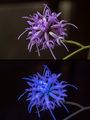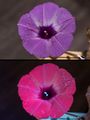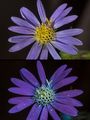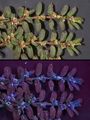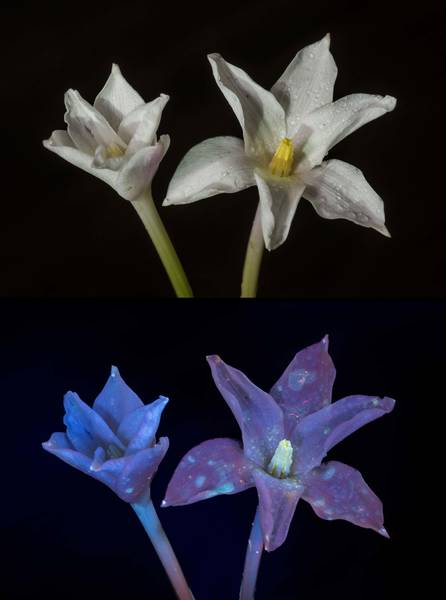

Rain lily (Cooperia drummondii) when exposed to regular daylight as well as when illuminated by a 365 nm ultraviolet (UV-A) blacklight from a trailway near Birch Creek Unit of Somerville Lake State Park. Texas


Album 3613: Lake Somerville - Sam Houston Forest, Texas, September 1 - 2, 2024
The image presents two photographs of flowers taken under different lighting conditions. The top photograph shows rain lilies (Cooperia drummondii) illuminated by regular daylight, while the bottom photograph displays them under ultraviolet (UV-A) blacklight.
**Photograph 1: Rain Lilies in Daylight**
* The white rain lily is shown against a dark background.
* It has six petals that curve outward from its yellow stamen.
* The flower appears to be growing from a green stem, which is visible at the base of the image.
* The overall appearance of the flower suggests it is healthy and thriving.
**Photograph 2: Rain Lilies Under UV-A Blacklight**
* The rain lily appears purple under the UV-A blacklight.
* Its petals are more pronounced than in the daylight photo, with a slight curvature towards the center of the flower.
* The yellow stamen remains visible but is less prominent due to the change in lighting conditions.
* The stem and leaves surrounding the flower are not as clearly visible as they were in the daylight photo.
**Comparison Between Photographs**
* The rain lily's color changes from white to purple when exposed to UV-A blacklight.
* Its petals become more pronounced, but its overall shape remains similar to that seen under regular daylight.
* The yellow stamen is less prominent under UV-A blacklight due to the change in lighting conditions.
**Conclusion**
The image shows how rain lilies appear differently depending on the type of light they are exposed to. While they have a natural white color when lit by regular daylight, they take on a purple hue and more pronounced petals when illuminated by UV-A blacklight. This suggests that the flowers' appearance can be influenced by external factors such as lighting conditions. – AI vision
🇪🇸 Descripción en español / Spanish Description
El lirio de lluvia (Cooperia drummondii) cuando está expuesto a la luz del día normal y también cuando es iluminado por una luz negra ultravioleta (UV-A) de 365 nm desde una pista cercana al área recreativa en el Lago Somerville State Park, Texas. El 1 de septiembre del 2024. La imagen presenta dos fotografías de flores tomadas bajo diferentes condiciones de iluminación. La fotografía superior muestra lirios de lluvia (Cooperia drummondii) iluminados por la luz normal del día, mientras que la fotografía inferior los muestra bajo una luz negra ultravioleta (UV-A). **Fotografía 1: Lirios de Lluvia en Luz Del Día** * El blanco lirio de lluvia se muestra contra un fondo oscuro. * Tiene seis pétalos que se curvan hacia afuera desde su estambre amarillo. * La flor parece estar creciendo desde un tallo verde, que es visible en la base de la imagen. * El aspecto general de la flor sugiere que está sana y prospera. **Fotografía 2: Lirios de Lluvia Bajo UV-A Blacklight** * El lirio de lluvia aparece púrpura bajo el UV-A blacklight. * Sus pétalos son más pronunciados que en la foto del día, con una ligera curvatura hacia el centro de la flor. * El estambre amarillo sigue siendo visible pero es menos prominente debido al cambio en las condiciones de iluminación. * Los tallos y hojas que rodean la flor no son tan claramente visibles como lo eran en la foto del día. **Comparación entre Fotografías** * El lirio de lluvia toma un color púrpura cuando se expone a la luz UV-A negra. * Sus pétalos se vuelven más prominentes, pero su forma general sigue siendo similar a la observada bajo la luz del día normal. * El estambre amarillo es menos prominente bajo la luz UV-A debido al cambio en las condiciones de iluminación. **Conclusión** La imagen muestra cómo los lirios de lluvia aparecen de manera diferente dependiendo del tipo de luz a la que están expuestos. Mientras tienen un color blanco natural cuando se ilumina con la luz normal del día, toman un tono púrpura y sus pétalos se vuelven más prominentes cuando son iluminados por UV-A negro. Esto sugiere que el aspecto de las flores puede verse influenciado por factores externos como las condiciones de iluminación. – Spanish translation