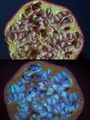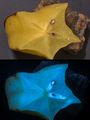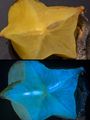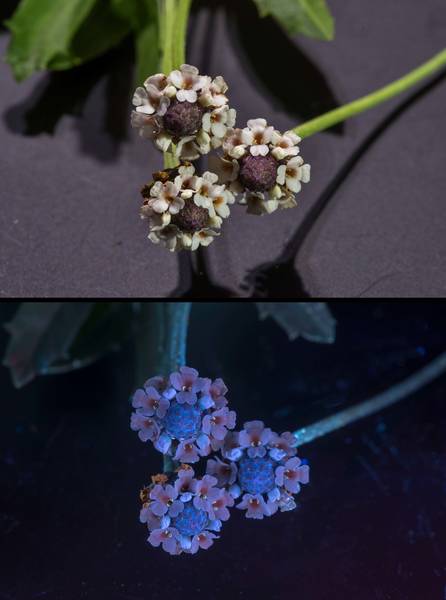

Frog fruit (Phyla incisa, Lippia) when exposed to regular daylight as well as when illuminated by a 365 nm ultraviolet (UV-A) blacklight from Bee Creek Park. College Station, Texas


Album 3625: College Station - Sam Houston Forest, Texas, September 23 - 23, 2024
The image presents two photographs of frog fruit (Phyla incisa), one taken under regular daylight and the other illuminated by a 365 nm ultraviolet (UV-A) blacklight. The purpose of these images is to compare how lighting affects the appearance of this plant species.
* **Top Image: Frog Fruit Under Daylight**
* This photograph captures the frog fruit in its natural state, exposed to regular daylight.
* The flowers appear white with a hint of pinkish coloration around their edges.
* There are no notable features or details that stand out in this image.
* **Bottom Image: Frog Fruit Under UV-A Blacklight**
* In contrast, the bottom photograph shows the same plant species illuminated by a 365 nm ultraviolet (UV-A) blacklight.
* The flowers exhibit a striking change in appearance under UV light, displaying vibrant blue hues with pinkish accents around their edges.
* This dramatic transformation highlights the presence of fluorescent pigments within the flowers that become visible only when exposed to specific wavelengths of light.
In summary, the image effectively demonstrates how different lighting conditions can alter our perception of a plant's appearance. While under daylight, the frog fruit's flowers appear relatively subdued in color, they burst into vibrant blue and pink hues when illuminated by UV-A blacklight, showcasing their unique fluorescent properties. – AI vision
🇪🇸 Descripción en español / Spanish Description
La fruta de rana (Phyla incisa, Lippia) cuando se expone a la luz diurna regular y cuando se ilumina con una luz negra ultravioleta (UV-A) de 365 nm desde Bee Creek Park. College Station, Texas, septiembre 23, 2024. La imagen presenta dos fotografías de la fruta de rana (Phyla incisa), una tomada bajo luz diurna y la otra iluminada con una luz negra ultravioleta (UV-A) de 365 nm. El propósito de estas imágenes es comparar cómo la iluminación afecta el aspecto de esta especie vegetal. * **Imagen superior: Fruta de Rana bajo Luz Diurna** * Esta fotografía captura la fruta de rana en su estado natural, expuesta a luz diurna regular. * Las flores aparecen blancas con un tinte rosado alrededor de sus bordes. * No hay características o detalles destacables en esta imagen. * **Imagen inferior: Fruta de Rana bajo Luz UV-A** * En contraste, la fotografía inferior muestra la misma especie vegetal iluminada por una luz negra ultravioleta (UV-A) de 365 nm. * Las flores muestran un cambio sorprendente en su apariencia bajo luz ultravioleta, mostrando tonos azules vibrantes con acentos rosados alrededor de sus bordes. * Esta transformación drástica destaca la presencia de pigmentos fluorescentes dentro de las flores que solo se vuelven visibles cuando se exponen a longitudes de onda específicas de luz. En resumen, la imagen demuestra efectivamente cómo diferentes condiciones de iluminación pueden alterar nuestra percepción del aspecto de una planta. Mientras que bajo luz diurna, las frutas de rana parecen flores relativamente atenuadas en su color, erupcionan con tonos azules y rosados vibrantes cuando se iluminan con UV-A, lo que resalta sus propiedades fluorescentes únicas. – Spanish translation