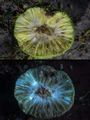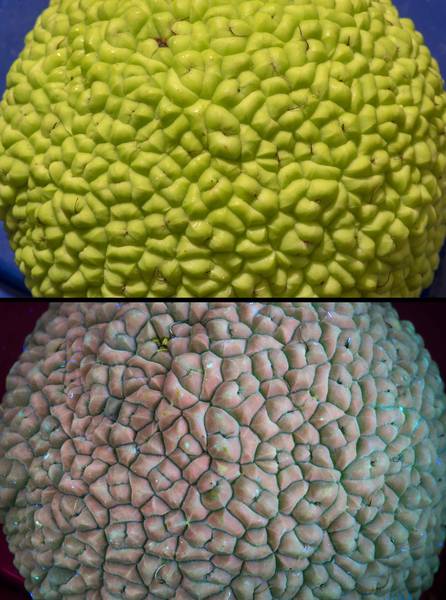

Fallen horse apple (osage orange, Maclura) both in natural light and under 365 nm ultraviolet (UV-A) blacklight from Bee Creek Park. College Station, Texas


Album 3627: College Station, Texas, October 2 - 4, 2024
The image presents a split-screen view of an Osage orange fruit, commonly referred to as a "horse apple," captured under two different lighting conditions: natural light and ultraviolet (UV-A) blacklight illumination at 365 nm.
**Top Image - Natural Light**
In the top image, the horse apple is illuminated by natural light. The fruit appears bright yellow-green in color, with a waxy texture that gives it a slightly glossy appearance. Its surface features numerous small bumps or protrusions, giving it a bumpy and irregular shape. The fruit is positioned on a dark background, which helps to accentuate its vibrant color.
**Bottom Image - UV-A Blacklight Illumination**
In the bottom image, the same horse apple is illuminated by 365 nm ultraviolet (UV-A) blacklight. Under this lighting condition, the fruit's appearance changes significantly. The bright yellow-green color of the top image gives way to a duller, more muted tone that is closer to green. Additionally, the waxy texture becomes even more pronounced, and the small bumps or protrusions on its surface become more visible.
**Comparison**
A comparison between the two images reveals several key differences in the appearance of the horse apple under natural light versus UV-A blacklight illumination. The most notable difference is the change in color tone, with the fruit appearing duller and greener under UV-A light. Additionally, the texture and surface features of the fruit become more pronounced under UV-A lighting, making it easier to see the small bumps or protrusions on its surface.
**Conclusion**
In conclusion, the image effectively demonstrates how different lighting conditions can affect the appearance of an object. The use of natural light versus 365 nm ultraviolet (UV-A) blacklight illumination highlights the importance of considering the lighting conditions when observing and recording the characteristics of objects in various fields, such as botany, biology, or materials science. – AI vision
🇪🇸 Descripción en español / Spanish Description
El manzano de las hojas caídas (maclura, Maclura) tanto en luz natural como bajo iluminación ultravioleta (UV-A) negra desde el Parque Bee Creek. College Station, Texas, 4 de octubre de 2024. La imagen presenta una vista dividida en dos partes de un manzano de las hojas caídas, comúnmente llamado "manzana de caballo", capturada bajo dos condiciones de iluminación diferentes: luz natural e iluminación ultravioleta (UV-A) negra a 365 nm. **Imagen superior - Luz Natural** En la imagen superior, el manzano de las hojas caídas está iluminado por luz natural. El fruto parece de color verde amarillento brillante, con una textura cerosa que le da un aspecto ligeramente lustroso. Su superficie presenta numerosas protuberancias o salientes pequeños, dándole una forma áspera e irregular. El fruto está posicionado sobre un fondo oscuro, lo cual ayuda a acentuar su color vibrante. **Imagen inferior - Iluminación ultravioleta (UV-A)** En la imagen inferior, el mismo manzano de las hojas caídas se ilumina con luz ultravioleta (UV-A) a 365 nm. Bajo esta condición de iluminación, el aspecto del fruto cambia significativamente. El tono amarillento brillante del fruto de la imagen superior da lugar a un tono más opaco y atenuado que se acerca más al verde. Además, la textura cerosa resulta todavía más pronunciada, y las protuberancias o salientes pequeños en su superficie son aún más visibles. **Comparación** Una comparación entre las dos imágenes revela varias diferencias importantes en el aspecto del manzano de las hojas caídas bajo iluminación natural versus ultravioleta (UV-A) negra. La diferencia más notable es el cambio en el tono de color, con el fruto apareciendo más opaco y verde bajo la luz UV-A. Además, la textura y las características superficiales del fruto resultan más pronunciadas bajo iluminación UV-A, lo que facilita ver las protuberancias o salientes pequeños en su superficie. **Conclusión** En conclusión, la imagen demuestra eficazmente cómo diferentes condiciones de iluminación pueden afectar el aspecto de un objeto. El uso de luz natural versus iluminación ultravioleta (UV-A) negra subraya la importancia de considerar las condiciones de iluminación al observar y registrar las características de objetos en diversas disciplinas, como la botánica, biología o ciencia de materiales. – Spanish translation