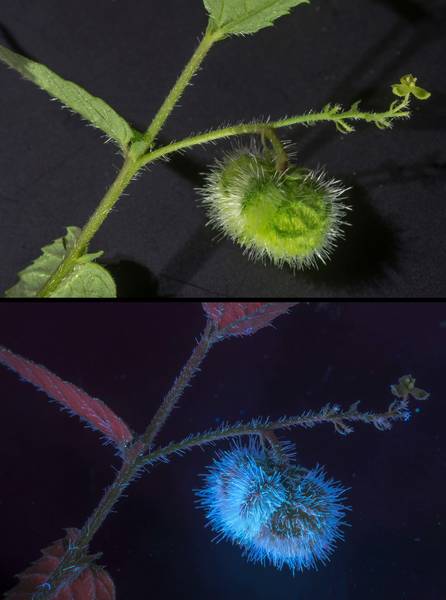

Branched noseburn (Tragia ramosa) when exposed to regular daylight as well as when illuminated by a 365 nm ultraviolet (UV-A) blacklight from Richards Loop Trail in Sam Houston National Forest. Texas


Album 3628: Sam Houston Forest - College Station, Texas, October 5 - 7, 2024
The image presents a close-up view of the Branched noseburn (Tragia ramosa), showcasing its appearance under two distinct lighting conditions: regular daylight and illumination by a 365 nm ultraviolet (UV-A) blacklight.
**Key Features**
* **Plant Description**: The plant's stem is characterized by small, thin leaves. A single flower or seed pod is visible at the end of the branch.
* **Lighting Conditions**
* **Daylight**: Under regular daylight, the plant appears greenish-yellow in color, with no notable features standing out.
* **UV-A Blacklight**: When illuminated by a 365 nm UV-A blacklight, the plant exhibits a striking transformation. The leaves and stem turn bright blue or purple, while the flower or seed pod glows an intense white.
* **Context**
* **Location**: The image was captured in Sam Houston National Forest, Texas, on October 5, 2024.
* **Photography Equipment**: A 365 nm ultraviolet (UV-A) blacklight was used to illuminate the plant.
**Overall Impression**
The image highlights the unique visual effects that can be observed when using UV-A light to illuminate plants. The transformation of the Branched noseburn's coloration and fluorescence under UV-A lighting demonstrates the importance of considering the impact of different lighting conditions on plant appearance. – AI vision
🇪🇸 Descripción en español / Spanish Description
Arbusto de la quema en la nariz (Tragia ramosa) cuando se expone a la luz del día regular, así como también cuando se ilumina con una luz negra ultravioleta (UV-A) de 365 nm desde el Richards Loop Trail en Sam Houston National Forest. Texas, 5 de octubre de 2024. La imagen presenta una vista detallada del arbusto de la quema en la nariz (Tragia ramosa), mostrando su apariencia bajo dos condiciones de iluminación distintas: luz del día regular e iluminación con una luz negra ultravioleta (UV-A) de 365 nm. * **Características Clave** * **Descripción de la Planta**: El tallo de la planta se caracteriza por hojas pequeñas y delgadas. Una sola flor o vaina de semillas es visible al final de la rama. * **Condiciones de Iluminación** * **Luz Del Día**: Bajo luz regular, la planta parece de color amarillo verdoso sin ninguna característica notable. * **Luz Negra UV-A**: Cuando se ilumina con una luz negra ultravioleta (UV-A) de 365 nm, la planta exhibe un cambio sorprendente. Las hojas y el tallo se vuelven azul o púrpura brillante, mientras que la flor o vaina de semillas brilla en blanco intenso. * **Contexto** * **Ubicación**: La imagen fue capturada en Sam Houston National Forest, Texas, el 5 de octubre de 2024. * **Equipamiento Fotográfico**: Se usó una luz negra ultravioleta (UV-A) de 365 nm para iluminar la planta. **Impresión General** La imagen destaca los efectos visuales únicos que pueden observarse cuando se utiliza la luz UV-A para iluminar las plantas. El cambio en la coloración y fluorescencia del arbusto de la quema en la nariz bajo la iluminación UV-A demuestra la importancia de considerar el impacto de diferentes condiciones de iluminación en la apariencia de las plantas. – Spanish translation