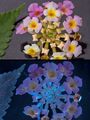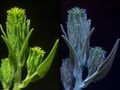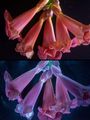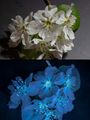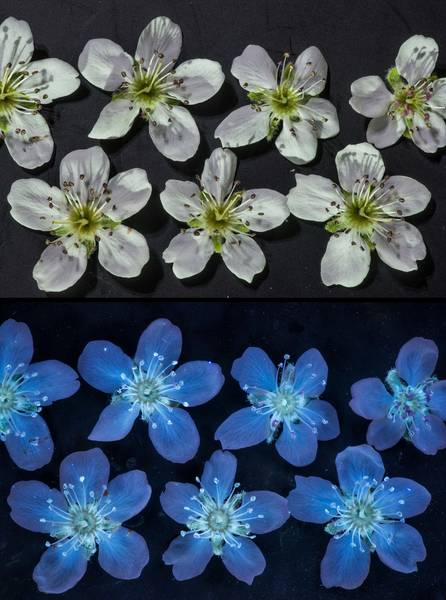

Flowers of Bradford pea when exposed to regular daylight as well as when illuminated by a 365 nm ultraviolet (UV-A) blacklight from Wolf Pen Creek Park. College Station, Texas


Album 3630: College Station - Sam Houston Forest, Texas, October 9 - 10, 2024
The image presents a striking comparison of Bradford pea flowers under two distinct lighting conditions: regular daylight and UV-A illumination using a blacklight. The photograph is divided into two sections, with the top section showcasing the flowers' appearance when exposed to normal daylight and the bottom section revealing their response to UV-A light.
**Daylight Illumination (Top Section)**
* The flowers display a delicate white hue.
* Their petals are thin and translucent, allowing the green stem to be visible through them.
* A subtle shadow is cast on the right side of each flower due to the light source's position.
* The background appears slightly darker than the flowers.
**UV-A Illumination (Bottom Section)**
* Under UV-A light, the flowers exhibit a vibrant blue coloration.
* Their petals become more opaque and take on a deep blue hue.
* The green stem is no longer visible through the petals due to their increased opacity.
* A shadow is cast on the right side of each flower similar to the daylight image.
**Comparison and Analysis**
* The most notable difference between the two images is the change in color, with the flowers transitioning from white to blue under UV-A illumination.
* The increased opacity of the petals when exposed to UV-A light suggests that this wavelength may enhance pigment production or absorption in the flowers.
* The shadows cast on the right side of each flower in both images indicate that the light source is positioned at an angle, creating uneven lighting conditions.
In summary, the image effectively illustrates the contrasting effects of regular daylight and UV-A illumination on Bradford pea flowers, highlighting their unique response to different wavelengths of light. – AI vision
🇪🇸 Descripción en español / Spanish Description
Las flores de guisante de Bradford cuando se exponen a la luz diurna regular, así como cuando se iluminan con una luz negra ultravioleta (UV-A) de 365 nm en el Parque Wolf Pen Creek. College Station, Texas, 9 de octubre de 2024. La imagen presenta una sorprendente comparación de las flores de guisante de Bradford bajo dos condiciones de iluminación distintas: luz diurna regular e iluminación UV-A utilizando una luz negra. La fotografía se divide en dos secciones, con la sección superior mostrando el aspecto de las flores cuando se exponen a la luz del día normal y la sección inferior revelando su respuesta a la luz UV-A.
**Iluminación diurna (sección superior)**
* Las flores muestran un tono blanco delicado. * Sus pétalos son delgados y translúcidos, lo que permite ver el tallo verde a través de ellos. * Se proyecta una sombra sutil en el lado derecho de cada flor debido a la posición de la fuente de luz. * El fondo aparece ligeramente más oscuro que las flores.
**Iluminación UV-A (sección inferior)**
* Bajo luz UV-A, las flores muestran una vibrante coloración azul. * Sus pétalos se vuelven más opacos y adquieren un tono azul oscuro. * El tallo verde ya no es visible a través de los pétalos debido a su mayor opacidad. * Se proyecta una sombra en el lado derecho de cada flor similar a la imagen de luz diurna.
**Comparación y análisis**
* La diferencia más notable entre las dos imágenes es el cambio de color, pasando de blanco a azul bajo la iluminación UV-A. * La mayor opacidad de los pétalos cuando se exponen a la luz UV-A sugiere que esta longitud de onda puede potenciar la producción o absorción de pigmento en las flores. * Las sombras proyectadas en el lado derecho de cada flor en ambas imágenes indican que la fuente de luz está posicionada formando un ángulo, creando condiciones de iluminación desiguales.
En resumen, la imagen ilustra efectivamente los contrastantes efectos de la luz diurna regular y la iluminación UV-A en las flores de guisante de Bradford, destacando su respuesta única a diferentes longitudes de onda de la luz. – Spanish translation