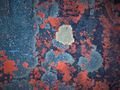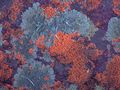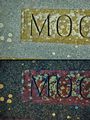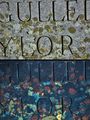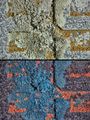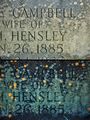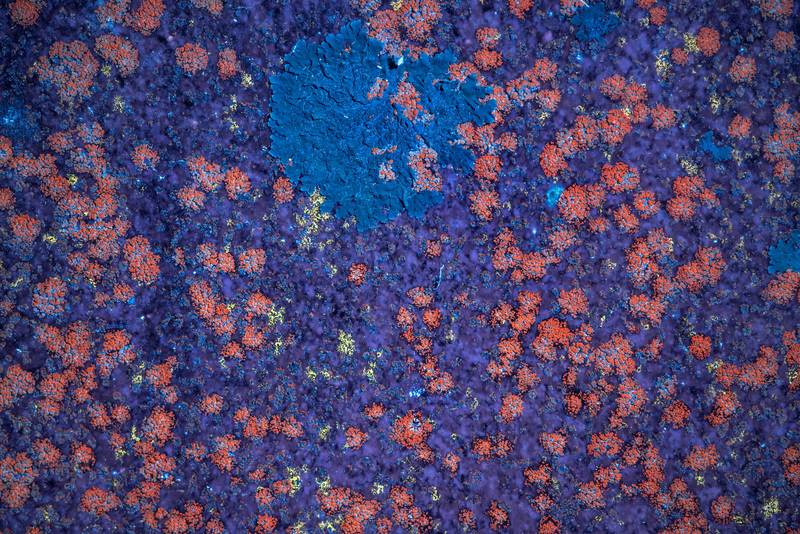

Granite tomb with fluorescent crustose lichens in ultraviolet light in City Cemetery. Bryan, Texas


Album 3635: Bryan, Texas, October 24, 2024
The image shows a granite tomb covered in fluorescent crustose lichens that emit blue and red fluorescence when exposed to UV light.
A close look at the image reveals that the tomb is made of dark gray granite with large, irregularly shaped flecks of pinkish-red feldspar that are common in many types of granite. The most striking feature, however, is the thick layer of crustose lichens covering its surface. Lichens are composite organisms consisting of fungi and algae or cyanobacteria living together in a symbiotic relationship.
The blue fluorescence observed under UV light in this image comes from a pigment called "parietin" or "lecanorin," which is produced by the lichen's fungal component, known as mycobiont. Parietin has been shown to have antimicrobial activity and can be used as an antiviral agent. The red fluorescence observed under UV light in this image comes from a pigment called "atranorin" or "norstictic acid," which is produced by the lichen's fungal component, known as mycobiont.
It appears that the tomb has been exposed to the elements for some time due to weathering and erosion. This can cause lichens to grow on its surface over time.
The image suggests a beautiful and peaceful scene, with the fluorescent lichens adding an otherworldly touch to the granite tomb. – AI vision
🇪🇸 Descripción en español / Spanish Description
Una tumba de granito con líquenes costrosos fluorescentes bajo luz ultravioleta en el Cementerio Municipal. Bryan, Texas, 24 de octubre del 2024. La imagen muestra una tumba de granito cubierta por líquenes costrosos fluorescentes que emiten fluorescencia azul y roja cuando se exponen a la luz UV. Una mirada más detallada a la imagen revela que el sepulcro está hecho de granito gris oscuro con grandes manchas irregularmente conformadas en forma de rosa-rojizo de campoespato, lo cual es común en muchos tipos de granito. La característica más llamativa, sin embargo, es la gruesa capa de líquenes costrosos que cubren su superficie. Los líquenes son organismos compuestos por hongos y algas o cianobacterias que viven juntos en una relación simbiótica. La fluorescencia azul observada bajo luz UV en esta imagen viene de un pigmento llamado "parietina" o "lecanorina", el cual es producido por el componente fúngico del lichen, conocido como micobionte. Se ha demostrado que la parietina tiene actividad antimicrobiana y puede ser utilizada como agente antiviral. La fluorescencia roja observada bajo luz UV en esta imagen viene de un pigmento llamado "atranorina" o "ácido norstítico", el cual es producido por el componente fúngico del lichen, conocido como micobionte. Parece que la tumba ha estado expuesta a los elementos durante algún tiempo debido al deterioro y erosión. Esto puede causar que crezcan líquenes en su superficie con el paso del tiempo. La imagen sugiere una escena bella y pacífica, con los líquenes fluorescentes añadiendo un toque de otro mundo al sepulcro de granito. – Spanish translation