 |
| |||||||||||||||||

| ||||||||||||||||||


| Similar |   |
  |
  |
  |
  |
| |||||||||||||||||||||||||||||
| |||||||||||||||||||||||||||||
| 1996 1997 1998 1999 2000 2001 2002 2003 2004 2005 2006 2007 2008 2009 2010 2011 2012 2013 2014 2015 2016 2017 2018 2019 2020 2021 2022 2023 2024 2025 2026 | |||||||||||||||||||||||||||||
| New version Slide Show Most Popular Full List Statistics Technical Details Home Page | |||||||||||||||||||||||||||||
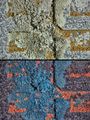
The image presents two photographs, taken on different days, of a granite tombstone bearing the name "Herne." The top image depicts the stone under regular daylight, while the bottom image captures it illuminated by a blacklight emitting 365 nm ultraviolet (UV-A) radiation. **Granite Tombstone Details** * Inscription: "HERNE" **Lighting Conditions** * Top Image: **Firedot Lichen Presence and Appearance** * **Caloplaca on Granite:** The presence of Caloplaca, a type of lichen, is evident on the granite tombstone. This organism thrives in environments with low humidity and high light intensity. **Conclusion** The image effectively demonstrates how different lighting conditions can affect the appearance of organisms like Caloplaca growing on granite surfaces. The use of regular daylight and UV-A blacklight highlights the unique characteristics of this lichen, showcasing its adaptability to various environmental conditions. – AI vision |
El líquen Firedot Caloplaca en una lápida de granito de Herne cuando se expone a la luz diurna regular, así como también cuando se ilumina con una luz negra ultravioleta (UV-A) de 365 nm en el Cementerio de la Ciudad. Bryan, Texas, 24 de octubre del 2024. La imagen presenta dos fotografías, tomadas en días diferentes, de una lápida de granito que lleva el nombre "Herne". La parte superior muestra la piedra bajo la luz diurna regular, mientras que la parte inferior captura la piedra iluminada por una luz negra que emite radiación ultravioleta (UV-A) de 365 nm. **Detalles de la lápida de granito** * Inscripción: "HERNE" * Superficie: Granito * Color: Ocre amarillento **Condiciones de iluminación** * Parte superior: * Fuente de luz: Luz diurna * Nivel de iluminación: Luz diurna regular * Parte inferior: * Fuente de luz: Luz negra (365 nm UV-A) * Nivel de iluminación: Mejorado por la luz negra **Presencia y aspecto del líquen Firedot** * **Caloplaca en granito:** La presencia de Caloplaca, un tipo de líquen, es evidente en la lápida de granito. Este organismo prospera en entornos con baja humedad e intensidad lumínica alta. * **Apariencia bajo luz diurna regular:** * Coloración: Ocre amarillento * Textura: Desde suave hasta ligeramente rugoso debido al crecimiento del líquen * **Apariencia bajo la luz negra de 365 nm UV-A:** * Coloración: Amarillo ocre intensificado con un matiz rojizo * Textura: Textura más pronunciada debido al efecto de la luz negra sobre el líquen **Conclusión** La imagen demuestra efectivamente cómo las diferentes condiciones de iluminación pueden afectar el aspecto de organismos como Caloplaca que crecen en superficies de granito. El uso de luz diurna regular y luz negra de 365 nm UV-A destaca las características únicas de este líquen, mostrando su adaptabilidad a diversas condiciones ambientales. – Spanish translation |
Keyword variants
high resolution online digital collection
burial of the dead
Lone Star State
last resting place
jaws of death
house of death
hand of death
finger of death
end of life
City Cemetery photographs
burial of corpse
United States
picture gallery
photo album
memorial stone
memorial park
leaving life
last rest
last home
eternal rest
documentary photographs
death knell
daily pics
burying ground
burial site
burial place
burial ground
burial chamber
bone house
vault
TX
travelogue
tombscape
tombs
tomb
snapshots
sightseeing
remembrance
photowalks
photoblog
passing
necropolis
monument
memento
insculpture
headstone
graveyard
gravestone
gravesite
graves
grave
graphic
funereal
funerals
funebrial
fotografias
foto
footstone
exit
dying
departure
crypt
cemeterium
cemetary
cemetarey
cementary
America