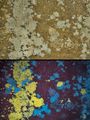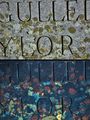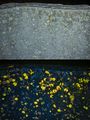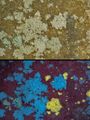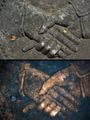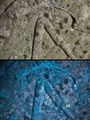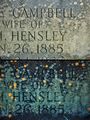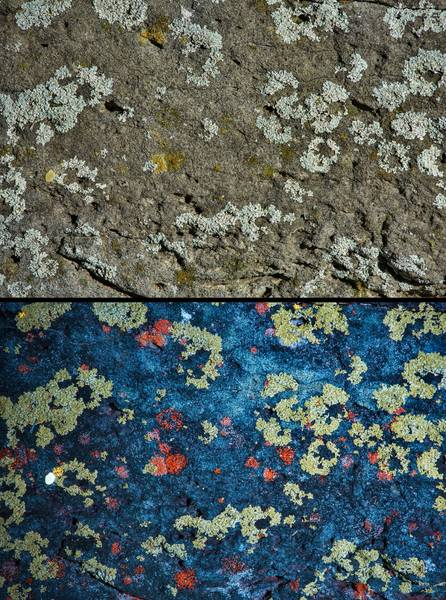

Crustose lichens of a rough surface of a tombstone both in natural light and under 365 nm ultraviolet (UV-A) blacklight in Odd Fellow Cemetery. Anderson, Texas


Album 3640: Anderson, Texas, November 9, 2024
The image presents a comparative analysis of the same area on a tombstone, showcasing how it appears both under natural light and when exposed to UV-A blacklight with a wavelength of 365 nanometers (nm). The top portion of the image features an area illuminated by natural light, while the bottom section is lit by UV-A blacklight.
Both areas display numerous lichens growing on the tombstone surface, but their appearances differ significantly based on the illumination source. Under natural light, the lichens appear as small, irregularly shaped patches in shades of grayish-brown and greenish-yellow hues. However, when exposed to UV-A blacklight, they exhibit a striking transformation. The lichen growth becomes more pronounced, with vibrant colors emerging from the surface. Some lichens display a reddish hue, while others appear yellowish or orange.
The differences between natural light and UV-A illumination are particularly evident on the bottom portion of the image. In this area, the lichens appear more vibrant and varied in color when exposed to UV-A blacklight compared to their subtle appearance under natural lighting conditions.
Overall, the image effectively highlights the contrast between how lichen growths appear under different light sources, demonstrating that they are not always visible or easily discernible without the aid of specialized illumination. – AI vision
🇪🇸 Descripción en español / Spanish Description
Los líquenes de superficie irregular en una lápida tanto a la luz natural como bajo luz negra ultravioleta (UV-A) de 365 nm en Odd Fellow Cemetery, Anderson, Texas, el 9 de noviembre de 2024. La imagen presenta un análisis comparativo del mismo área en una lápida, mostrando cómo aparece a la luz natural y cuando se expone a luz negra UV-A con una longitud de onda de 365 nanómetros (nm). La parte superior de la imagen muestra un área iluminada por la luz natural, mientras que la sección inferior está iluminada por luz negra UV-A. Ambas áreas presentan numerosos líquenes creciendo en la superficie de la lápida, pero su aspecto difiere significativamente según la fuente de iluminación. A la luz natural, los líquenes aparecen como pequeñas manchas de forma irregular con tonalidades grisáceo-marrón y verde-amarillento. Sin embargo, cuando se exponen a luz negra UV-A, muestran una transformación impactante. El crecimiento de líquenes es más pronunciado, surgiendo colores vibrantes desde la superficie. Algunos líquenes presentan un matiz rojizo, mientras que otros aparecen amarillentos u oranjas. Las diferencias entre la luz natural y la iluminación UV-A son particularmente evidentes en la parte inferior de la imagen. En esta área, los líquenes aparecen más vibrantes y con una variedad cromática mayor cuando se exponen a luz negra UV-A en comparación con su aspecto sutil bajo condiciones de iluminación natural. En general, la imagen destaca efectivamente el contraste entre cómo crecen los líquenes bajo diferentes fuentes de luz, demostrando que no siempre son visibles o fácilmente discernibles sin ayuda de una iluminación especializada. – Spanish translation