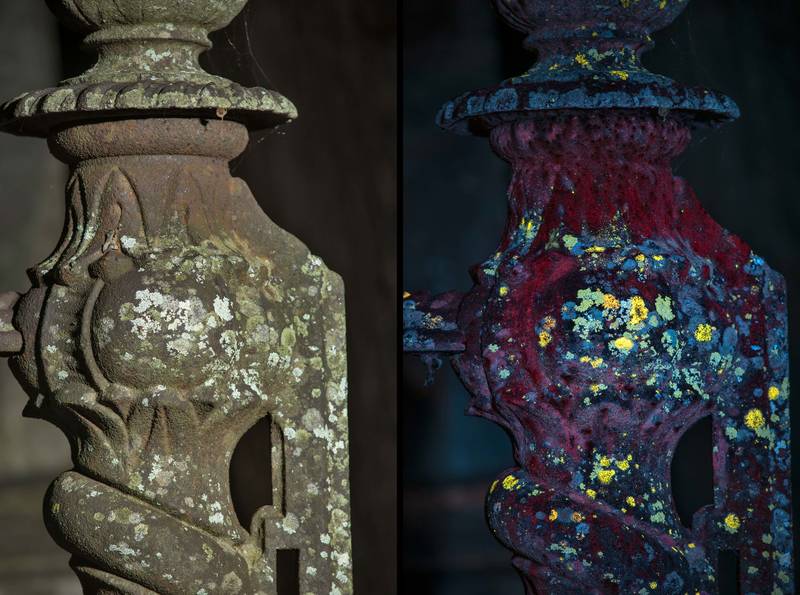

Iron stand with lichens of a cast iron tomb fence both in natural light and under 365 nm ultraviolet (UV-A) blacklight in Odd Fellow Cemetery. Anderson, Texas


Album 3640: Anderson, Texas, November 9, 2024
The image presents a comparative analysis of an iron stand with lichens on a cast iron tomb fence in both natural light and under 365 nm ultraviolet (UV-A) blacklight.
**Left Image: Natural Light**
* The left image captures the iron stand in its natural state, illuminated by daylight.
* The cast iron material exhibits a weathered appearance, with visible signs of aging and wear.
* Lichens are present on the surface of the stand, displaying their characteristic greenish hue.
* The lichens appear to be growing on the irregularities of the metal's surface.
**Right Image: UV-A Blacklight**
* In contrast, the right image shows the same iron stand under 365 nm ultraviolet (UV-A) blacklight.
* Under UV-A illumination, the lichens emit a vibrant yellowish-green fluorescence, highlighting their presence on the cast iron surface.
* The fluorescence of the lichens is more pronounced compared to their appearance in natural light.
* The background of the image remains dark and unlit.
**Comparison**
* The two images demonstrate how UV-A blacklight can enhance the visibility of lichens growing on metal surfaces.
* In natural light, the lichens are somewhat camouflaged by the weathered cast iron material.
* Under UV-A illumination, however, their fluorescence becomes more apparent, making them easier to detect and observe.
**Conclusion**
The image effectively illustrates the utility of UV-A blacklight in identifying and visualizing lichens on metal surfaces. This method can be particularly useful for conservation efforts, as it allows researchers to better understand the presence and distribution of lichens on historical artifacts. – AI vision
🇪🇸 Descripción en español / Spanish Description
El hierro con musgos de una valla de hierro fundido en luz natural y bajo luz negra ultravioleta (UV-A) de 365 nm en Odd Fellow Cemetery. Anderson, Texas, 9 de noviembre de 2024. La imagen presenta un análisis comparativo de una estructura de hierro con musgos en una valla de hierro fundido en luz natural y bajo luz negra ultravioleta (UV-A) de 365 nm. **Imagen izquierda: Luz natural**
*La imagen izquierda captura el soporte de hierro en su estado natural, iluminado por la luz del día. *El material de hierro fundido exhibe un aspecto desgastado, con signos visibles de envejecimiento y desgaste. *Los musgos están presentes en la superficie del soporte, mostrando su característico tono verdoso. *Los musgos parecen crecer en las irregularidades de la superficie del metal. **Imagen derecha: Luz negra UV-A**
*En contraste, la imagen de la derecha muestra el mismo soporte de hierro bajo luz negra ultravioleta (UV-A) de 365 nm. *Bajo iluminación UV-A, los musgos emiten una fluorescencia amarillenta verde vibrante, resaltando su presencia en la superficie del hierro fundido. *La fluorescencia de los musgos es más pronunciada en comparación con su aspecto a simple vista. *El fondo de la imagen sigue siendo oscuro y no iluminado. **Comparación**
*Las dos imágenes demuestran cómo la luz negra UV-A puede mejorar la visibilidad de los musgos que crecen en superficies metálicas. *En luz natural, los musgos están camuflados en cierta medida por el material oxidado del hierro fundido. *Sin embargo, bajo iluminación UV-A, su fluorescencia se vuelve más evidente, lo que hace que sea más fácil detectarlos y observarlos. **Conclusión**
La imagen ilustra de manera efectiva la utilidad de la luz negra UV-A para identificar y visualizar musgos en superficies metálicas. Este método puede ser particularmente útil para los esfuerzos de conservación, ya que permite a los investigadores entender mejor la presencia y distribución de musgos en artefactos históricos. – Spanish translation