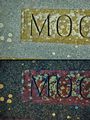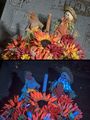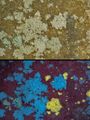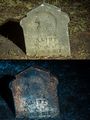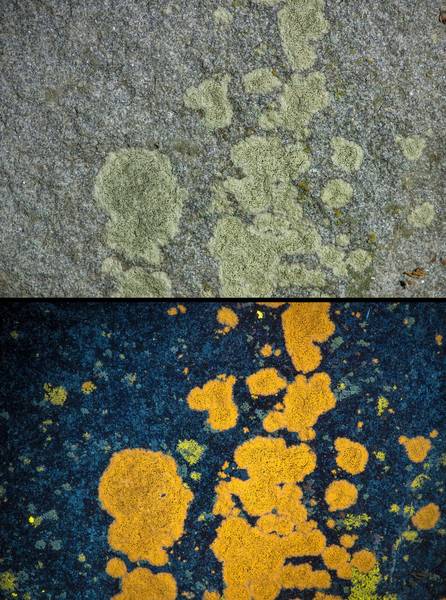

Crustose lichen with bright orange fluorescence on a granite tomb when exposed to regular daylight as well as when illuminated by a 365 nm ultraviolet (UV-A) blacklight in Odd Fellow Cemetery. Anderson, Texas


Album 3640: Anderson, Texas, November 9, 2024
The photograph showcases two distinct images of a granite tombstone, each capturing the effects of various lighting conditions on a crustose lichen. The top image is illuminated by natural daylight from the sun, while the bottom image is lit by a 365 nm ultraviolet (UV-A) blacklight.
In the top image, the lichen appears as a light greenish-gray patch with fainter areas around it, suggesting that some of the original granite has been weathered away. The overall effect is one of aging and wear, giving the appearance of an old tombstone.
In contrast, the bottom image reveals a strikingly different scene when illuminated by UV-A blacklight. The lichen now exhibits vibrant orange fluorescence throughout its entire surface area, with no signs of fading or discoloration. This dramatic transformation highlights the unique properties of the lichen and its ability to absorb and emit light in response to specific wavelengths.
The use of both natural daylight and UV-A blacklight allows for a nuanced understanding of how different lighting conditions can affect the appearance of organisms like this crustose lichen, which thrives on rocks or soil surfaces. By comparing these two images, we gain insight into the complex relationships between environmental factors, biological organisms, and our perception of their surroundings.
Overall, this image effectively demonstrates the power of photography in capturing subtle yet significant changes in the natural world, inviting viewers to appreciate the intricate details that underlie our everyday experiences. – AI vision
🇪🇸 Descripción en español / Spanish Description
El líquen de corteza con fluorescencia naranja brillante en una lápida de granito cuando se expone a la luz diurna regular y también cuando se ilumina con luz negra ultravioleta (UV-A) de 365 nm en el cementerio Odd Fellow. Anderson, Texas, el 9 de noviembre de 2024. La fotografía muestra dos imágenes distintas de una lápida de granito, capturando los efectos de varias condiciones de iluminación en un líquen de corteza. La imagen superior se ilumina con luz natural del sol, mientras que la imagen inferior se ilumina con una luz negra ultravioleta (UV-A) de 365 nm. En la imagen superior, el líquen aparece como un parche grisáceo claro con áreas más claras alrededor, lo que sugiere que parte del granito original se ha erosionado. El efecto general es uno de envejecimiento y desgaste, dando la apariencia de una lápida antigua. En contraste, la imagen inferior revela una escena sorprendentemente diferente cuando se ilumina con luz UV-A. El líquen ahora presenta una fluorescencia naranja vívida en toda su superficie, sin signos de desvanecimiento o decoloración. Esta transformación dramática resalta las propiedades únicas del líquen y su capacidad para absorber y emitir luz como respuesta a longitudes de onda específicas. El uso tanto de luz diurna natural como de luz negra UV-A permite una comprensión matizada de cómo diferentes condiciones de iluminación pueden afectar la apariencia de organismos como este líquen de corteza, que prospera en rocas o superficies de suelo. Al comparar estas dos imágenes, obtendremos información sobre las complejas relaciones entre los factores ambientales, los organismos biológicos y nuestra percepción de sus alrededores. En general, esta imagen demuestra eficazmente el poder de la fotografía en capturar cambios sutiles pero significativos en el mundo natural, invitando a los espectadores a apreciar los detalles intrincados que subyacen a nuestras experiencias cotidianas. – Spanish translation