Home Page > Picture Archives > Child art > Crayon drawings 1963-1964
Child art: Pre-school crayon drawings
Crayon and pencil drawings and greeting cards, 1963-1964
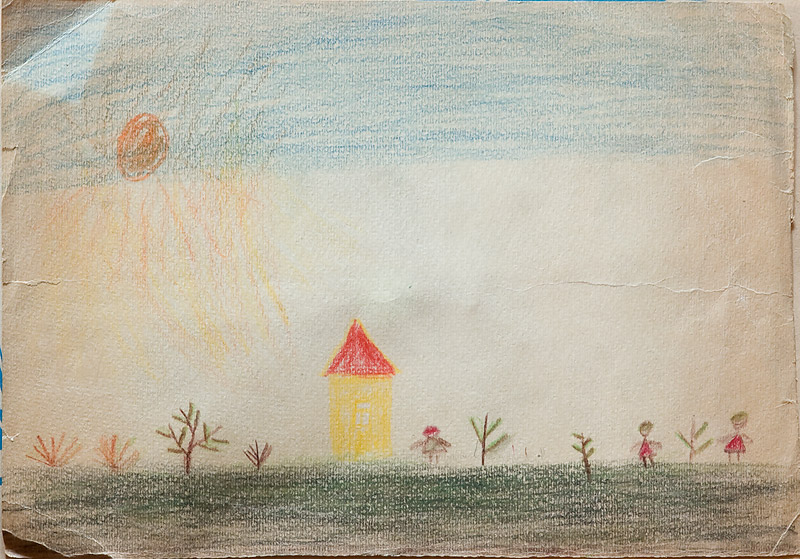
Kindergarten baseline drawing with trees, a house and figures of people.
This early childhood artwork captures a classic "baseline" composition, where figures, structures, and plants are anchored firmly to a dark green ground line beneath a broad band of blue sky. A massive, radiant sun with sweeping orange rays dominates the upper left, showing an expressive grasp of environmental energy. While the scene is wonderfully naive, the artist already demonstrates an analytical reliance on foundational geometry—constructing the central house from a distinct yellow rectangle and an overhanging red triangle, and abstracting the small human figures into simple shapes. Notably, the sparse vegetation is depicted through intersecting, Y-shaped line work. This early, deliberate representation of branching shows a nascent attempt to understand the structural, fractal-like mechanics of organic growth, hinting at the analytical mindset that would later flourish in mathematics and the physical sciences.
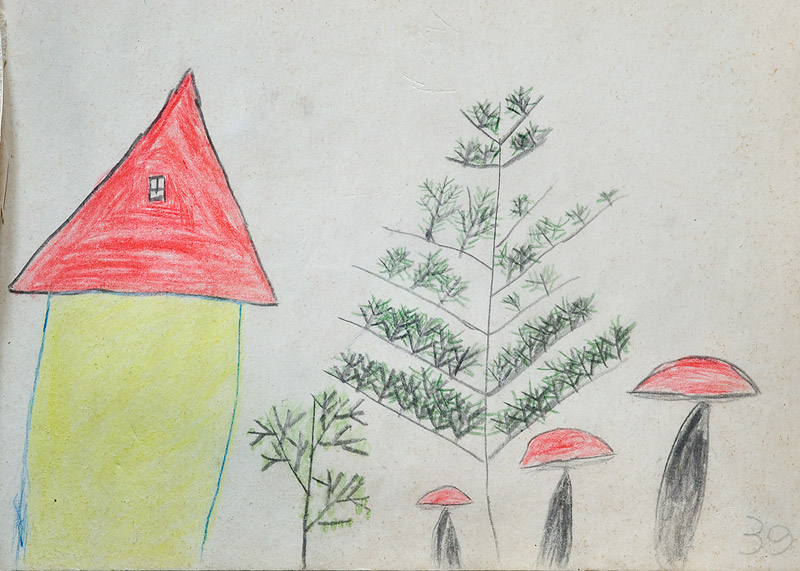
Symbolic baseline drawings of a house, trees and three red cap mushrooms. Album page No. 39.
This 1963 pencil and crayon drawing from Leningrad provides a charming look into a child's perception of nature, capturing a woodland scene with deliberate attention to specific structural details. The building features a tall, bright yellow rectangular body topped with a prominent, solid red triangular roof. Two coniferous trees are drawn with a methodical approach, utilizing a central vertical trunk and straight, angled branches, with distinct clusters of green pencil strokes representing pine needles. Three distinct mushrooms, resembling prized edible boletes (podosinoviki), are arranged in ascending size with thick, dark grey stems and flattened red caps. The artwork exemplifies the expressive, naive style typical of early childhood development, utilizing bold primary colors and foundational geometric shapes. The analytical, diagrammatic approach to structuring the tree branches suggests a logical mind, while the specific depiction of edible boletes hints at a future passion for mycology.
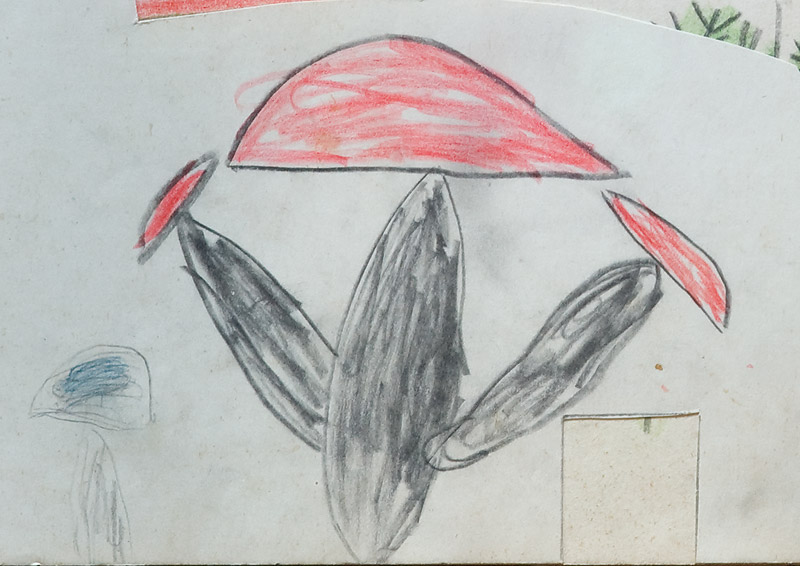
Three-prong forked red cap mushroom. The paper was cut around the drawing. Album page No. 41.
This fascinating mixed-media composition highlights a distinct shift toward isolated structural observation. A dominant, three-pronged mushroom with thick, dark grey stipes and flattened red caps has been carefully drawn, cut out along its contours, and overlaid onto a secondary woodland scene. The central bolete features a massive primary stem that diverges into two smaller lateral shoots, demonstrating an early fascination with biological branching and topological variations in nature. By intentionally cutting the object out from its original context, the young artist exhibits an abstract, analytical desire to isolate and examine a specific geometric structure independently of its background. The underlying page (marked as No. 43) reveals familiar themes: the crisp red triangle of a roof and a highly methodical, fractal-like conifer tree built from repeating, straight-angled line segments. Together, the layered elements foreshadow a lifelong intellectual path dedicated to structural logic, mathematical modeling, and precise natural observation.
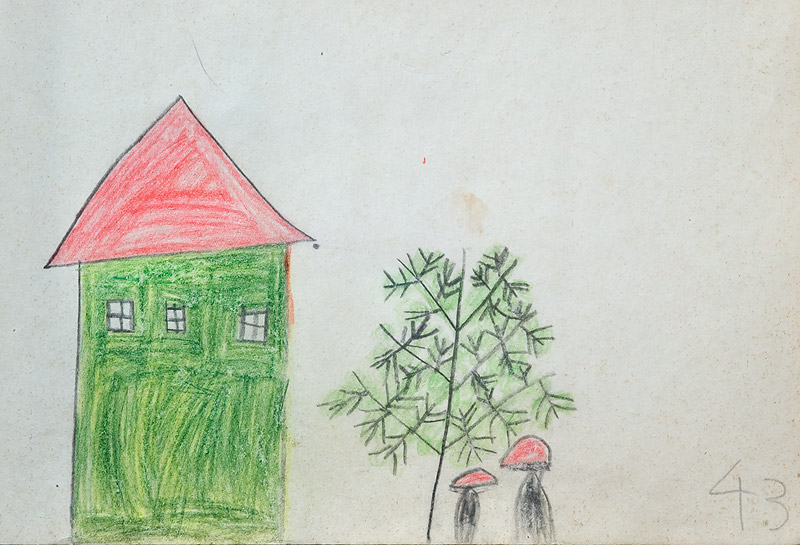
Baseline drawing of a green house, a three level branching tree and two red cap mushrooms. Album page No. 43.
This drawing further develops the artist's structured approach to analyzing and representing their environment. The composition features a prominent green house constructed with clear geometric intention, topped by a solid red triangular roof and detailed with three distinct, cross-paned windows. Beside the house, a highly methodical conifer tree dominates the natural landscape. Unlike a simple, solid shape, the tree is built using a complex, three-level fractal branching pattern—a single vertical trunk diverges into primary branches, which then split into secondary and tertiary needle clusters. This meticulous, iterative line work demonstrates a deep, early intuition for the mathematical mechanics of organic growth. At the base of the tree sit two distinct red-cap mushrooms (boletes), characterized by their thick, dark stipes and flattened caps. The recurring, precise depiction of these specific fungal structures reinforces a sharp observational focus that naturally prefigures a lifelong interest in mycology and the analytical sciences.
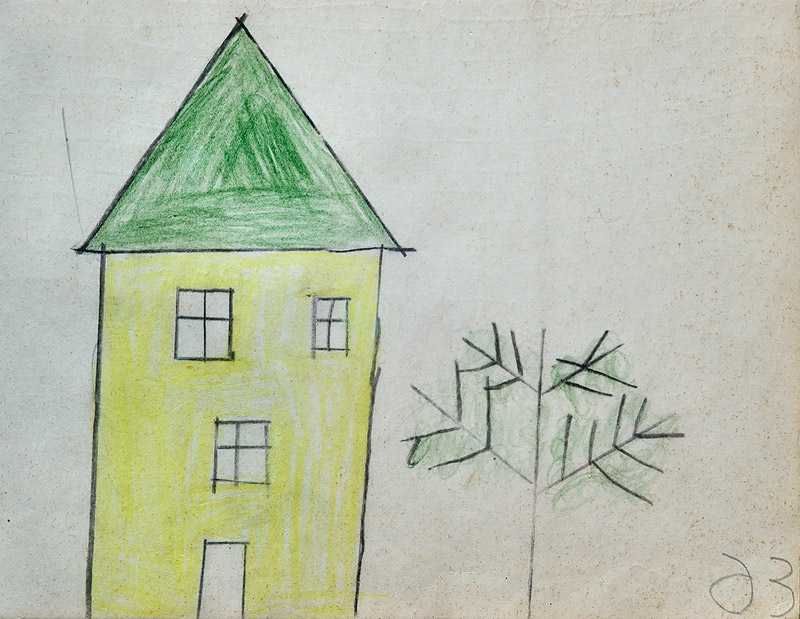
Baseline drawing of a yellow house and a two level branching tree. Album page No. 36(?).
This drawing strips the woodland scene down to its core structural elements, showcasing a highly analytical approach to visual representation. The composition is anchored by a tall, yellow rectangular house fitted with three deliberately placed cross-paned windows and a central door. It is capped by a stark, green triangular roof featuring heavy, diagonal pencil strokes that emphasize the shape's solid geometry. Beside the house stands a remarkable tree that serves as a pure exercise in fractal branching. Devoid of a solid canopy, the tree is meticulously constructed from a single vertical line that splits into rigid, angled branches, which in turn split again into secondary segments. The sparse green shading behind the branches seems almost like an afterthought compared to the precision of the line work. This deliberate focus on the underlying skeletal framework of natural objects reveals a young mind deeply engaged with the mathematical principles of structure and recursive growth.
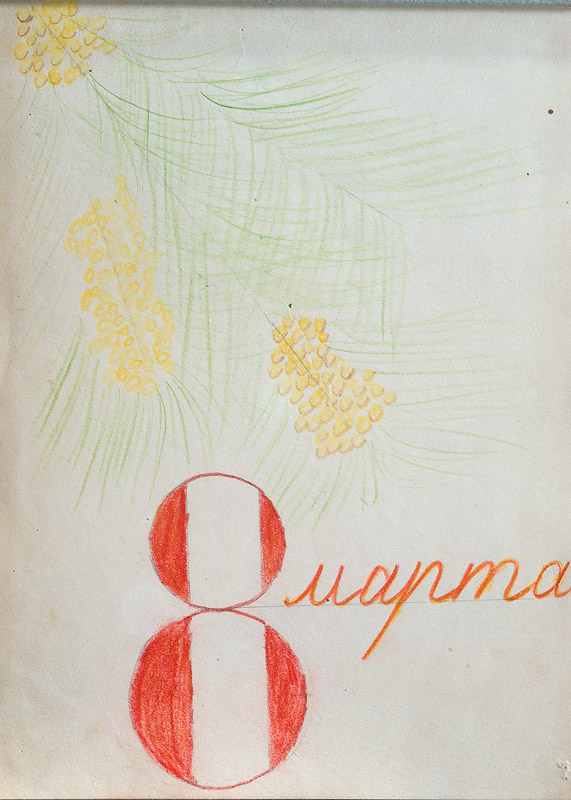
Greeting card for 8th of March holiday (Women's Day) showing mimosa with clusters of yellow globular flowers.
This delicate pencil and crayon drawing represents a heartfelt childhood gift for the 8th of March, traditionally celebrated in Russia as a day to honor mothers and grandmothers. Likely copied from a professional printed postcard, the composition demonstrates a young artist practicing the discipline of reproduction and fine motor control. The focal point is a large, meticulously drafted number "8," drawn with carefully outlined concentric circles and filled with solid red shading on the outer edges to create a ribbon-like, three-dimensional effect. The cursive word "марта" (March) is traced along a faint, perfectly straight baseline, showing an early, methodical approach to practicing penmanship. Above the text, sweeping green lines represent the feathery foliage of a mimosa branch, punctuated by tight clusters of yellow, globular flowers. While less abstractly analytical than the artist’s original woodland scenes, the careful, faint guidelines and disciplined tracing reveal a distinct appreciation for neatness and structured drafting.
Draft drawing of some flowers.
This minimalist pencil sketch offers a glimpse into the young artist's process of replication and draftsmanship. Drawn over a page bearing the faintly embossed cursive letters "марта" from a previous 8th of March greeting card, the composition consists of delicate, traced outlines of a floral bouquet. Using only light yellow and red pencil strokes, the artist carefully maps out the structural boundaries of the flowers, leaves, and a cluster of berries, rather than filling them in with solid color. The inclusion of small, stylized curlicues on the stems suggests an attempt to replicate the specific decorative flourishes of a printed postcard. While not as original as the woodland scenes, this exercise in tracing fine contours demonstrates a quiet, methodical patience and a developing hand for technical line work.
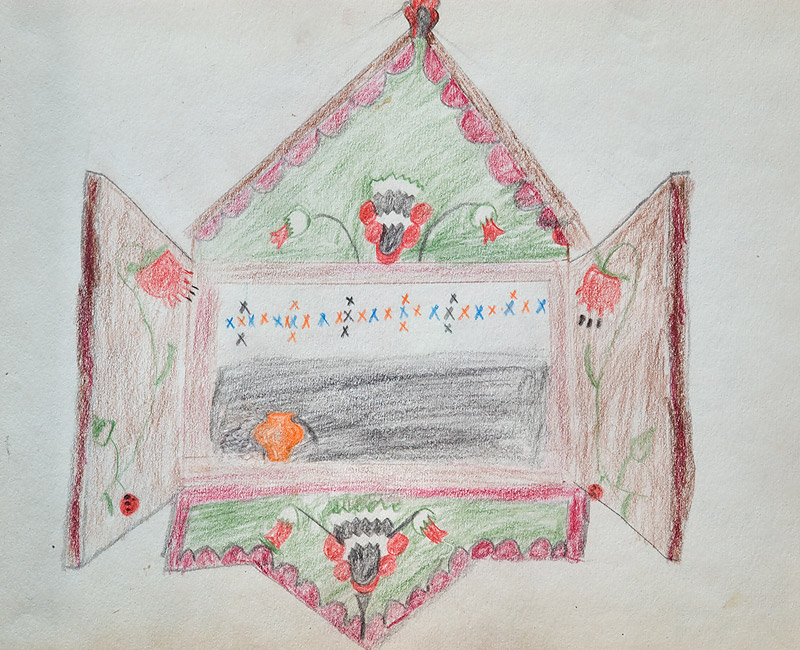
Highly detailed pencil drawing of woodwork of a window, with decorated shutters.
This remarkable drawing demonstrates a significant leap in spatial reasoning and structural design. Moving beyond the flat, baseline compositions of earlier works, the artist tackles a complex, symmetrical interior-exterior perspective. The central window frames a stark, monochromatic landscape holding a single orange vessel, bordered by a meticulously drafted, repeating cross-stitch pattern suspended in the air. The true analytical achievement, however, lies in the surrounding architectural frame. The artist precisely renders the angular, green pediment and the corresponding lower apron, both decorated with mirrored floral motifs and a scalloped red border. Crucially, the brown wooden shutters are drawn angled outward, showing an intuitive attempt at forced perspective and three-dimensional projection. This rigorous dedication to bilateral symmetry, patterned repetition, and structural geometry showcases a highly developed logical framework—an early, artistic manifestation of the precision required for advanced mathematics and engineering.
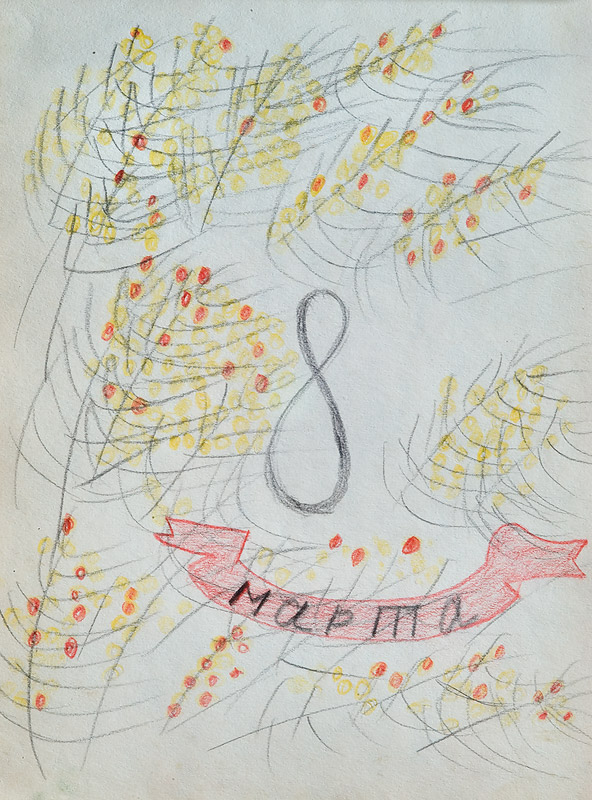
Sloppily drawn greeting card for 8th of March holiday (Women's Day) showing mimosa with clusters of yellow and red globular flowers.
In contrast to the precise drafting seen in earlier works, this 8th of March greeting card exhibits a burst of rapid, expressive energy. The composition centers on a bold, single-line figure "8" hovering above a stylized red ribbon banner that contains the roughly sketched block letters "МАРТА" (March). Surrounding this central text is a chaotic but structurally recognizable explosion of mimosa branches. The artist uses quick, sweeping pencil strokes to map out the feathery foliage, which is then heavily populated by hastily scribbled clusters of yellow and red globular flowers. While the execution feels unpolished—prioritizing sheer abundance and dynamic movement over methodical line work—it reflects an intuitive attempt to capture the overwhelming, blooming texture of early spring floral arrangements. This piece stands as a charming example of shifting artistic focus, choosing a rapid, energetic output over the rigid geometric analysis that characterized the artist's natural landscapes.
Pencil draft drawing of a school portfolio.
This minimalist pencil sketch strips away narrative context to focus entirely on the functional design of an everyday object. The artist maps out the structural boundaries of a classic school portfolio (briefcase) using faint, tentative, but highly proportionate geometric lines. The primary rectangle is subdivided by a gentle, curved line denoting the overhanging front flap. Most notably, the artist dedicates their firmest pencil strokes to the mechanical components: the curved carrying handle with its distinct, darkened attachment rings, the central clasping mechanism, and the reinforced corner protectors—one of which is filled in with a subtle hint of yellow to denote brass or metal. This isolated study of hardware and functional structure highlights a very early inclination to dissect how things are built and fastened together, reflecting an inquisitive, engineering-oriented mindset.
Illegible pencil draft drawing of helium balloons(?).
This very faint, rapid pencil sketch appears to represent a cluster of helium balloons floating upward, tethered by long, trailing strings. Unlike the rigid geometric structures of the artist's houses and trees, this drawing attempts to capture buoyancy and volume. The artist uses overlapping, continuous circular strokes to group the balloons together at the top, demonstrating an early intuition for how objects cluster and obscure one another in three-dimensional space. The strings converge and sweep downwards in loose, parallel lines, contrasting with the careful, straight-edge drafting seen in other works. Though abstract and hurried, the sketch provides a glimpse into the young mind experimenting with different physical properties—moving from static, anchored structures to objects defined by lightness and upward trajectory.
Ссылки / Links


