
A wooden house built at the end of 19th century (?) at 7/59 Morskaya Street near Sestroretskiy Kurort, 15 miles north-west from Sankt Petersburg. Russia, October 2, 2000

A 19th (?) century house at 82 Truda Street. Cheliabinsk, Russia, August 13, 2001

A 19th (?) century house at Truda Street. Cheliabinsk, Russia, August 13, 2001

Serene autumn scene at Laskovy Beach (Russian: Laskovyy Plyazh) in the settlement of Solnechnoe, located on the shore of the Gulf of Finland, approximately 40 kilometers northwest of Saint Petersburg. Laskovy Beach is one of the most popular beaches in the Kurortny District of Saint Petersburg. The name "Laskovy" translates to "Affectionate" or "Tender," while the settlement name, Solnechnoe, means "Sunny". This area has a rich history as a summer resort destination; formerly known as the Finnish village of Ollila, it became a hub for St. Petersburg s intelligentsia and dacha owners in the late 19th and early 20th centuries. The image shows a trio of birch trees with vibrant yellow and orange leaves, which is characteristic of the "Golden Autumn" season in the Leningrad Region during early-to-mid October. The golden leaves contrast strikingly with the blue sky and the dark blue waters of the Gulf. The large white concrete sphere on the sand is a landscaping feature. Russia, October 9, 2025

Italian Pergola located in the Private Garden (Sobstvenny Sadik) of Catherine Park. The pergola was built in 1865 (mid-19th century) during the reign of Alexander II. It was designed specifically to be covered in climbing plants, creating a shaded walkway or "veranda" that offered respite from the sun while allowing views of the obelisk and the surrounding landscape. Pushkin (former Tsarskoe Selo) near Saint Petersburg, Russia, October 10, 2025

Naturalistic style of the English landscape garden, which dominates the areas surrounding the formal canals, with rich textural contrast between the golden maples and dark evergreen firs, creating a painterly composition typical of 19th-century Russian park design. The untamed, wilder growth of the underbrush and tall grasses contrasts with the manicured lawns found elsewhere, evoking a sense of romantic melancholy suited to the "golden autumn" season. The dense, layered foliage creates an intimate, enclosed space that feels removed from the grand palace architecture, focusing entirely on the mood of the forest. Aleksandrovsky (Alexander) Park in Pushkin (former Tsarskoe Selo) near Saint Petersburg, Russia, October 10, 2025

Big Lamsky Pond (Bolshoy Lamskoy Prud), part of a system of ponds originally dug in the early 19th century to drain the park s marshy terrain. Aleksandrovsky (Alexander) Park in Pushkin (former Tsarskoe Selo) near Saint Petersburg, Russia, October 10, 2025

Ancient oak tree trunk. Many oaks in the park are over 200 years old, some dating back to the park s initial landscaping in the 18th and 19th centuries. The gnarled, textured bark and massive girth signify its age and resilience. Northern part of Aleksandrovsky (Alexander) Park in Pushkin (former Tsarskoe Selo) near Saint Petersburg, Russia, October 10, 2025

Tunnel-like quality of the linden alley, a hallmark of 19th-century Russian park design. The interlocking branches of the mature linden trees (Tilia) form a "gothic arch" overhead, completely enclosing the path. This creates a sense of protection and separation from the outside world, which aligns with the secluded, monastic theme of the nearby Feodorovsky Gorodok. Pushkin (former Tsarskoe Selo) near Saint Petersburg, Russia, October 10, 2025

Autumn in Upper Park. The large glacial boulder (erratic block) on the side of the path is a typical element of 19th-century romantic park design, intended to add a sense of antiquity and natural wildness. Oranienbaum palace-and-park ensemble in Lomonosov (a suburb of St. Petersburg), Russia, October 13, 2025

scenery near the Chinese Palace in the Upper Park. The foreground features a massive, aged oak tree with a prominent hollow in its trunk. This "veteran tree" adds a sense of history and wildness, characteristic of 19th-century English landscape gardens that prized such picturesque imperfections. Oranienbaum palace-and-park ensemble in Lomonosov (a suburb of St. Petersburg), Russia, October 13, 2025

Stone bridge in Oranienbaum Park in the "Russian Switzerland" section of the Upper Park. The bridge is built from rough, unpolished granite boulders, giving it a deliberately archaic, "ruin-like" appearance that blends seamlessly into the natural landscape, typical of the romantic style popular in the 19th century. It spans a bend in the Karasta River, connecting a gravel path that winds through rolling green hills, which were artificially shaped to mimic an alpine valley. Oranienbaum palace-and-park ensemble in Lomonosov (a suburb of St. Petersburg), Russia, October 13, 2025

An ancient stone staircase crossing the Kristatelka River which is a charming remnant of the park s 19th-century romantic landscape design. Sergievka Park, Old Peterhof, west from Saint Petersburg, Russia, October 13, 2025

Rustic stone arch bridge, nestled deep within the Sergievka Park ravine. Built from rough-hewn granite blocks, the bridge was designed to look ancient and weather-beaten even when new, fitting the 19th-century romantic preference for melding architecture with wild nature. The bridge spans a small cascade of the Kristatelka River, where water tumbles over mossy stone steps, creating a soothing auditory backdrop to the visual serenity. The scene is framed by golden maples and fallen leaves that carpet the banks and settle into the stream s rocky bed, enhancing the secluded, fairy-tale atmosphere. Sergievka Park, Old Peterhof, west from Saint Petersburg, Russia, October 13, 2025

This stone bridge serves as a picturesque crossing over the Kristatelka River ravine, situated at the foot of the slope directly beneath the Leuchtenberg Palace. As part of the 19th-century Sergievka ensemble, this bridge links the wilder, lower ravine paths (near the "Adam s Head" boulder) with the landscaped grounds surrounding the palace on the upper terrace. It features a solid masonry arch topped with simple iron railings, designed to provide a functional yet scenic vantage point for viewing the deep ravine that defines the estate s geography. Sergievka Park, Old Peterhof, west from Saint Petersburg, Russia, October 13, 2025

From the elevated terrace of the Leuchtenberg Palace, a thoughtfully designed "prospect" (vista) opens up towards the Gulf of Finland, offering a serene coastal panorama framed by autumn foliage. This clearing was intentionally cut through the forest in the 19th century to create a direct visual link between the palace and the sea, a common feature in romantic landscape architecture. The busy road visible in the middle ground is the Oranienbaum Highway, which separates the upper park from the lower coastal meadows. In the distance, the grey-blue waters of the Gulf of Finland merge with the overcast sky, creating a vast, moody backdrop that emphasizes the estate s prime coastal location. Sergievka Park, Old Peterhof, west from Saint Petersburg, Russia, October 13, 2025

Decorative vase, located in the parterre of the park near the Main Building of the Forestry University, a concrete copy of a 19th-century original. The original vase was created in the 1860s by the famous sculptor David Jensen (1816-1902). The original work was carved from unpolished granite. Today s version is a concrete replica installed in the 1970s. The central motif depicts putti (cherubs), which are playful, chubby male children often found in classical art. The putti appear to be engaged in a playful struggle with a goat, a common allegorical theme in baroque and neoclassical art often representing the abundance of nature or Bacchic festivities. This theme fits well with the park s history as a place of botanical study and appreciation of nature. Lesnoy Park (Lesotekhnicheskiy Universitet), Saint Petersburg, Russia, October 14, 2025
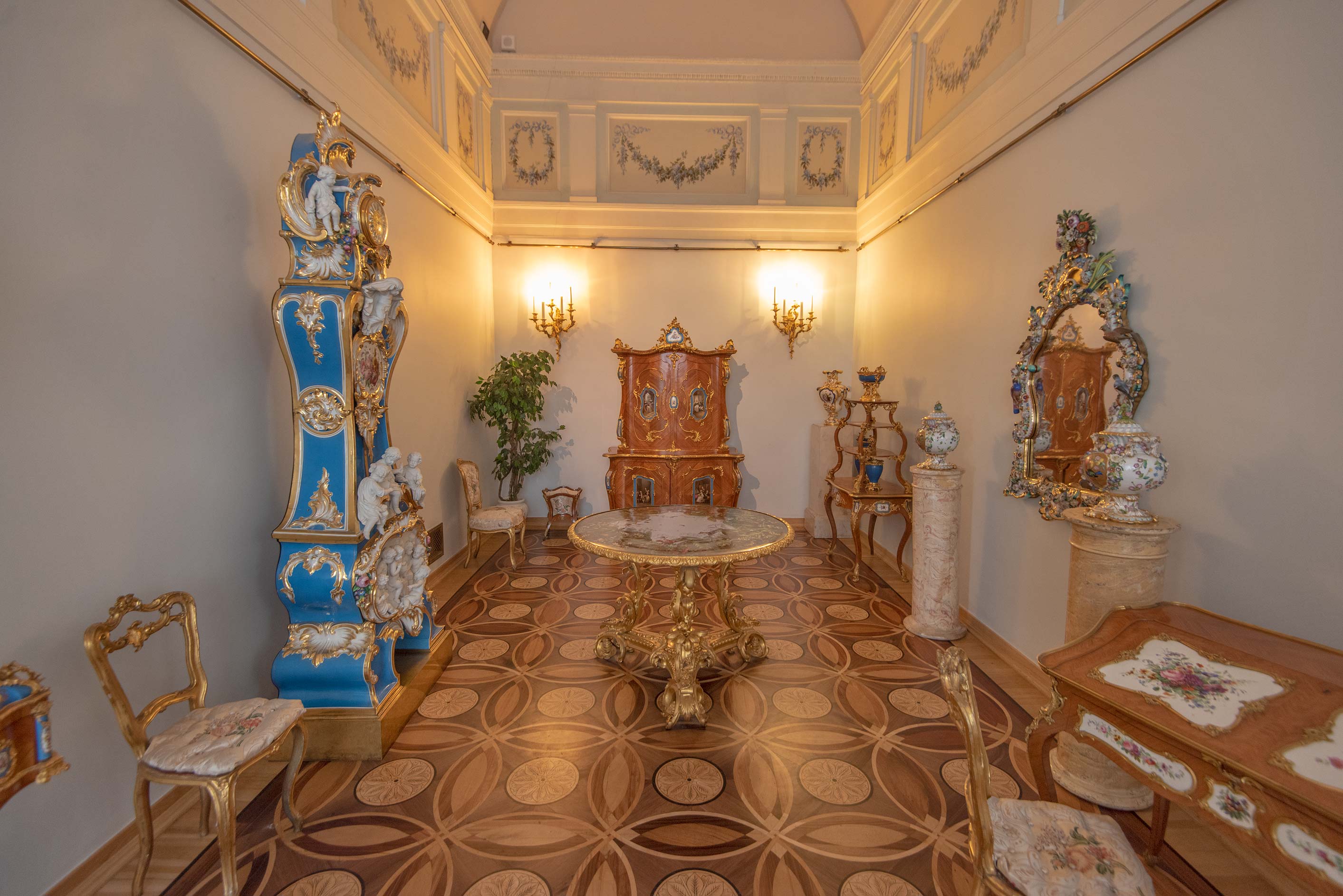
Set upon an intricate circular-patterned marquetry parquet floor in the Boudoir of the 1840s-1850s (the Second Rococo exhibition in the former Dressing Room of Empress Alexandra Feodorovna) of the Winter Palace, this room features an ornate blue-and-white porcelain stove with sculpted putti on the left, a central gilt-and-porcelain-topped round table, and an inlaid bureau against the far wall. Framed by a coved ceiling with painted floral garlands, gilded wall sconces, porcelain-trimmed writing tables, floral-upholstered gilt chairs, and a porcelain-framed wall mirror complete the intimate 19th-century interior in the State Hermitage Museum in Saint Petersburg, Russia, September 10, 2026
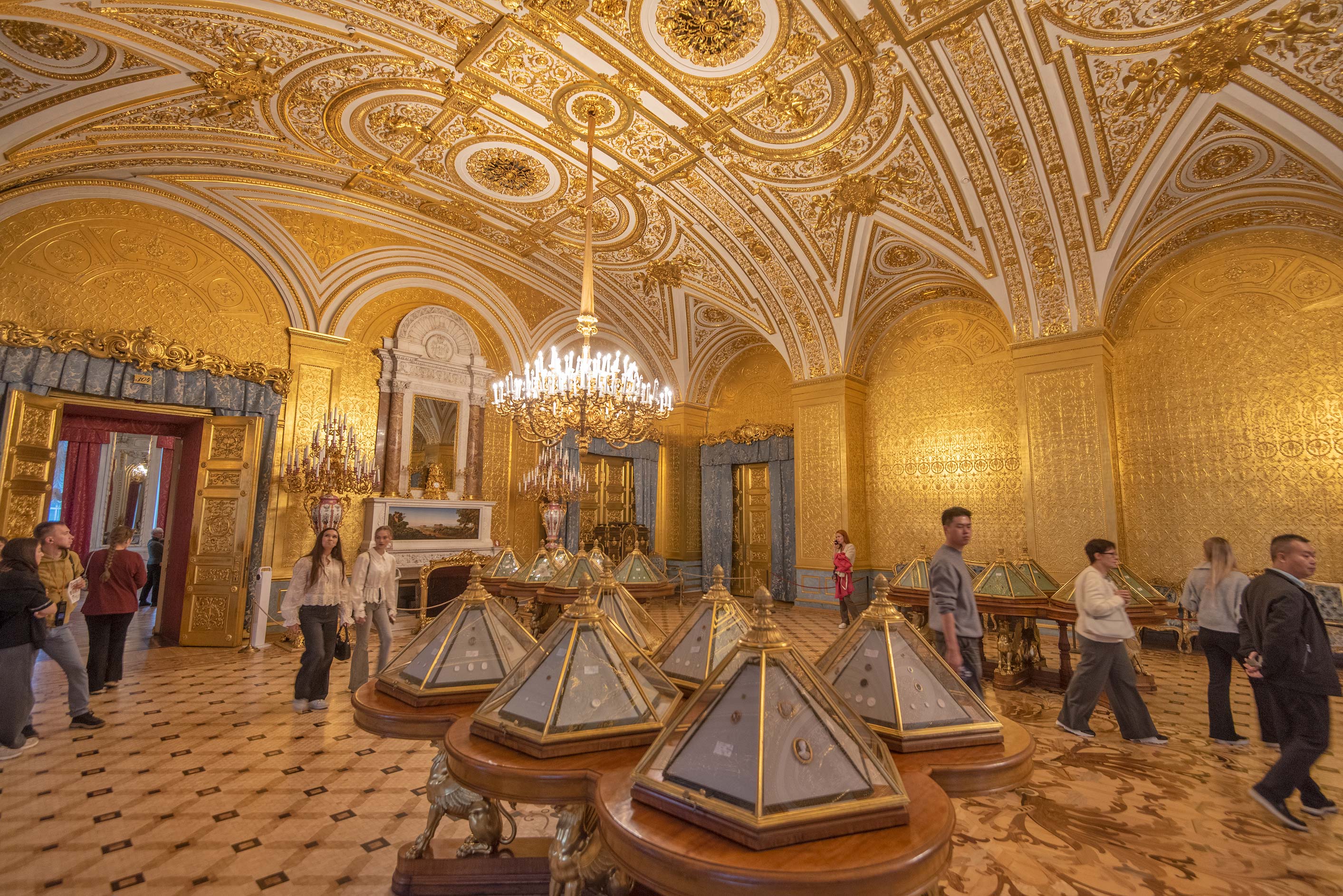
Viewed from a broader angle across the patterned marquetry parquet floor, this scene captures the Golden Drawing Room (Room 304) of the Winter Palace, highlighting the pyramid-topped cameo display cases resting on gilt lion-legged tables in the foreground beneath a central gilt-bronze chandelier and gilded arabesque vaults. Surrounding the visitors, fully gilded walls, blue-grey silk draperies framing carved gilt doors, and a white marble fireplace with a mosaic landscape overmantel complete the 19th-century interior in the State Hermitage Museum in Saint Petersburg, Russia, September 10, 2026
