
Decorated window of Church of Savior on Blood. Saint Petersburg, Russia, June 25, 2009

Windows and mosaic of Church of Savior on Blood. Saint Petersburg, Russia, December 20, 2005

Side window of Church of Savior on Blood. Saint Petersburg, Russia, February 2, 2013

Paintings and windows of Church of Savior on Blood. Saint Petersburg, Russia, February 2, 2013

Dome of the Rock mosque from a window of a small church Dominus Flevit on a slope of Mount of Olives. Jerusalem, the Middle East, October 31, 2002

Stained glass window of Saint Patrick s Catholic Church at 724 Camp Street. New Orleans, Louisiana, May 7, 2006

Old City from a window of a small church Dominus Flevit on a slope of Mount of Olives. Jerusalem, the Middle East, October 31, 2002

A church on central square that was built to replace V. I. Lenin monument, view from a window of a bus. Pushkin, a suburb of Saint Petersburg, Russia, February 5, 2013

Church of "Aleksy Mitropolit Moskovsky" in Taytsy, near Saint Petersburg, view from a window of a bus. Russia, June 20, 2009

A window of Emmanuel Episcopal Church at Spring Street. Newport, Rhode Island, November 13, 2004

A window of Bethel A. M. E. Church after snowfall. New Bedford, Massachusetts, December 27, 2004

A window of Emmanuel Episcopal Church at Spring Street. Newport, Rhode Island, November 13, 2004

A window of Holy Trinity Church (1853) at 721 Saint Ferdinand Street in Faubourg Marigny. New Orleans, Louisiana, May 14, 2005.

A church window in Uspensky Monastery. Tikhvin, Leningrad Region, Russia, December 25, 2005

This view from the St. Nicholas Church (Niguliste kirik) viewing platform offers a detailed look at the dense, red-roofed tapestry of Tallinn s Old Town, looking north towards the harbor. Dominating the skyline on the right is the spire of St. Olaf s Church (Oleviste kirik), which historically served as a navigational landmark for ships. Its green copper spire contrasts sharply with the surrounding red clay tiles. Looking directly down into the "canyon" of streets, one can trace Rataskaevu Street winding through the heart of the lower town. The prominent yellow building in the foreground (with the red roof and dormer windows) is likely part of the historic housing blocks near Rataskaevu and Ru"u"tli streets. Its bright facade stands out against the more muted tones of the neighboring structures. The view captures the intricate layers of the city s architecture--chimneys, dormer windows, and varying roof pitches that reveal the organic growth of the medieval city over centuries. Estonia, October 16, 2025

This view from the St. Nicholas Church tower looks down into the heart of the lower town, specifically capturing the densely packed historic streets below. Ru"u"tli and Rataskaevu Streets: The view likely centers on the intersection or alignment of Ru"u"tli (Knight) and Rataskaevu streets, which run close to the church. These streets are characterized by their medieval layout and historic merchant houses. The prominent yellow building with the red roof in the foreground (bottom center) stands out with its orderly rows of windows and distinct dormers. This is typical of the 18th and 19th-century residential architecture found in this part of the Old Town, often housing guest apartments today. The image perfectly illustrates the "red roofscape" of Tallinn, with various shades of terracotta tiles covering the gabled roofs. You can see the complex interplay of courtyards, chimneys, and firewalls that define the city s historic urban fabric. St. Olaf s in Distance: In the upper right corner, the spire of St. Olaf s Church pierces the skyline, providing a vertical counterpoint to the horizontal spread of the lower town. The view extends to the gray waters of the bay in the background, reinforcing the city s coastal setting. Estonia, October 16, 2025

This view from the St. Nicholas Church (Niguliste) tower looks down towards the dense medieval streets of the lower town, offering a detailed perspective of the residential architecture and rooftops. The narrow, curved street cutting through the scene is Rataskaevu Street, one of the most picturesque lanes in the Old Town. Yellow Building: The prominent, multi-story yellow building in the foreground (with the large red-tiled roof and dormer windows) is likely situated on or near Rataskaevu Street. Buildings in this area often date from the 18th or 19th centuries and now frequently house guest apartments, such as the Rataskaevu Boutique Apartments or Rataskaevu Guest Apartment. Its bright facade and orderly fenestration are typical of the later updates to the medieval fabric. The image showcases the iconic "sea of red roofs" that defines Tallinn s aerial aesthetic. The jumble of gables, chimneys, and varying roof pitches reveals the organic development of the city over centuries. In the background, the spire of St. Olaf s Church (Oleviste kirik) rises above the horizon, providing a vertical anchor to the cityscape and connecting the view to the harbor beyond. Estonia, October 16, 2025

A view along Lai Street (Lai ta"nav) in the Old Town of Tallinn, Estonia, looking towards the iconic St. Olaf s Church. The dominant spire in the background belongs to St. Olaf s Church. This Gothic church was once the tallest building in the world (from 1549 to 1625), and its 124-meter spire remains a defining feature of the Tallinn skyline. As the name suggests, this is one of the wider medieval thoroughfares in the city, running parallel to the busier Pikk ("Long") Street. Historically, it was a prestigious residential area for wealthy merchants and artisans. The street is lined with well-preserved medieval merchant houses. The buildings on the right likely include or are near the famous "Three Brothers" complex (Lai 38, 40, and 42), a group of medieval gabled houses similar to the "Three Sisters" on Pikk Street. The building with the warm light in the window (foreground right) exemplifies the historic limestone architecture characteristic of the Hanseatic era. Tallinn, Estonia, October 16, 2025

Evening view of Lai Street (looking towards St. Olaf s Church). The large grey building on the right (Lai 44/46) stands out with its curved bay windows and decorative facade elements. This is a fine example of Jugendstil (Art Nouveau) architecture, which appeared in Tallinn during the early 20th century. Its smoother lines and larger windows contrast sharply with the smaller medieval merchant houses nearby. On the left, the yellow building (Lai 33) retains a more traditional, modest scale typical of the street s residential past. At the end of the street, the illuminated white tower of St. Olaf s Church (Lai 50) acts as a dramatic focal point. The lighting accentuates the church s massive walls and the green copper spire against the twilight sky. Tallinn, Estonia, October 16, 2025

Evening view that provides a dramatic, upward-looking perspective of St. Olaf s Church (Oleviste kirik) from the street level (near Lai 48), emphasizing the towering scale of its west facade. The image is dominated by the massive limestone tower of St. Olaf s. The perspective highlights the transition from the square base to the octagonal upper stages, a typical feature of Gothic architecture in the Hanseatic region. The long, narrow window with its pointed arch (lancet window) is a defining Gothic element, allowing light into the nave. To the right, you can see the upper stories of the adjacent building (likely Lai 48 or 50). Its simple, plastered facade and regularly spaced windows provide a domestic scale that contrasts with the monumental church. The distinctive rain gutter (downspout) on the left foreground acts as a framing element, drawing the eye upward. This view underscores why St. Olaf s was once the tallest building in the world (1549-1625). The sheer verticality visible here was originally intended to serve as a landmark for trading ships approaching Tallinn s harbor. Tallinn, Estonia, October 16, 2025

Intersection of Pikk Street and Pikk jalg (Long Leg) Street, one of the most historically significant spots in Tallinn, marking the boundary between the Lower Town and the Upper Town (Toompea). The massive white tower on the right is the Long Leg Gate Tower, built in the 14th century (c. 1380). It served as the primary fortified gateway connecting the merchant Lower Town to the aristocratic Upper Town. Historically, this gate was locked at night to separate the two distinct social classes. The street rising steeply through the gate arch is Pikk jalg. Its name distinguishes it from the parallel "Short Leg" (Lu"hike jalg), which is a pedestrian-only staircase.:200b The clock attached to the wall on the far right (though partially cut off) is not the famous Holy Spirit Church clock but a decorative element often associated with the Krause Pharmacy building or nearby shops in this tourist-heavy zone. The pink building on the left corner (housing "Krause" and "Eesti Ka"sito"o"" shops) is a classic example of Old Town architecture, with its chamfered corner entrance and large shop windows. Tallinn, Estonia, October 16, 2025

Aerial view of Tallinn. The heart of the image is the medieval Old Town, identifiable by its dense cluster of red-tiled roofs, church spires (including the tall St. Olaf s Church), and the fortified Toompea Hill. Surrounding the Old Town are the modern high-rises of the financial district (left foreground), including the Swisso^tel and Tornima"e towers. To the right, the Port of Tallinn (Vanasadam) stretches out into the Baltic Sea, with ferries and cruise ships visible. The sweeping coastline of the Tallinn Bay dominates the background. The clear blue sky and the calm sea suggest a crisp, sunny morning. View from a window of an airplane from Tallinn to Helsinki. Estonia, October 17, 2025

Looking along Lai Street near number 38 toward St. Olaf[CloseCurlyQuote]s Church (Oleviste kirik), whose square limestone tower and copper-clad spire rise above the surrounding houses to a height of 123.7 metres. Tall pointed recesses divide the tower[CloseCurlyQuote]s lower walls, while paired arched openings and four small corner pinnacles mark the transition to the spire. The houses on the right retain steep gables, small attic openings, and shuttered upper loading doors associated with their former storage use. Their irregular window arrangements and rough plaster contrast with the adjoining taller building[CloseCurlyQuote]s projecting bays and more elaborate fac,ade. Red-tiled roofs and the broad cobbled roadway define this section of Lai--[OpenCurlyDoubleQuote]Wide Street[CloseCurlyDoubleQuote]--within the Lower Old Town. Tallinn, Estonia, August 26, 2026
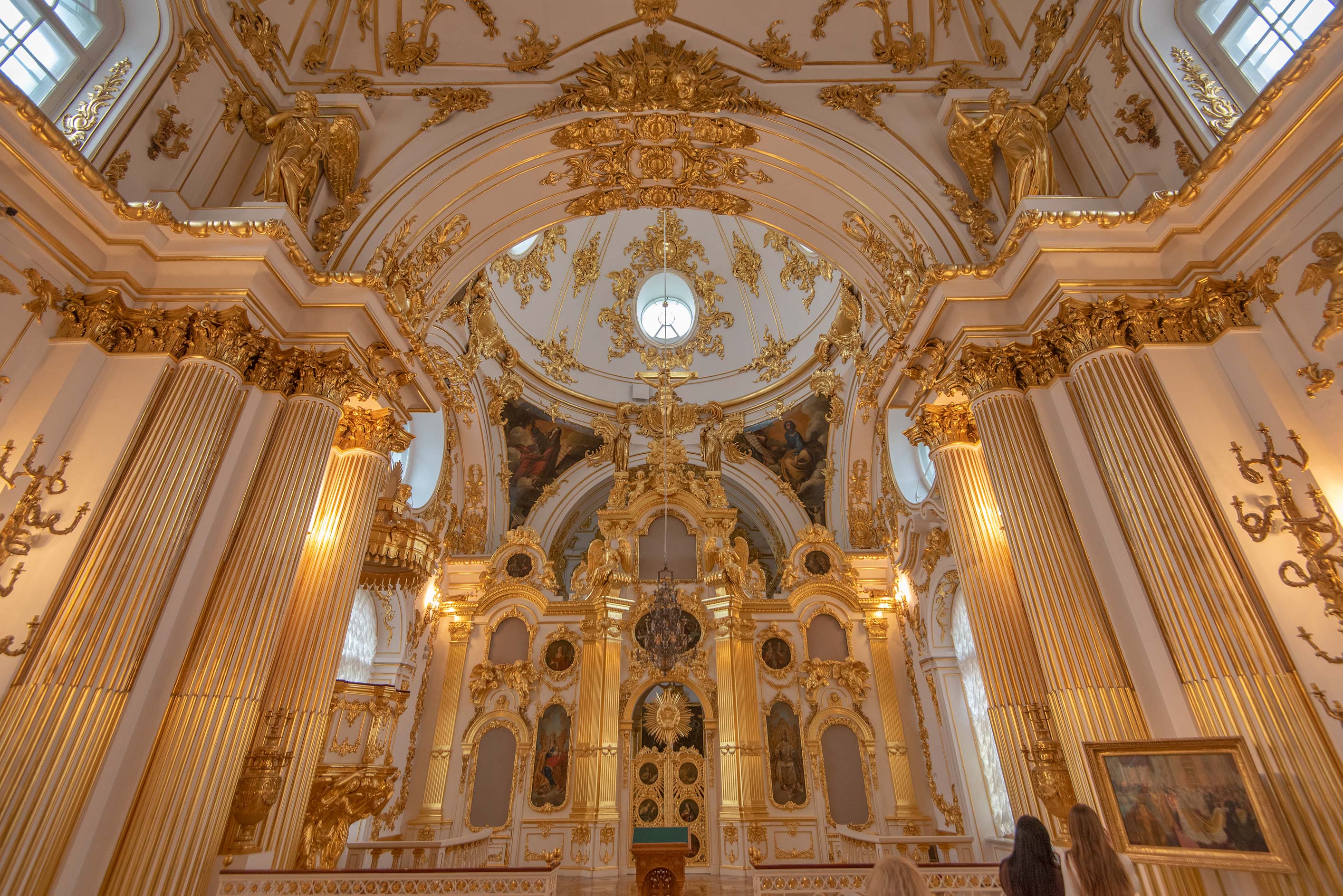
Designed by architect Francesco Bartolomeo Rastrelli and restored in the late 1830s by Vasily Stasov following the 1837 fire, the Grand Church of the Winter Palace (Cathedral of the Image of Christ Not Made by Hands) features white walls lined with clusters of fluted gilded Corinthian pilasters, sculpted angels above the cornice, and a three-tiered gilded wooden iconostasis. Beneath a domed ceiling pierced by oval windows and painted pendentives depicting the Evangelists, the sanctuary includes a gilded pulpit on the left, a carved lectern before the Royal Doors, and a framed historical painting on the right in the State Hermitage Museum in Saint Petersburg, Russia, September 10, 2026
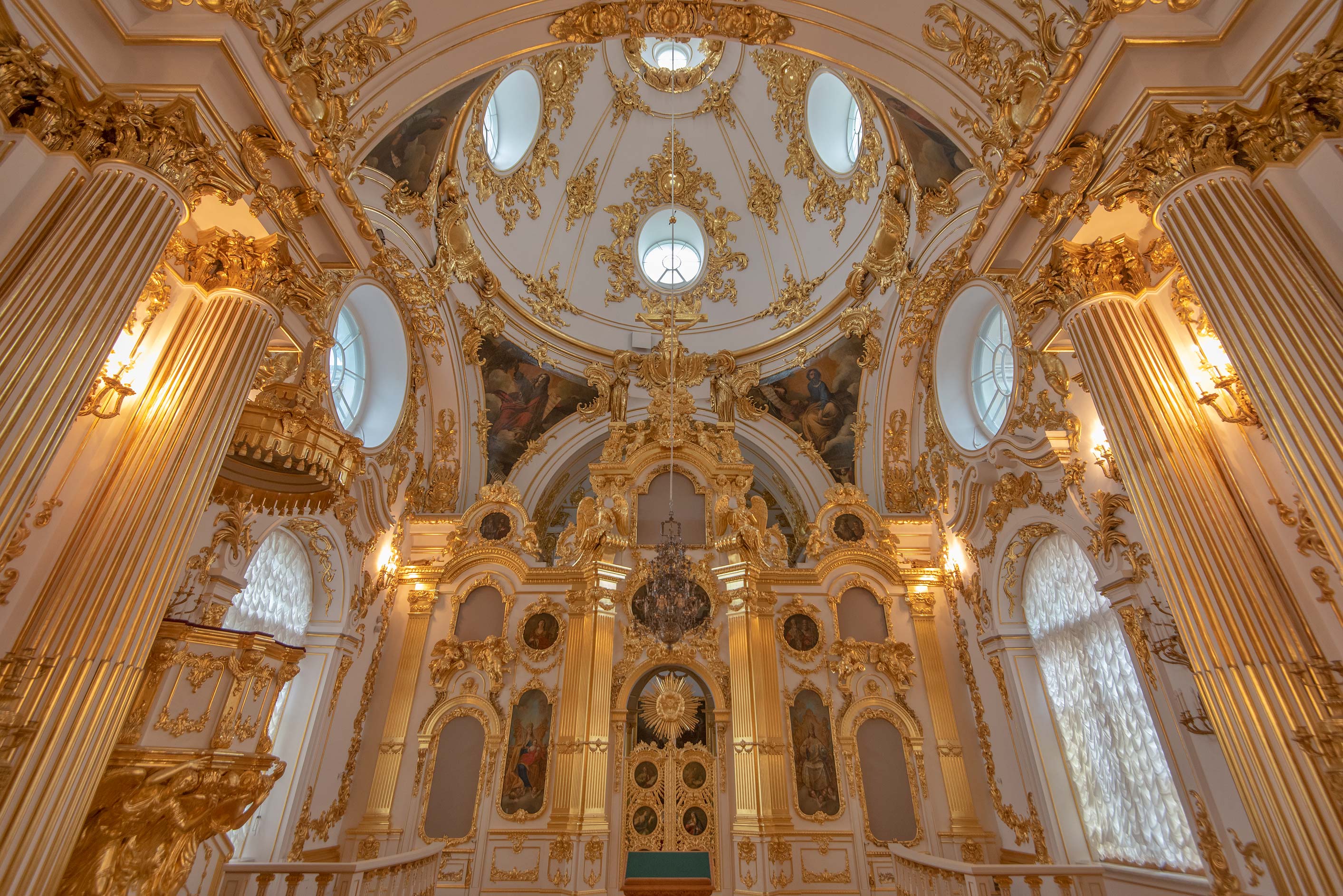
Viewed from a closer vantage point within the Grand Church of the Winter Palace, this composition focuses on the three-tiered gilded wooden iconostasis--featuring fluted columns, carved rocaille cartouches, painted icons, and the central Royal Doors surmounted by a radiant sunburst--set beneath a vaulted dome pierced by oval windows and painted pendentives. On the left, a heavily carved gilded pulpit topped with a tasseled canopy projects from a cluster of fluted Corinthian pilasters beside tall arched windows draped in sheer curtains in the State Hermitage Museum in Saint Petersburg, Russia, September 10, 2026
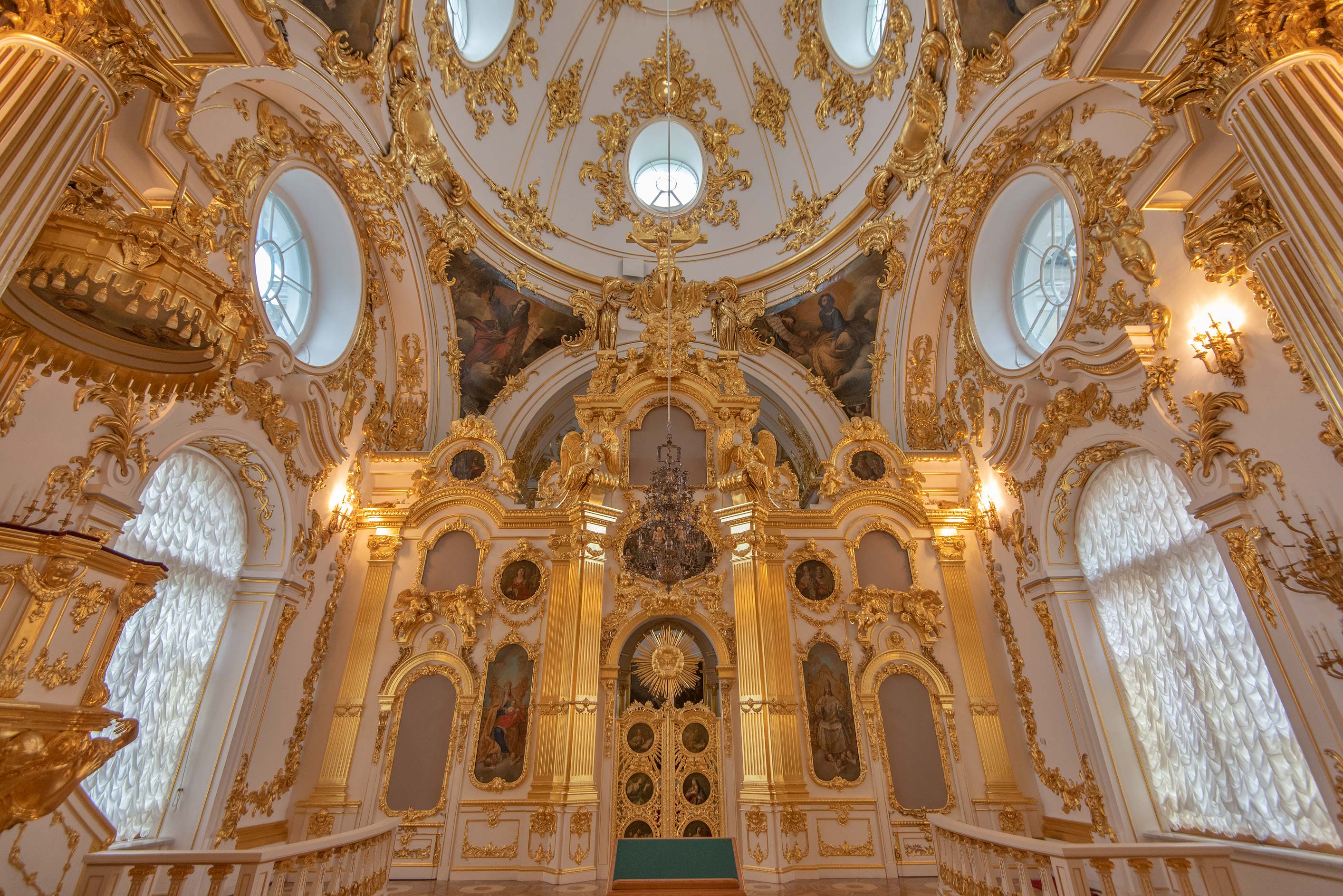
Positioned directly along the central axis of the Grand Church of the Winter Palace, this symmetrical view centers on the three-tiered gilded wooden iconostasis--featuring fluted columns, rocaille carvings, painted icons, a suspended dark bronze chandelier, and the pierced Royal Doors beneath a radiant sunburst--framed by white-and-gold balustrades and a central green-topped lectern. Above the sanctuary, tall arched windows with sheer curtains, oval clerestory windows, and painted pendentives depicting the Evangelists lead up into the stucco-adorned white cupola in the State Hermitage Museum in Saint Petersburg, Russia, September 10, 2026
