
Dvortsovaya Square, Alexandriysky Stolp (Alexander Column, Pillar), and Winter Palace (Hermitage museum). Saint Petersburg, Russia, June 25, 2003

Marble columns in Gatchina Palace near Saint Petersburg. Russia, December 23, 2005

Dvortsovaya Square, Alexandriysky Stolp (Alexander Column, Pillar), and Winter Palace (Hermitage museum). Saint Petersburg, Russia, June 25, 2003

Green columns in Pavlovsky Palace. Pavlovsk, a suburb of Saint Petersburg, Russia, June 14, 2011

Large hall with green columns in Pavlovsky Palace. Pavlovsk, a suburb of Saint Petersburg, Russia, February 5, 2013

Green columns in Pavlovsky Palace. Pavlovsk, a suburb of Saint Petersburg, Russia, February 5, 2013

Hall with green columns in Pavlovsky Palace. Pavlovsk, a suburb of Saint Petersburg, Russia, February 5, 2013

Large hall with green columns in Pavlovsky Palace. Pavlovsk, a suburb of Saint Petersburg, Russia, June 14, 2011

Hall with columns in Menshikovsky Palace in Saint Petersburg, Russia, June 29, 2010

Shuvalov Palace with columns and belvedere in Shuvalovo Park. Saint Petersburg, Russia, May 31, 2011

Rostral Column and Stock Exchange on a spit of Vasilyevsky Island from Palace Embankment. Saint Petersburg, Russia, December 16, 2016

Rostral Column on a spit of Vasilyevsky Island from Palace Embankment. Saint Petersburg, Russia, December 16, 2016

Leuchtenberg Palace, designed by architect Andrei Stackenschneider and completed in 1842. The facade reflects the Late Classicism style (resembling a Roman villa), characterized by a grand portico with Corinthian columns, symmetrical window arrangements, and a pediment that gives the structure a noble, temple-like appearance. The palace s yellow stucco walls show signs of weathering and peeling paint, contributing to the estate s romantic, slightly melancholic atmosphere of a "forgotten" royal residence. The palace is situated on a terrace overlooking the Gulf of Finland, with its color palette harmonizing with the surrounding golden autumn foliage, reinforcing the seamless blend of architecture and nature intended by its designers. Sergievka Park, Old Peterhof, west from Saint Petersburg, Russia, October 13, 2025
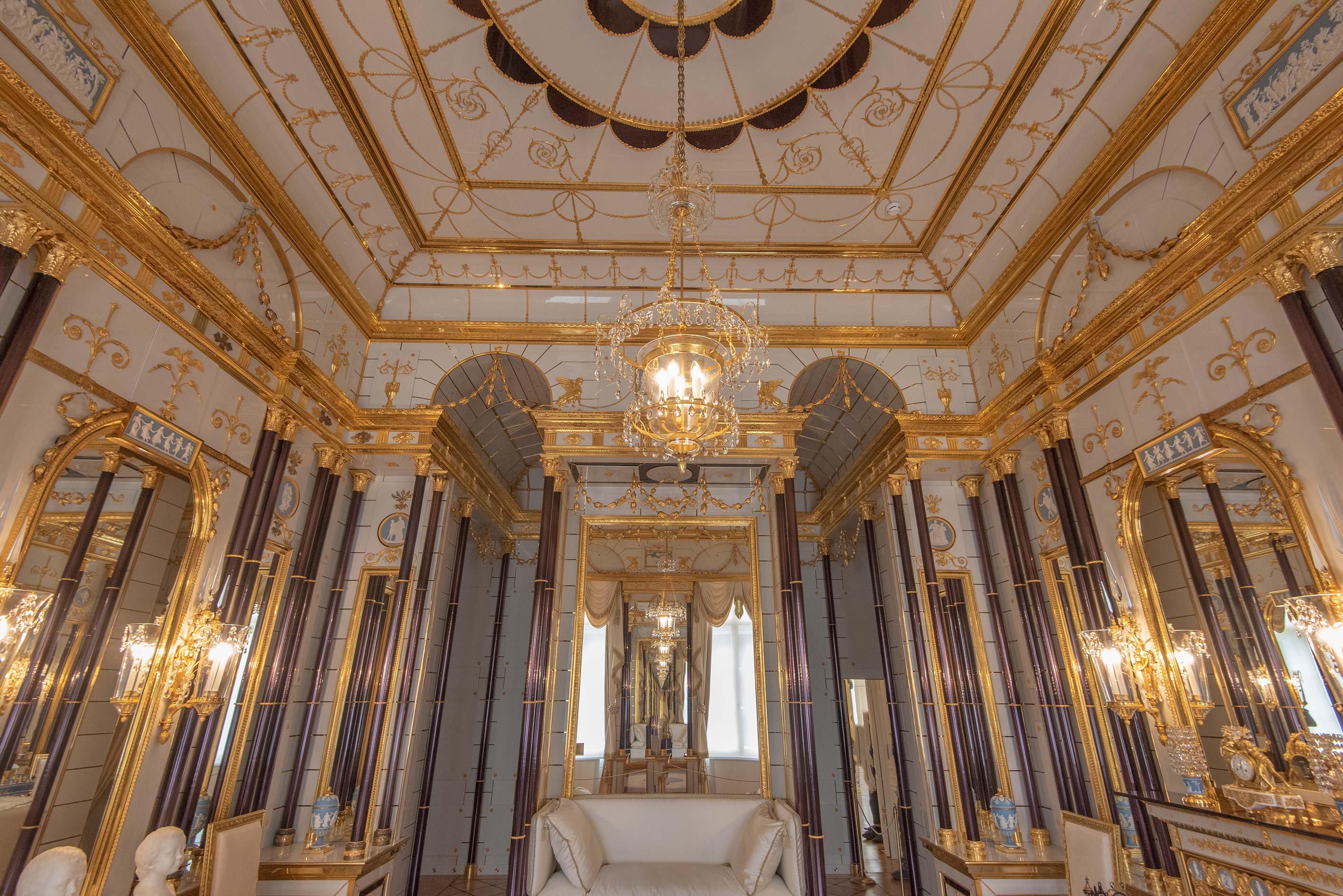
Symmetrical perspective looks directly toward the alcove sofa inside the Silver Study, showcasing the rhythmic placement of dark, slender porphyry columns that partition the mirrored walls, in Zubov Wing of the Catherine Palace. Tsarskoe Selo near Saint Petersburg, Russia, September 6, 2026
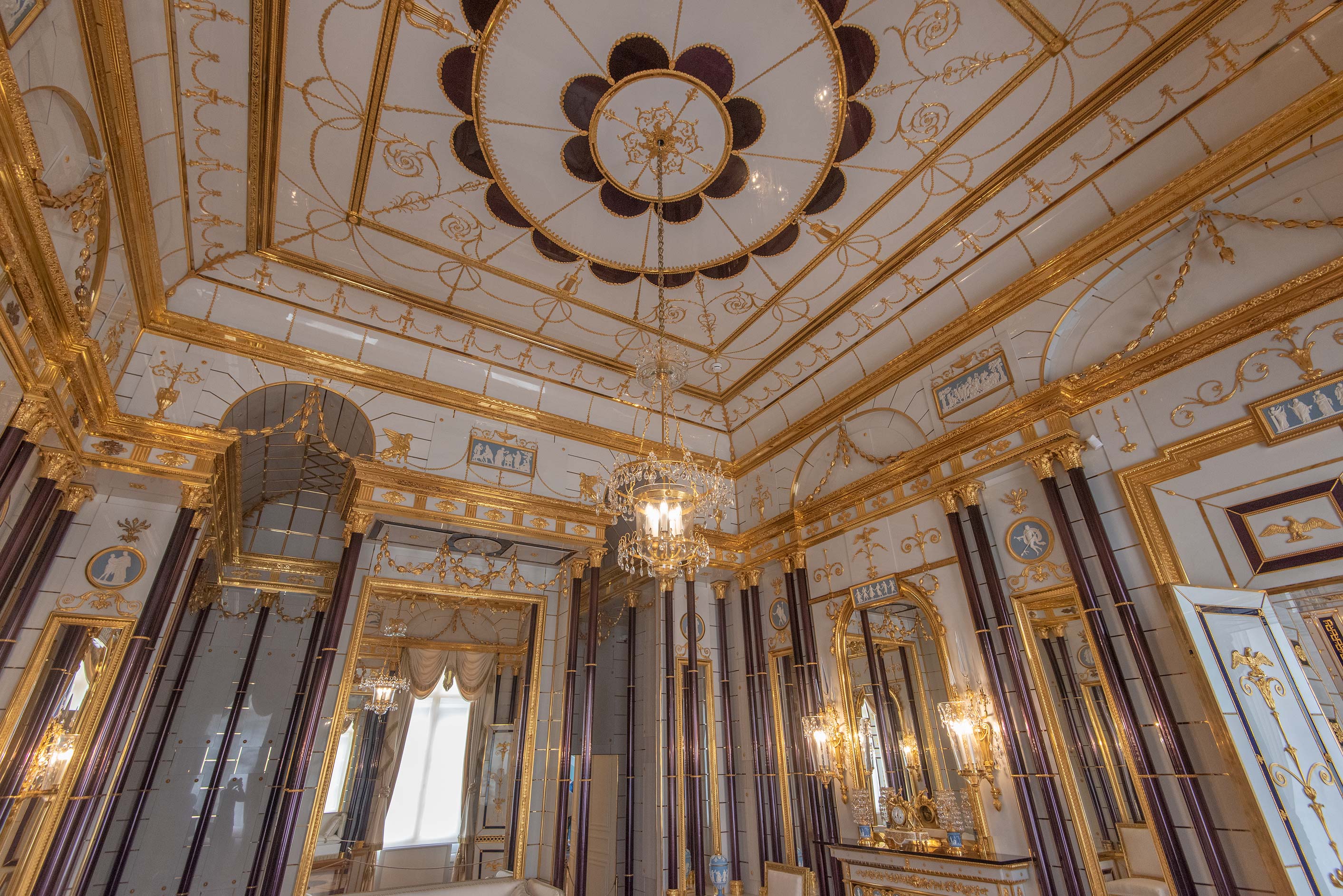
Wide, upward perspective of the intersection of the walls and ceiling inside the Silver Study, showcasing how the dark porphyry columns align with the gilded ceiling framework, in Zubov Wing of the Catherine Palace. Tsarskoe Selo near Saint Petersburg, Russia, September 6, 2026
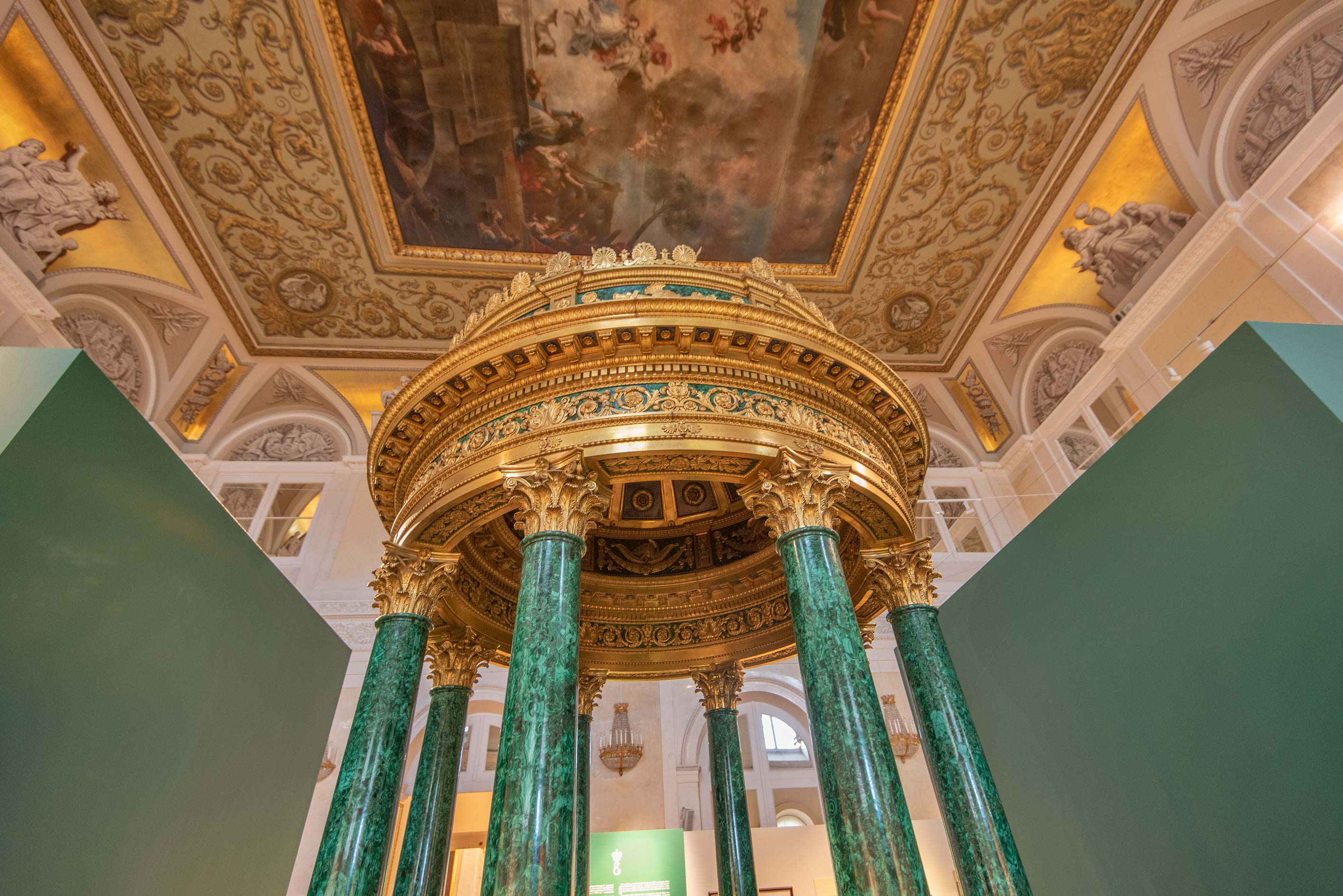
Looking upward past dark green exhibition partitions, the image centers on the Malachite Rotunda in the Rotunda Hall of the Winter Palace, featuring eight malachite-veneered columns with gilded Corinthian capitals supporting an ornate, coffered gilt-and-malachite dome. Above the rotunda, the hall s vaulted ceiling displays gilded arabesque scrollwork, corner stucco sculptures, and a central mythological plafond painting in the State Hermitage Museum in Saint Petersburg, Russia, September 10, 2026
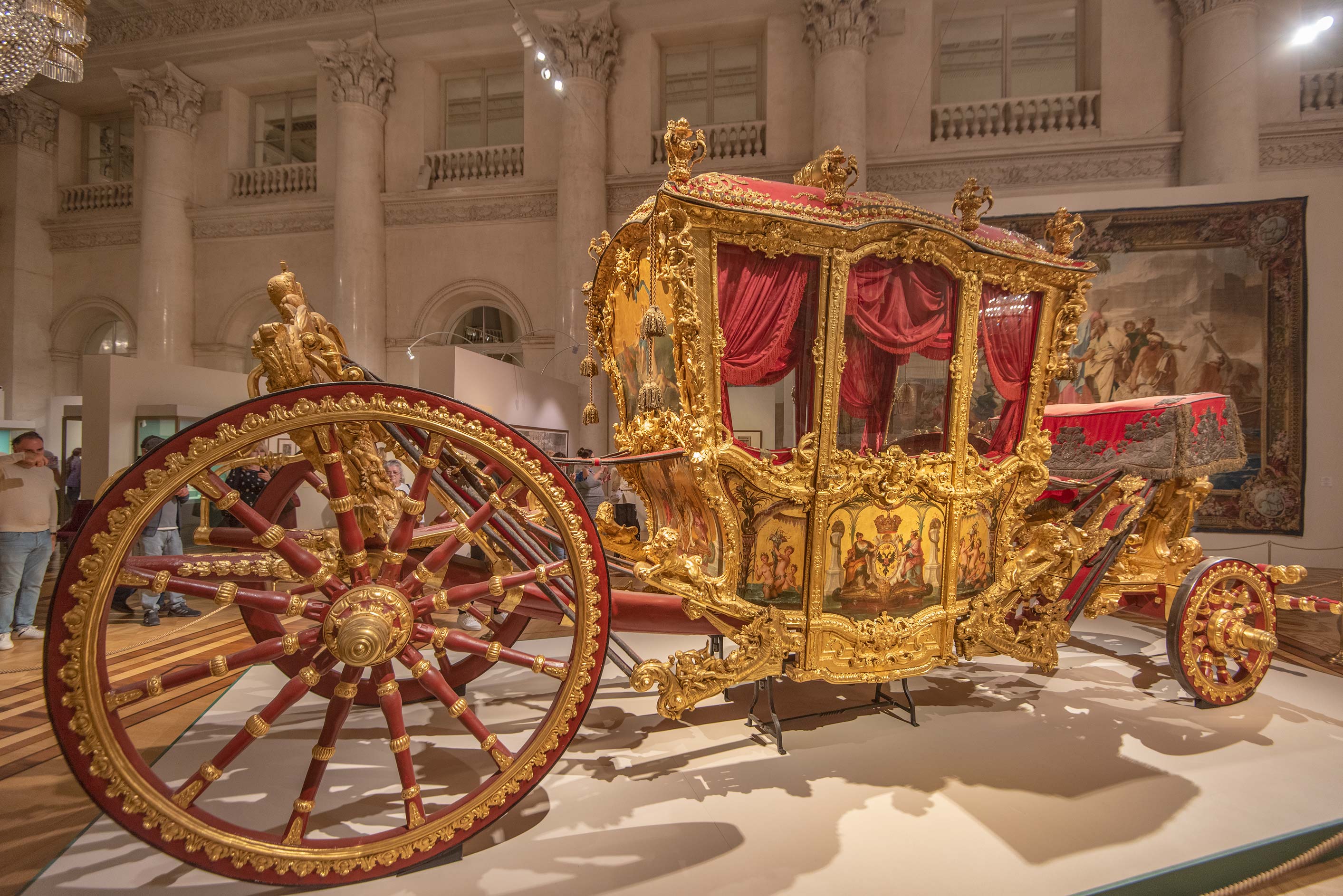
Displayed on a raised white platform in the Field Marshals Hall of the Winter Palace, the 18th-century Grand Coronation Carriage (commissioned in Paris by Peter the Great for Catherine I and later used by Catherine the Great) features gilded wood carvings, painted allegorical panels, crimson velvet curtains, and large red-spoked wheels. Behind the coach, neoclassical Corinthian columns, an upper gallery balustrade, and a large woven tapestry frame the exhibition space in the State Hermitage Museum in Saint Petersburg, Russia, September 10, 2026
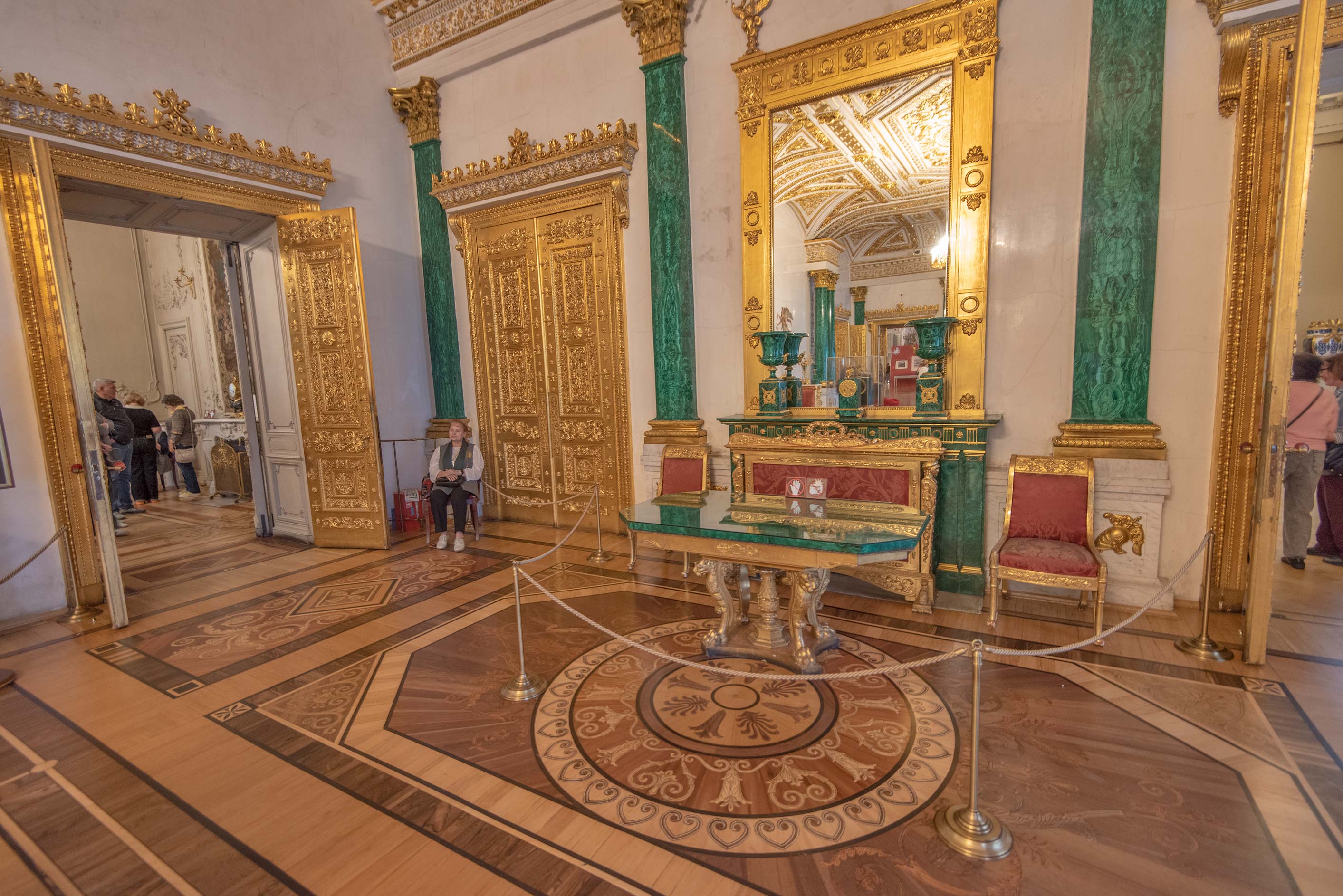
Set upon an intricate geometric wood parquet floor in the Malachite Room of the Winter Palace, a roped-off malachite-topped table with carved gilt legs stands before a matching malachite fireplace, paired vases, and a tall gilded mirror reflecting the coffered ceiling. Flanking the hearth, green malachite columns with gilded Corinthian capitals, crimson-upholstered gilt chairs, and elaborately carved gilded doors frame the grand imperial reception room in the State Hermitage Museum in Saint Petersburg, Russia, September 10, 2026
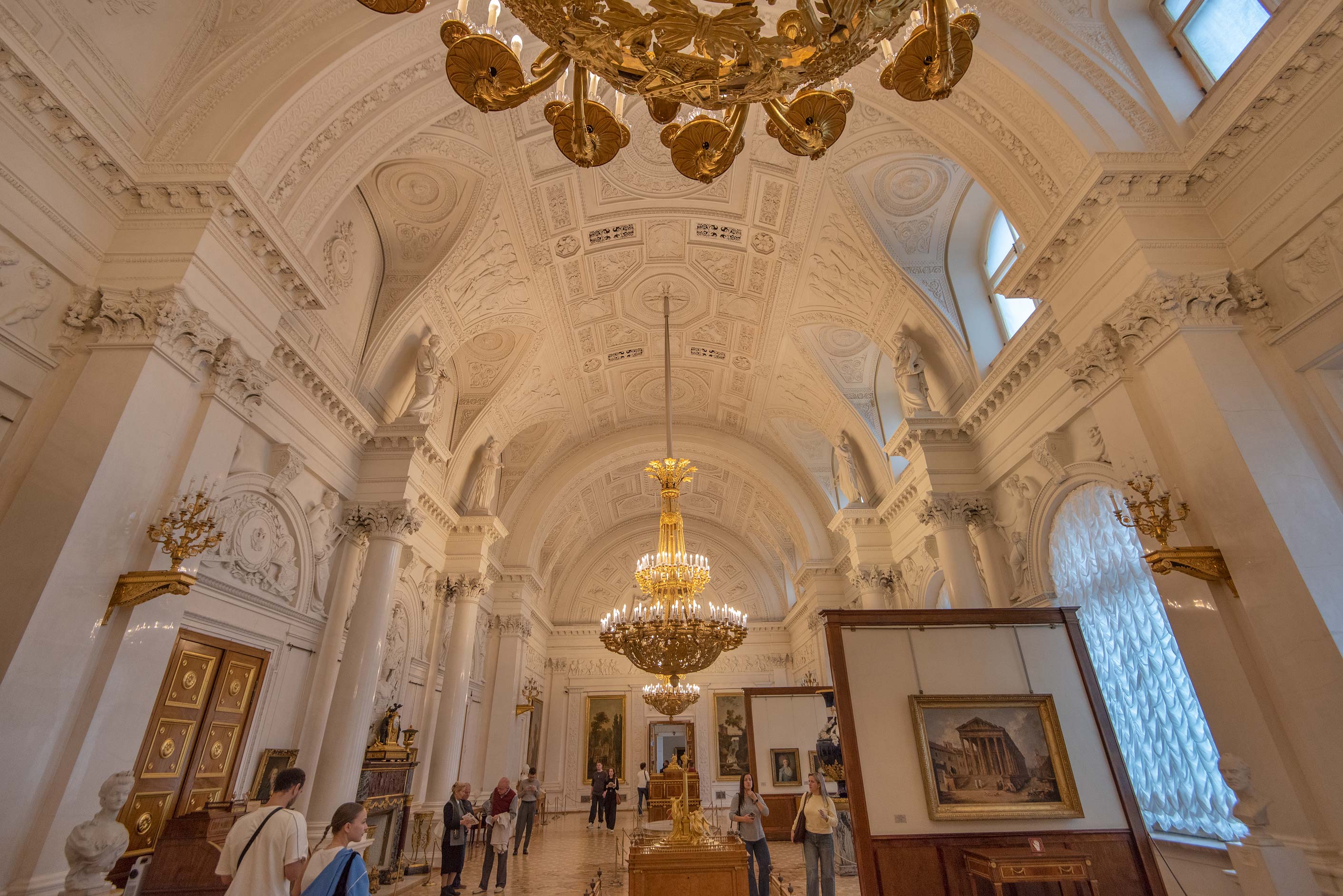
Designed by architect Alexander Briullov in 1841, the neoclassical White Hall (Room 289) of the Winter Palace features a coffered barrel-vaulted ceiling with white stucco reliefs, Corinthian columns topped with classical statues, and tiered gilt-bronze chandeliers. Gilded wall sconces, carved wooden doors, marble busts, and freestanding exhibition partitions displaying 19th-century European paintings fill the grand space in the State Hermitage Museum, September 10, 2026
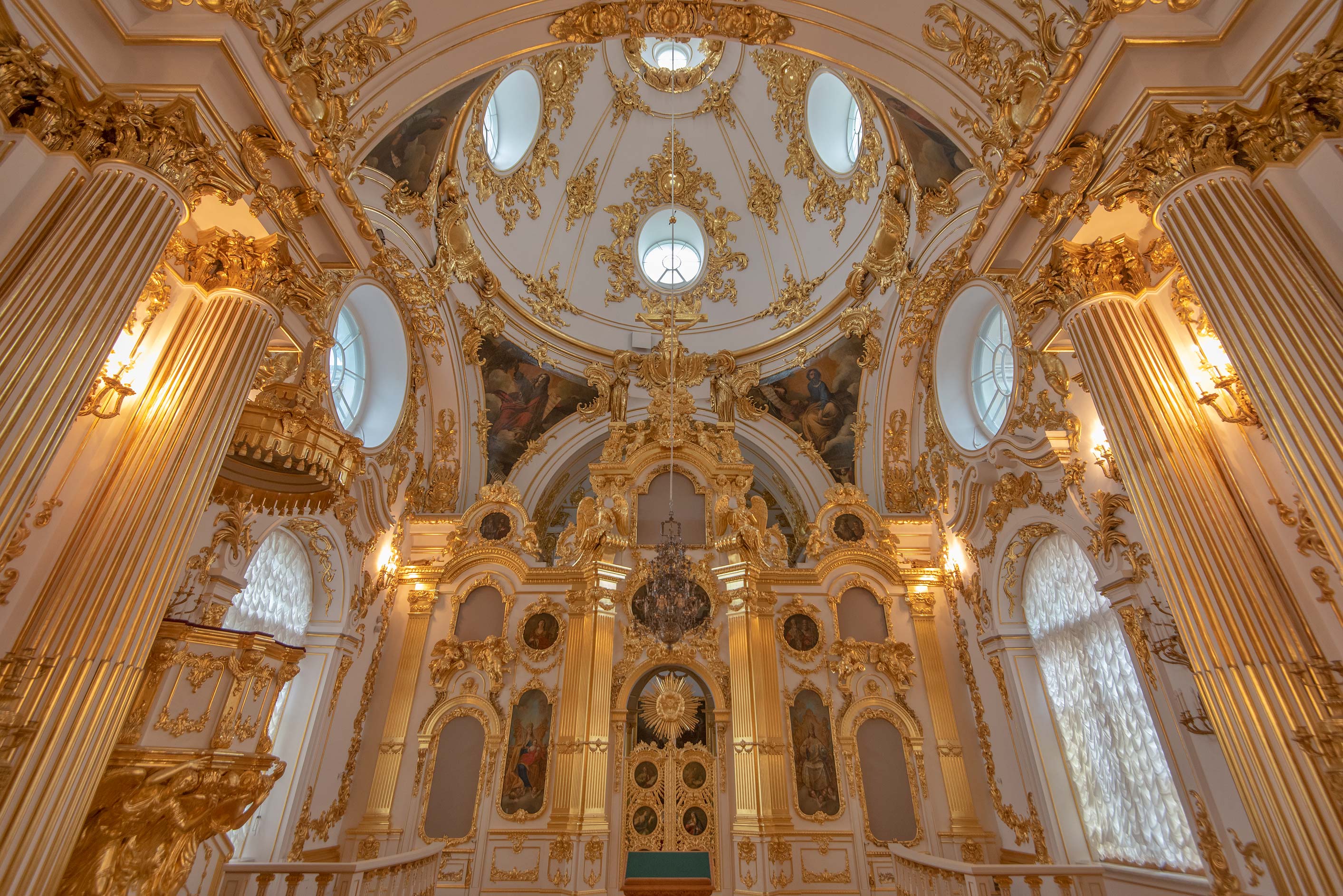
Viewed from a closer vantage point within the Grand Church of the Winter Palace, this composition focuses on the three-tiered gilded wooden iconostasis--featuring fluted columns, carved rocaille cartouches, painted icons, and the central Royal Doors surmounted by a radiant sunburst--set beneath a vaulted dome pierced by oval windows and painted pendentives. On the left, a heavily carved gilded pulpit topped with a tasseled canopy projects from a cluster of fluted Corinthian pilasters beside tall arched windows draped in sheer curtains in the State Hermitage Museum in Saint Petersburg, Russia, September 10, 2026
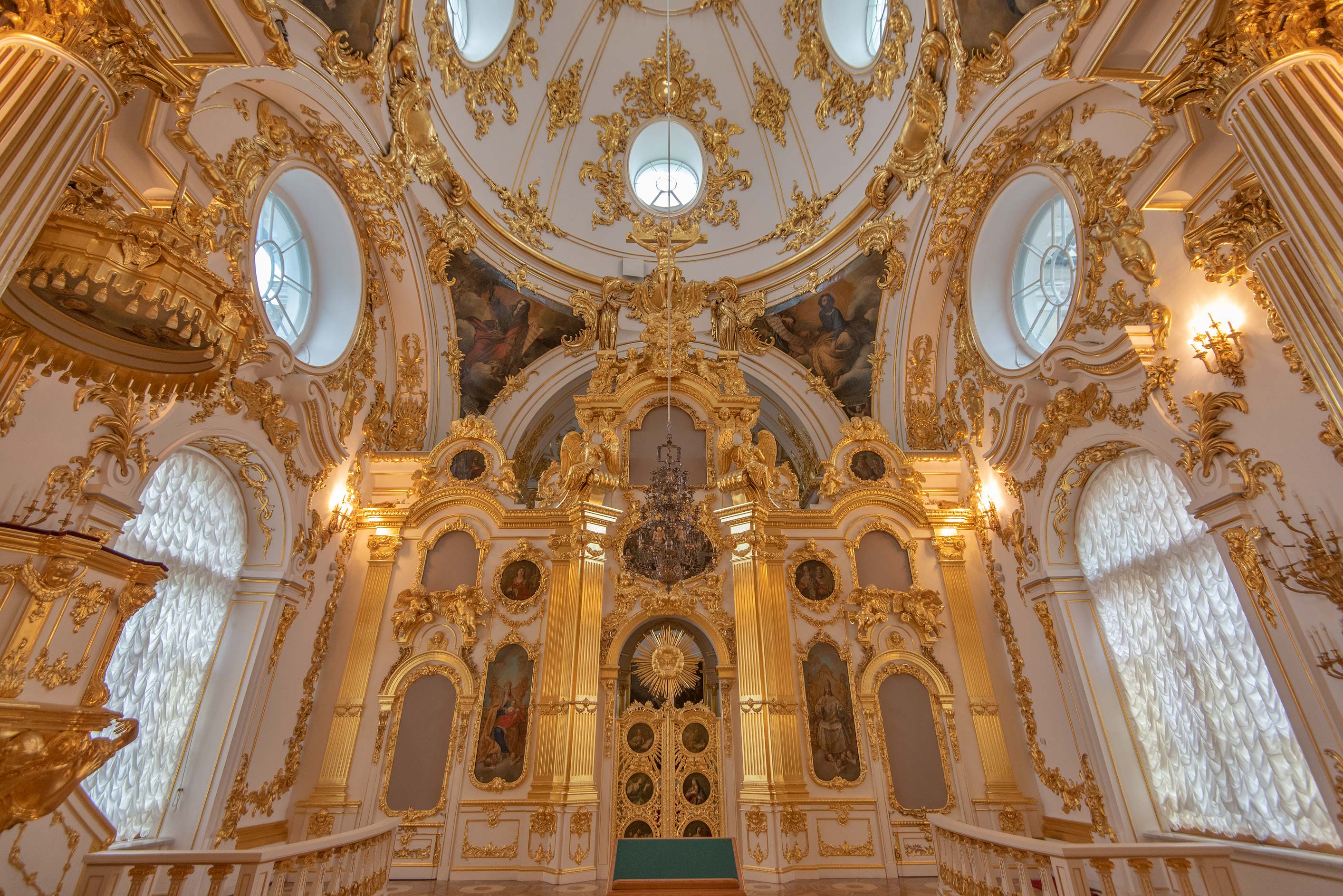
Positioned directly along the central axis of the Grand Church of the Winter Palace, this symmetrical view centers on the three-tiered gilded wooden iconostasis--featuring fluted columns, rocaille carvings, painted icons, a suspended dark bronze chandelier, and the pierced Royal Doors beneath a radiant sunburst--framed by white-and-gold balustrades and a central green-topped lectern. Above the sanctuary, tall arched windows with sheer curtains, oval clerestory windows, and painted pendentives depicting the Evangelists lead up into the stucco-adorned white cupola in the State Hermitage Museum in Saint Petersburg, Russia, September 10, 2026
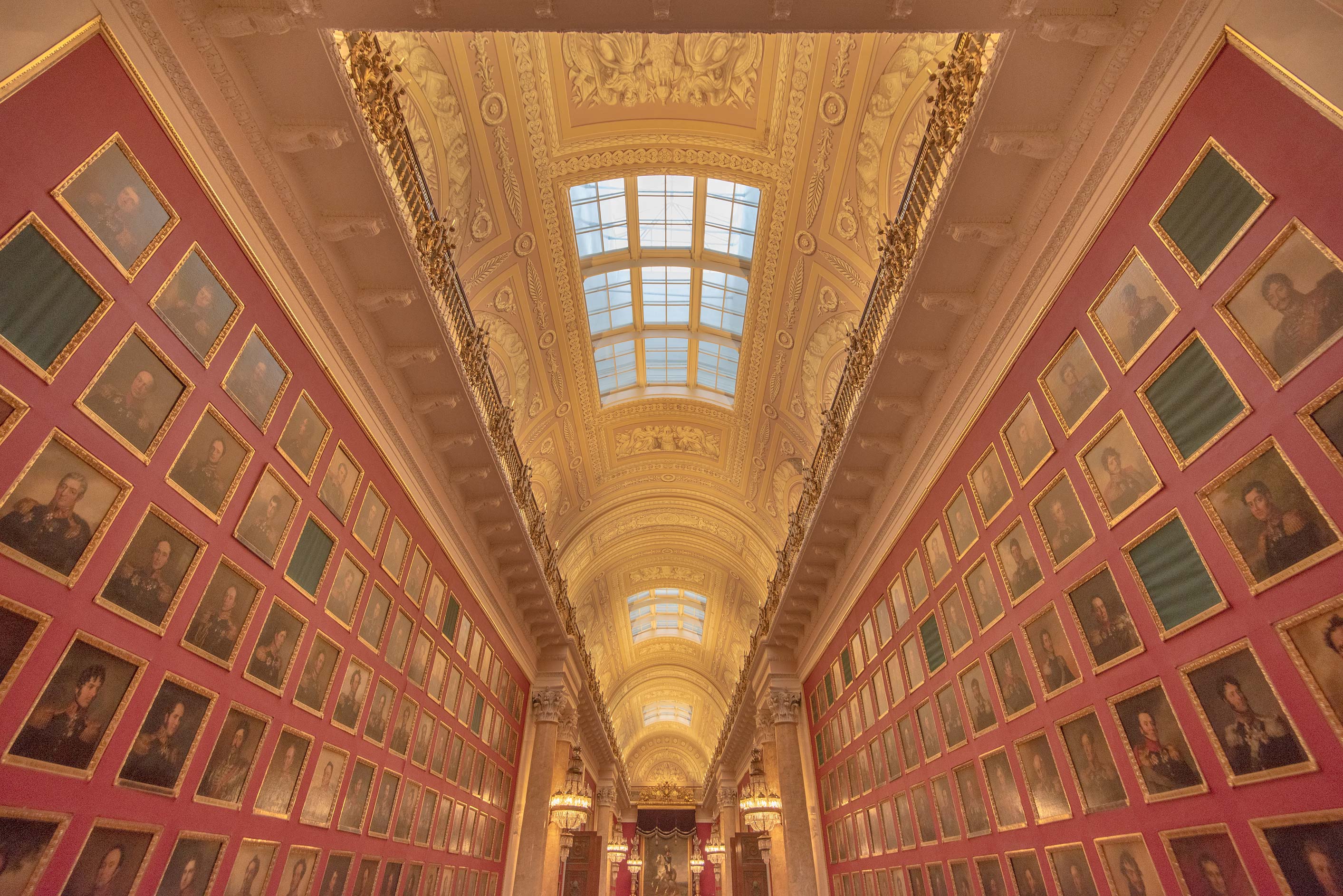
Designed by architect Carlo Rossi in 1826 and rebuilt by Vasily Stasov after the 1837 fire, the Military Gallery of 1812 in the Winter Palace features red-upholstered walls densely hung with five tiers of gilt-framed portraits of Russian generals who fought against Napoleon--painted primarily by English artist George Dawe and his assistants, alongside green silk-draped frames representing generals who died without surviving portraits. Overhead, a coffered barrel-vaulted ceiling decorated with stucco military trophies and glazed skylights runs between gilded upper gallery railings, leading the eye toward paired Corinthian columns, tiered chandeliers, and a monumental equestrian portrait of Emperor Alexander I at the far end in the State Hermitage Museum in Saint Petersburg, Russia, September 10, 2026
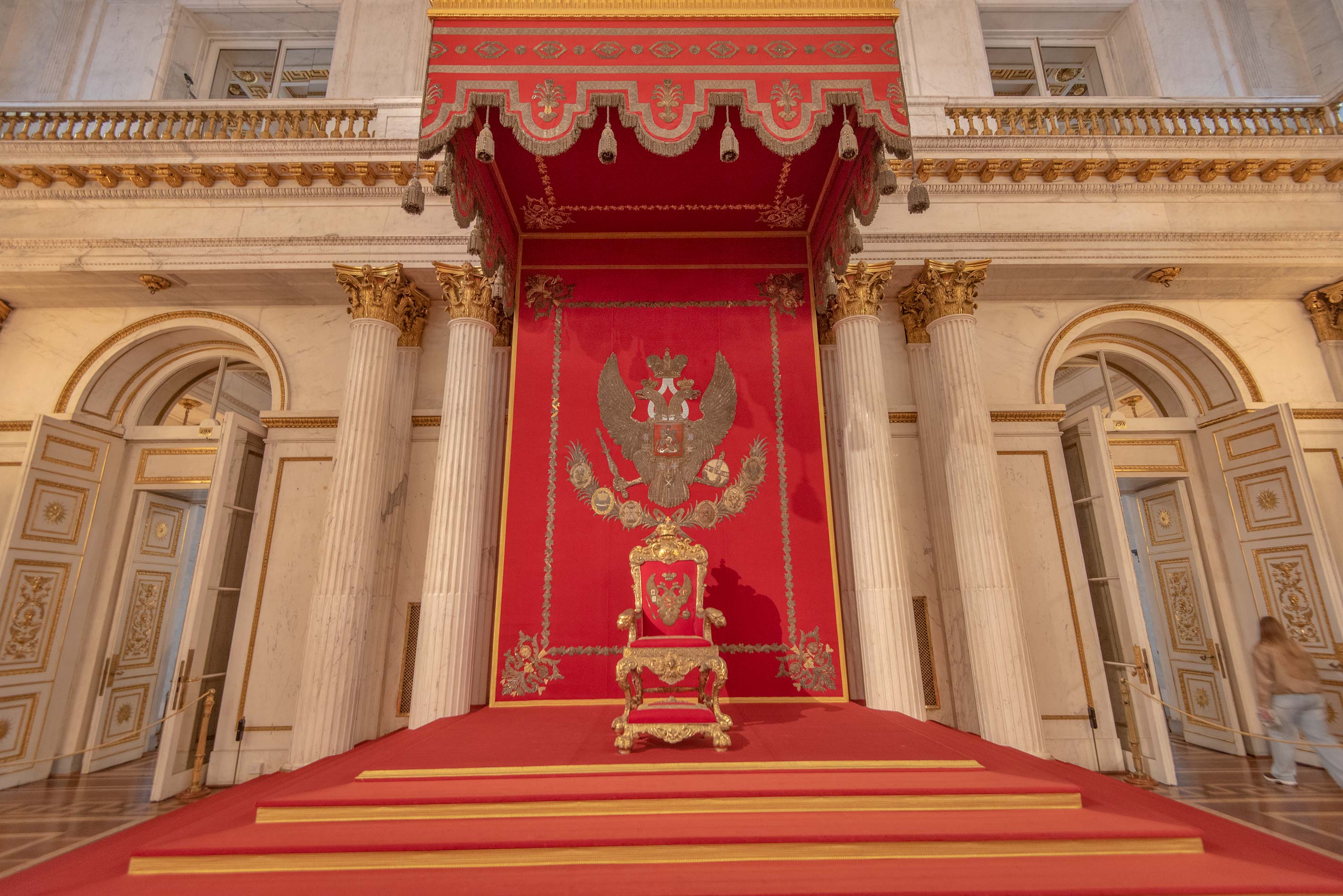
Positioned atop a four-stepped crimson-carpeted dais in the neoclassical St. George Hall (Great Throne Room) of the Winter Palace, the carved gilt-wood and crimson-velvet Imperial Throne (made in London in 1731 by Nicholas Clausen for Empress Anna Ioannovna) sits beneath a tasseled red velvet baldachin embroidered in silver and gold thread with the Russian double-headed eagle. Flanked by paired fluted Carrara marble Corinthian columns, arched white-and-gold double doors, and an upper gallery balustrade, the ceremonial throne ensemble stands in the State Hermitage Museum in Saint Petersburg, Russia, September 10, 2026
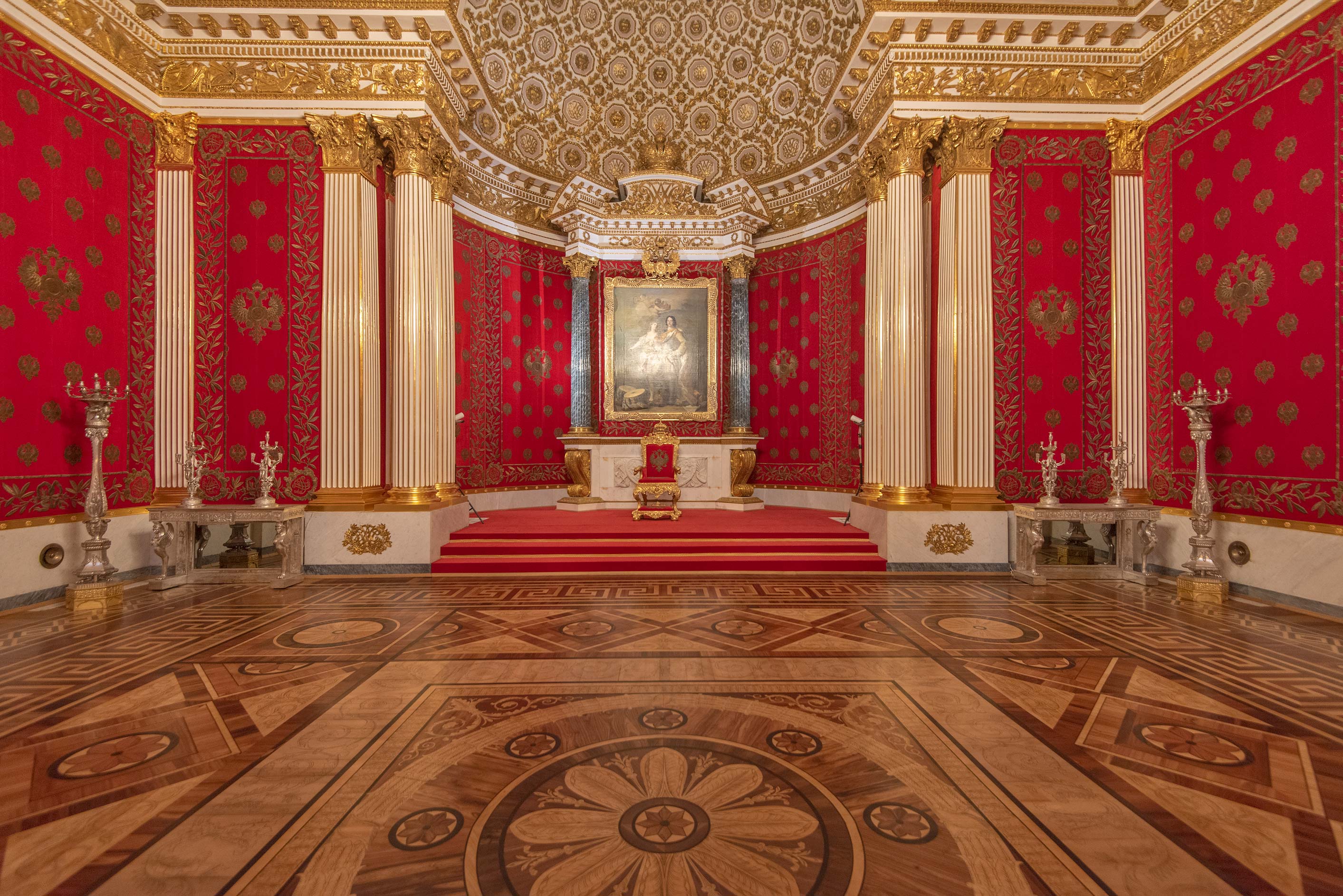
Designed by architect Auguste de Montferrand in 1833 in honor of Emperor Peter the Great and restored by Vasily Stasov after the 1837 fire, the Small Throne Room (or Peter Hall) of the Winter Palace features walls draped in crimson Lyon velvet embroidered with silver-gilt double-headed eagles, fluted white columns with gilded Corinthian capitals, and a coffered vaulted ceiling. In the central apse atop a stepped red-carpeted dais, the 1731 London-made gilt-wood and crimson-velvet throne sits beneath Jacopo Amigoni s monumental painting Peter the Great with the Goddess Minerva framed by jasper columns, while an intricate floral-and-geometric parquet floor and chased silver console tables and candelabra complete the room in the State Hermitage Museum in Saint Petersburg, Russia, September 10, 2026

Architectural detail of the Catherine Palace exterior highlighting its gilded wrought-iron balcony balustrade and sculpted stucco window surrounds. The mid-18th-century Baroque facade combines white columns, sky-blue plaster, and ochre ornamentation in Ekaterininsky (Catherine) Park of Pushkin (former Tsarskoe Selo), a suburb of Saint Petersburg. Russia, September 22, 2026

Close-up of the upper central pediment of the Catherine Palace, featuring the sculpted double-headed eagle coat of arms framed by military banners and Baroque volutes. Below the multi-tiered cornice, Corinthian columns flank a third-story window crowned with an ochre lion mask in Ekaterininsky (Catherine) Park of Pushkin (former Tsarskoe Selo), a suburb of Saint Petersburg. Russia, September 22, 2026

Oblique view along the garden facade of the Catherine Palace, showing a row of sculpted ochre atlantes supporting the second-story balcony. Above the gilded wrought-iron balustrade, white Corinthian columns and half-length herms alternate between tall arched windows in Ekaterininsky (Catherine) Park of Pushkin (former Tsarskoe Selo), a suburb of Saint Petersburg. Russia, September 22, 2026

Close-up of a side pediment on the Catherine Palace facade, featuring an ochre Baroque cartouche enclosing the monogram of Empress Elizabeth Petrovna. Below the broken cornice, Corinthian columns frame a third-story window topped by a sculpted cherub head and an arched second-story window flanked by caryatids in Ekaterininsky (Catherine) Park of Pushkin (former Tsarskoe Selo), a suburb of Saint Petersburg. Russia, September 22, 2026

Vertical view along the lower gallery of the Catherine Palace, showing sculpted ochre atlantes standing on scroll brackets and paneled pedestals beside the stone-paved terrace. Above the ground-floor arcade, white Corinthian columns and half-length herms line the upper story against sky-blue walls in Ekaterininsky (Catherine) Park of Pushkin (former Tsarskoe Selo), a suburb of Saint Petersburg. Russia, September 22, 2026

Four classical marble statues stand on stone pedestals before a colonnade of white columns with gilded Corinthian capitals along the main facade of the Catherine Palace. Above the ground-floor portico, a gilded wrought-iron balcony railing runs beneath the palace s sky-blue upper stories as the long Baroque wing recedes into autumn fog in Ekaterininsky (Catherine) Park of Pushkin (former Tsarskoe Selo), a suburb of Saint Petersburg. Russia, September 22, 2026

Four classical marble statues stand along the ground-floor colonnade of the Catherine Palace, framed by white columns with ochre Corinthian capitals. Beyond the portico, a row of sculpted atlantes and a projecting gilded balcony stretch down the sky-blue Baroque facade into autumn fog in Ekaterininsky (Catherine) Park of Pushkin (former Tsarskoe Selo), a suburb of Saint Petersburg. Russia, September 22, 2026
