
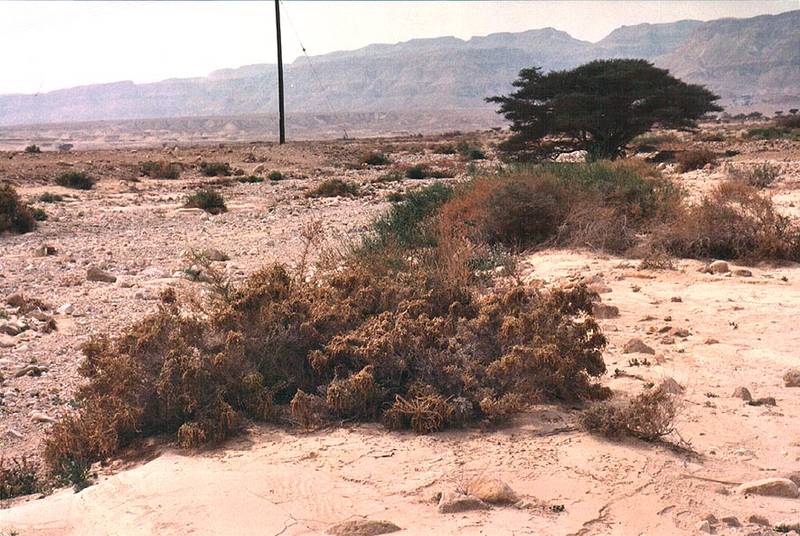

Lower Nahal Mishmar river, near Dead Sea. The Middle East


Album 256: Timna Cliffs near Eilat - Mishmar River near Dead Sea, February 14 - 21, 2002
The image depicts a desert landscape with a dry riverbed, or wadi, running through it. The foreground is dominated by sandy terrain and sparse vegetation, characterized by small bushes and weeds scattered across the ground. In the distance, more dense foliage can be seen on the left side of the river, while rocky hills rise in the background.
The overall atmosphere suggests a hot and dry climate, likely during the summer months when it would be extremely difficult to find water there. The presence of sparse vegetation indicates that this area is arid, with limited rainfall or access to water sources.
Notably, despite being located near the Dead Sea, one of the saltiest bodies of water in the world, the landscape appears to lack any visible signs of water. This may be due to the dry season or the fact that the riverbed is currently dry and devoid of water.
In summary, the image portrays a harsh desert environment with limited vegetation and no apparent access to water, despite its proximity to the Dead Sea. – AI vision


