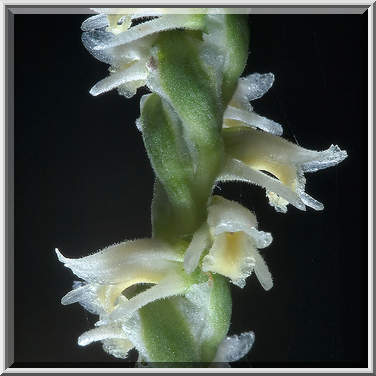


Black-eyed susan (Rudbeckia hirta) flower on Post Oak Trail in Lick Creek ParkLick Creek: Background Notes. College Station, Texas


Album 862: Independence - College Station, Texas, May 16 - 22, 2010
The image presents a close-up view of a single black-eyed susan flower, captured from an angle that showcases its right side. The flower's petals are predominantly yellow, with two maroon-colored stripes running down each petal towards their base. This distinctive pattern is likely responsible for the name "black-eyed susan," as it creates the illusion of dark eyes in the center of a daisy-like bloom.
The flower's stem appears green and slender, while its leaves are not visible within this frame. The background is predominantly black, with some faint specks of light scattered throughout. These specks could be attributed to dust or debris on the lens used to capture the image, rather than any actual features in the scene.
Overall, the image provides a detailed and intimate view of a single black-eyed susan flower, highlighting its unique coloration and structure. The dark background serves to emphasize the flower's vibrant colors and textures, making it stand out as the central focus of the image. – AI vision
🇪🇸 Descripción en español / Spanish Description
Una flor de ojo de gato (Rudbeckia hirta) en el Sendero Post Oak en Lick Creek Park. College Station, Texas, 19 de mayo de 2010. La imagen presenta una vista detallada de una sola flor de ojo de gato, capturada desde un ángulo que muestra su lado derecho. Las pétalas de la flor son predominantemente amarillas, con dos rayas de color marrón que se extienden hacia abajo cada pétalo hacia su base. Este patrón distintivo es probablemente responsable del nombre "ojo de gato negro", ya que crea la ilusión de ojos oscuros en el centro de una flor similar a una margarita. El tallo de la flor aparece verde y delgado, mientras que las hojas no son visibles dentro de este marco. El fondo es predominantemente negro, con algunos destellos débiles dispersados por todas partes. Estos destellos podrían atribuirse al polvo o restos en la lente utilizada para capturar la imagen, en lugar de cualquier característica real en la escena. En general, la imagen proporciona una vista detallada e íntima de una sola flor de ojo de gato, resaltando su coloración y estructura únicas. El fondo oscuro sirve para enfatizar los colores y texturas vibrantes de las flores, haciéndolas destacar como el foco central de la imagen. – Spanish translation


