
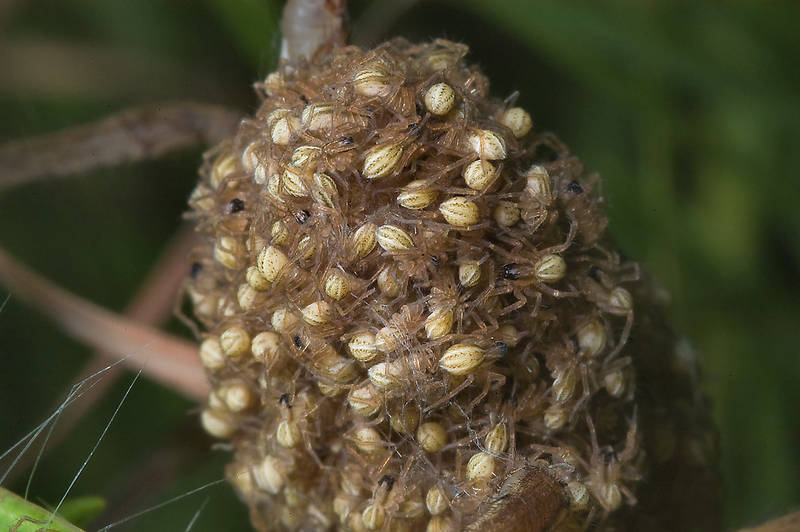

Globular cluster of spiderlings (baby spiders) in Lake Bryan Park. Bryan, Texas


Album 886: College Station - Independence, Texas, August 2 - 7, 2010
The image presents a captivating close-up view of a globular cluster of baby spiders, also known as spiderlings, nestled within a web-like structure. The spiderlings are predominantly pale yellow or beige, featuring small white and black markings on their bodies.
The majority of the spiderlings are clustered together in a tight ball, with some straggling outwards from the center. Their elongated legs are visible, and each spider has eight eyes arranged in two rows. The web that encases this group is thin and transparent, providing a delicate framework for the young spiders to cling to.
The background of the image is blurred, but it appears to be a natural setting with some greenery present. This suggests that the spiderlings are likely found outdoors, possibly on vegetation or within a web attached to a plant stem. The overall atmosphere of the image conveys a sense of serenity and tranquility, as if the viewer has stumbled upon a hidden world teeming with life.
The presence of these baby spiders in their natural habitat offers a unique glimpse into the fascinating realm of arachnids. It is likely that this cluster of spiderlings will eventually disperse and begin to explore their surroundings, potentially leading them to new habitats or encounters with other creatures. The image serves as a reminder of the intricate web of life that exists in our environment, where even the smallest organisms play a vital role in maintaining the balance of nature. – AI vision
🇪🇸 Descripción en español / Spanish Description
El cúmulo globular de arañitas (arañas bebé) en el Lago Bryan Park. Bryan, Texas, agosto de 4 de 2010. La imagen presenta una cautivadora vista de cerca de un cúmulo globular de arañitas bebé, también conocido como arañitas, anidado dentro de una estructura similar a una red. Las arañas bebé son predominantemente de color amarillo pálido o beige, con pequeñas marcas blancas y negras en sus cuerpos. La mayoría de las arañas bebé se agrupan juntas en una bola apretada, con algunas que se extienden hacia fuera desde el centro. Sus patas alargadas son visibles, y cada araña tiene ocho ojos dispuestos en dos filas. La red que encierra este grupo es delgada y transparente, proporcionando una estructura delicada para que los jóvenes arañas se agarren. El fondo de la imagen está borroso, pero parece ser un entorno natural con algo de vegetación presente. Esto sugiere que las arañas bebé probablemente se encuentran al aire libre, posiblemente en vegetación o dentro de una red unida a un tallo de planta. La atmósfera general de la imagen transmite una sensación de serenidad y tranquilidad, como si el espectador se hubiera topado con un mundo oculto repleto de vida. La presencia de estas arañas bebé en su hábitat natural ofrece un vistazo único al fascinante reino de los arácnidos. Es probable que este cúmulo de arañitas se disperse eventualmente y comience a explorar sus alrededores, lo que podría llevarlos a nuevos hábitats o encuentros con otras criaturas. La imagen sirve como recordatorio de la intrincada red de vida que existe en nuestro entorno, donde incluso los organismos más pequeños desempeñan un papel vital en el mantenimiento del equilibrio natural. – Spanish translation


