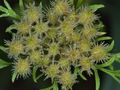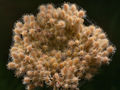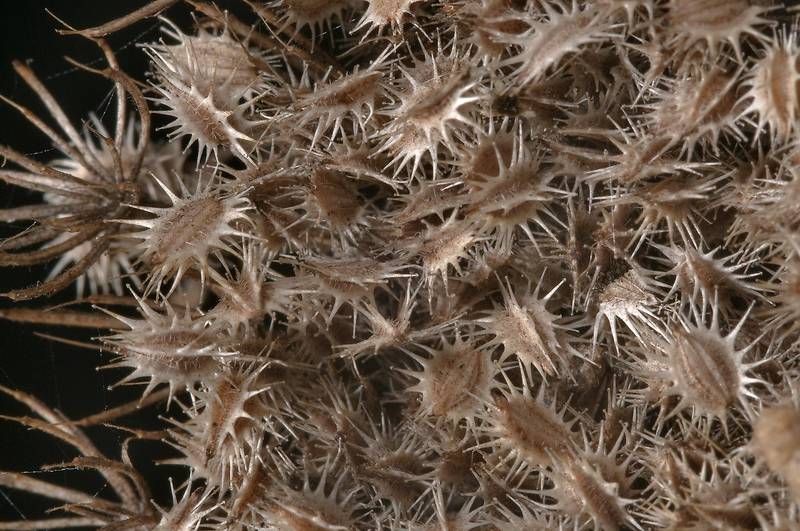

Seeds of Wild Carrot (Daucus pusillus) in Lick Creek ParkLick Creek: Background Notes. College Station, Texas


Album 887: College Station - Independence, Texas, August 8 - 22, 2010
The image presents a close-up view of numerous tiny seeds from a wild carrot plant. The seeds are characterized by their distinctive shape and texture, featuring thin spikes that radiate outward from each seed's center. These spikes give the seeds a spiky appearance.
**Image Composition**
* The seeds are densely packed together, filling the entire frame.
* A black background is visible in the upper left-hand corner of the image.
* The overall effect is one of intricate detail and texture, highlighting the unique features of these wild carrot seeds.
**Visual Analysis**
* **Color:** The seeds appear to be a light brown or tan color, which provides good contrast with the surrounding environment.
* **Size:** Each seed is quite small, measuring only a few millimeters in diameter. This makes them difficult to see without magnification.
* **Shape:** As mentioned earlier, the seeds have a distinctive shape characterized by thin spikes that radiate outward from their center.
**Conclusion**
Overall, the image provides a detailed and intimate look at the seeds of a wild carrot plant. The use of a black background helps to emphasize the texture and features of the seeds, making them stand out even more. – AI vision
🇪🇸 Descripción en español / Spanish Description
Semillas de Zarza Cimarrón (Daucus pusillus) en el Parque Lick Creek. College Station, Texas, 17 de agosto de 2010. La imagen presenta una vista detallada de numerosas semillas minúsculas de una planta de zarza cimarrón. Las semillas se caracterizan por su forma y textura distintivas, con espigas finas que se irradian hacia fuera desde el centro de cada semilla. Estas espigas le dan a las semillas un aspecto punzante. **Composición de la imagen** * Las semillas están empaquetadas densamente, llenando todo el marco. * Un fondo negro es visible en la esquina superior izquierda de la imagen. * El efecto general es un detalle e textura intrincados, resaltando las características únicas de estas semillas de zarza cimarrón. **Análisis visual** * **Color:** Las semillas parecen tener un color marrón claro o beige, lo que proporciona buen contraste con el entorno circundante. * **Tamaño:** Cada semilla es bastante pequeña, midiendo solo unos pocos milímetros de diámetro. Esto las hace difíciles de ver sin ampliación. * **Forma:** Como se mencionó anteriormente, las semillas tienen una forma distintiva caracterizada por espigas finas que se irradian hacia fuera desde su centro. **Conclusión** En general, la imagen proporciona un vistazo detallado e íntimo de las semillas de una planta de zarza cimarrón. El uso de un fondo negro ayuda a enfatizar la textura y los rasgos de las semillas, haciéndolas destacar incluso más. – Spanish translation