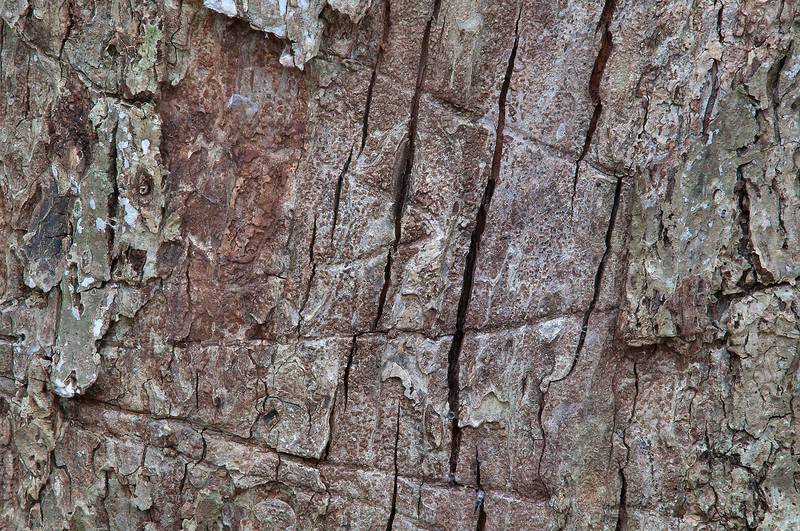

Texture of tree bark in Lick Creek ParkLick Creek: Background Notes. College Station, Texas


Album 1126: College Station - Bryan, Texas, December 11 - 15, 2012
The image presents a detailed view of tree bark, showcasing its intricate texture and coloration. The tree bark is depicted with multiple layers of rough, grayish-brown skin that appears to be peeling off. This layering creates a sense of depth and dimensionality in the image.
As the eye moves through the image, it becomes apparent that several cracks run vertically along the length of the tree trunk. These cracks are not uniform but instead vary in size and shape, adding to the overall complexity of the texture.
Notably, the bark is also characterized by numerous small fissures and crevices, which further contribute to its rugged appearance. Some areas appear lighter or more weathered than others, suggesting that the tree has been exposed to various environmental conditions over time.
The background of the image is not visible due to the close-up nature of the photograph, but it can be inferred that the bark is set against a natural environment, such as a forest or woodland area. The overall effect of the image is one of ruggedness and resilience, highlighting the tree's ability to withstand the elements while still maintaining its unique texture and appearance.
In summary, the image provides a detailed and nuanced portrayal of tree bark, showcasing its intricate texture, coloration, and structure. Through careful attention to detail and composition, the photographer has created an engaging and informative visual representation of this natural phenomenon. – AI vision
🇪🇸 Descripción en español / Spanish Description
Textura de corteza de árbol en Lick Creek Park. College Station, Texas, 14 de diciembre de 2012. La imagen presenta una vista detallada de la corteza del árbol, mostrando su intrincada textura y coloración. La corteza del árbol se representa con múltiples capas de piel gruesa y pardusca que parecen descamarse. Este estratificado crea una sensación de profundidad y dimensión en la imagen. A medida que el ojo se desplaza por la imagen, se hace evidente que varias grietas discurren verticalmente a lo largo del tronco del árbol. Estas grietas no son uniformes sino que varían de tamaño y forma, contribuyendo a la complejidad general de la textura. Cabe destacar que la corteza también se caracteriza por numerosas pequeñas fisuras y hendiduras, lo que contribuye a su aspecto áspero. Algunas áreas aparecen más claras o más desgastadas que otras, lo que sugiere que el árbol ha estado expuesto a diversas condiciones ambientales con el tiempo. El fondo de la imagen no es visible debido a la naturaleza de cerca de la fotografía, pero puede inferirse que la corteza está frente a un entorno natural, como un bosque o una zona boscosa. El efecto global de la imagen es el de resistencia y resiliencia, destacando la capacidad del árbol para resistir los elementos al mismo tiempo que mantiene su textura y aspecto únicos. En resumen, la imagen proporciona una descripción detallada y matizada de la corteza del árbol, mostrando su intrincada textura, coloración y estructura. A través de una atención minuciosa al detalle y a la composición, el fotógrafo ha creado una representación visual atractiva e informativa de este fenómeno natural. – Spanish translation