
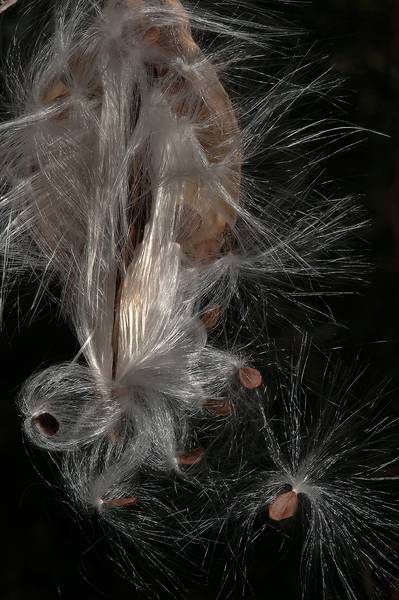

Dehisced seedpod (follicle) releasing seeds (silky white pappus) of angularfruit milkvine (anglepod, Matelea gonocarpos) in Birch Creek Unit of Somerville Lake State Park. Texas


Album 1127: College Station - Bryan, Texas, December 21 - 28, 2012
The photograph captures a dehisced seedpod of the angular fruit milk vine, also known as anglepod or Matelea gonocarpos, releasing its seeds (silky white pappus) into the air. The plant's follicles are visible on the left side of the image, where they have split open to release their contents.
The seedpods are characterized by their angular shape and long, thin dehiscence tubes that extend from them. These tubes play a crucial role in dispersing seeds, allowing them to travel through the air or water with greater ease. The presence of these structures is likely an adaptation for increasing seed dispersal efficiency.
In the foreground, several seeds (silky white pappus) are visible, having been released by the dehisced seedpod. These seeds are characterized by their soft and fluffy appearance, which helps them float through the air or water more easily. The seeds' ability to disperse in this manner is likely an adaptation for reaching new areas with minimal energy expenditure.
The background of the image appears dark, suggesting that it was taken at night or under low light conditions. This could indicate that the plant has adapted to thrive in environments with limited sunlight or vegetation.
Overall, the photograph provides valuable insights into the unique characteristics and adaptations of the angular fruit milk vine. By examining the morphology of its seedpods and seeds, we can gain a better understanding of how this species has evolved to disperse its propagules effectively. – AI vision
🇪🇸 Descripción en español / Spanish Description
La cápsula de la semilla (follículo) liberando las semillas (pelos de seda blancuzca) del calabacín angular (Matelea gonocarpos) en Birch Creek Unit of Somerville Lake State Park. Texas, 22 de diciembre de 2012. La fotografía muestra una cápsula liberando sus semillas por deshiscencia, que se ven como pelos de seda blancuzcos en el aire. Los follículos de la planta están visibles en el lado izquierdo de la imagen, donde se han abierto para liberar su contenido. Las cápsulas son características por su forma angular y los largos y delgados tubos dehiscentes que se extienden desde ellas, jugando un papel crucial en la dispersión de las semillas. Esto les permite viajar por el aire o agua con mayor facilidad. La presencia de estas estructuras es probablemente una adaptación para aumentar la eficiencia de dispersión de semillas. A primer plano, varias semillas (pelos de seda blancuzcos) son visibles, habiendo sido liberadas por la cápsula dehiscente. Estas semillas se caracterizan por su apariencia blanda y esponjosa, que las ayuda a flotar más fácilmente en el aire o agua. La capacidad de dispersarse de esta manera probablemente sea una adaptación para llegar a nuevas áreas con un gasto de energía mínimo. El fondo de la imagen aparece oscuro, lo que sugiere que se tomó de noche o en condiciones de poca luz. Esto podría indicar que la planta ha evolucionado para prosperar en entornos con poca luz solar o vegetación. En general, la fotografía brinda información valiosa sobre las características y adaptaciones únicas del calabacín angular. Al examinar la morfología de sus cápsulas y semillas, podemos tener una mejor comprensión de cómo esta especie ha evolucionado para dispersar eficazmente sus propágulos. – Spanish translation


