
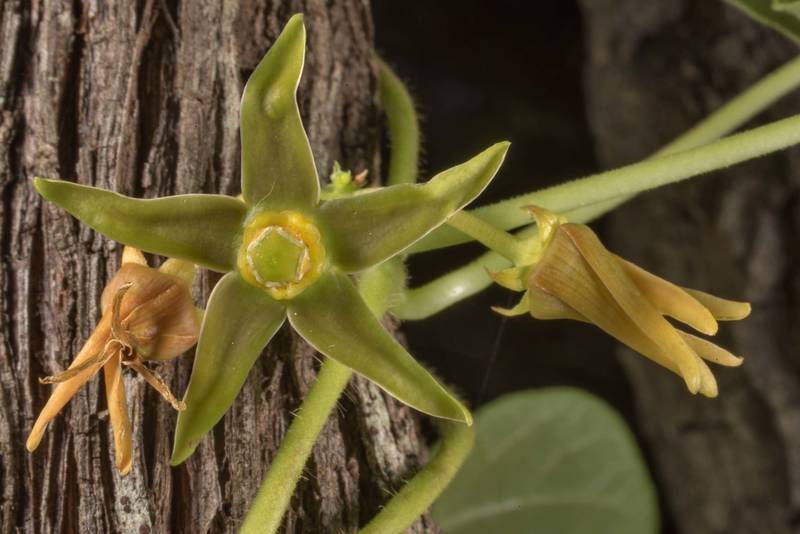

Green flowers of angularfruit milkvine (anglepod, Matelea gonocarpos) at Lake Somerville Trailway near Birch Creek Unit of Somerville Lake State Park. Texas


Album 2730: Lake Somerville, Texas, June 14, 2020
The image presents a close-up view of the green flowers and stem of angularfruit milkvine (anglepod, Matelea gonocarpos), situated in front of a tree trunk or bark, with the flower facing the camera directly. The plant's slender green stem extends from left to right across the image, featuring three yellowish-green flowers that are shaped like starfish, with five-pointed leaves and short hairs along their edges.
The anglepod is a flowering vine, native to eastern North America. It thrives in woodland areas, particularly preferring moist soils and sun-dappled conditions. The plant has been recorded as far north as Canada's southernmost regions but is more commonly found south of the Ohio River. In Texas, it can be spotted growing on trees or other vertical surfaces.
The flowers are pollinated by various insects such as bees and wasps. As a member of the milkweed family (Asclepiadaceae), they produce latex that contains toxic compounds like cardenolides, which deter herbivores from feeding on them. When ingested, these toxins can be harmful to humans and animals.
The plant's name "angularfruit" refers to its fruit, which is shaped like an angle or a triangle, while "milkvine" comes from the fact that it produces white latex when injured. This latex has been used in traditional medicine for centuries.
In terms of conservation status, angularfruit milkvine is listed as Least Concern on the IUCN Red List, indicating that it does not currently face any significant threats to its survival in the wild. However, its habitats are often fragmented and degraded due to human activities such as deforestation and urbanization.
Overall, the image showcases the unique appearance of angularfruit milkvine flowers and highlights the importance of preserving natural habitats to protect this species and others like it. – AI vision
🇪🇸 Descripción en español / Spanish Description
Las flores verdes de la planta carnosa (Matelea gonocarpos) en el Lake Somerville Trailway cerca del Birch Creek Unit del Parque Estatal Somerville Lake. Texas, 14 de junio de 2020. La imagen presenta una vista detallada de las flores y tallos verdes de la planta carnosa (Matelea gonocarpos), ubicados frente a un tronco o corteza de un árbol, con la flor mirando directamente hacia la cámara. El esbelto tallo verde se extiende desde la izquierda a la derecha en toda la imagen, mostrando tres flores en forma de estrella de color verdoso-amarillento, con hojas de cinco puntas y cortos pelos a lo largo de sus bordes. La planta carnosa es una especie herbácea nativa del este de América del Norte. Prospera en zonas boscosas, preferiblemente suelos húmedos y condiciones de luz solar difusa. El angelpod se ha registrado hasta en las regiones más septentrionales de Canadá pero es más común al sur del río Ohio. En Texas, puede observarse creciendo en árboles u otras superficies verticales. Las flores son polinizadas por diferentes insectos como abejas y avispas. Como miembro de la familia del amapola (Asclepiadaceae), produce látex que contiene compuestos tóxicos como las cardenolidas, que impiden que los herbívoros se alimenten de ellos. Cuando se ingieren, estas toxinas pueden ser dañinas para humanos y animales. El nombre "angularfruit" hace referencia a su fruto, que tiene forma de ángulo o triángulo, mientras que "milkvine" proviene del hecho de que produce látex blanco cuando se lesiona. Este látex se ha usado en medicina tradicional durante siglos. En términos de estado de conservación, la planta carnosa (Matelea gonocarpos) está catalogada como «menos preocupante» en la Lista Roja de la UICN, lo que indica que actualmente no enfrenta amenazas significativas para su supervivencia en la naturaleza. Sin embargo, sus hábitats a menudo están fragmentados y degradados debido a actividades humanas como la deforestación y la urbanización. En general, la imagen muestra el aspecto único de las flores de la planta carnosa (Matelea gonocarpos) y destaca la importancia de preservar hábitats naturales para proteger esta especie y otras similares. – Spanish translation


