
Ice crystals on leaves of yaupon holly (Ilex vomitoria) in Lick Creek ParkLick Creek: Background Notes. College Station, Texas


Album 1133: College Station, Texas, January 15 - 17, 2013
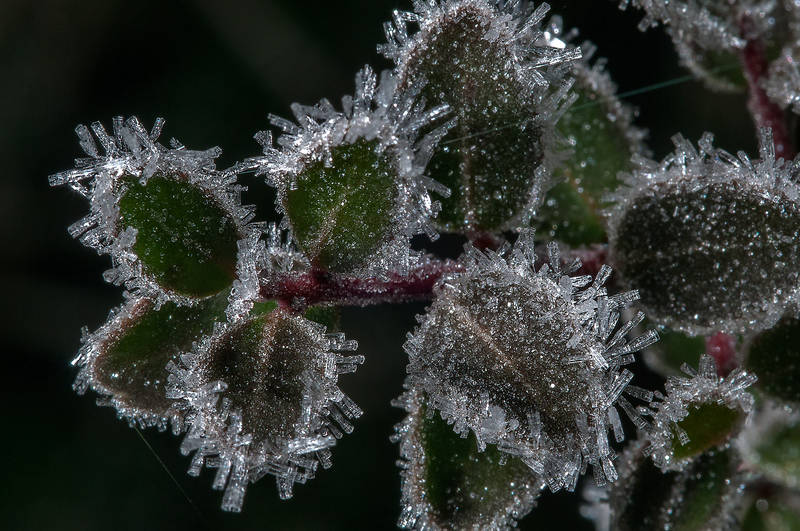
The image presents a close-up view of ice crystals encasing the leaves of an Ilex vomitoria plant, commonly known as yaupon holly, located in Lick Creek Park, College Station, Texas. The photograph was taken on January 17, 2013.
**Composition:**
* **Background:** The background is predominantly black, with a subtle gradient that gradually darkens towards the top of the image.
* **Subject Matter:** The subject of the image is the yaupon holly leaves, which are encased in intricate ice crystals. The plant's reddish stems are visible among the foliage.
**Visual Elements:**
* **Ice Crystals:** The ice crystals on the leaves exhibit a delicate, crystalline structure that resembles tiny glass shards or needles. They appear to be randomly distributed across the surface of each leaf.
* **Leaf Shape and Size:** The yaupon holly leaves in this image are relatively small and oval-shaped, with pointed tips and serrated edges.
**Lighting:**
* **Overall Illumination:** The lighting is soft and diffused, suggesting that the photograph was taken during a cloudy or overcast day. This type of illumination helps to minimize harsh shadows and emphasizes the texture and details of the subject.
* **Highlight Areas:** There are no prominent highlight areas in the image, which further supports the assumption that it was captured on an overcast day.
**Atmospheric Conditions:**
* **Temperature:** The presence of ice crystals on the leaves indicates that the ambient temperature at the time of capture was below freezing. This suggests that the photograph was taken during a period of cold weather.
* **Humidity:** The formation of ice crystals also implies high humidity in the air, which would have facilitated the condensation and freezing of water vapor onto the leaves.
**Camera Settings:**
* **Aperture:** Although the aperture setting is not explicitly stated, it can be inferred that a relatively small aperture (high f-stop number) was used to achieve sufficient depth of field for capturing the intricate details of the ice crystals.
* **Shutter Speed:** The shutter speed appears to have been set to a moderate value, allowing for a smooth and even exposure across the entire image.
**Inferences:**
* **Seasonal Context:** Given the presence of ice crystals on the leaves, it is likely that this photograph was taken during winter or early spring when temperatures are typically colder.
* **Environmental Conditions:** The fact that the plant has been encased in ice suggests that it may have been exposed to freezing rain or sleet at some point before the photograph was taken.
In summary, the image presents a detailed and intimate view of yaupon holly leaves encased in intricate ice crystals. The soft lighting and lack of prominent highlights suggest that the photograph was taken on an overcast day during cold weather conditions. – AI vision
🇪🇸 Descripción en español / Spanish Description
Los cristales de hielo en las hojas del laurel de yaupon (Ilex vomitoria) en Lick Creek Park. College Station, Texas, 17 de enero de 2013. La imagen presenta una vista detallada de los cristales de hielo que encerran las hojas de una planta Ilex vomitoria, comúnmente conocida como laurel de yaupon, ubicada en Lick Creek Park, College Station, Texas. La fotografía se tomó el 17 de enero de 2013. **Composición:** * **Fondo:** El fondo es predominantemente negro, con un gradiente sutil que se oscurece hacia la parte superior de la imagen. * **Materia principal:** La materia principal de la imagen son las hojas de yaupon holly, encerradas en cristales de hielo intrincados. Los tallos rojizos de la planta son visibles entre el follaje. **Elementos visuales:** * **Cristales de hielo:** Los cristales de hielo en las hojas muestran una estructura delicada y cristalina que recuerda pequeños trozos o agujas de vidrio. Parecen estar distribuidos aleatoriamente en la superficie de cada hoja. * **Forma y tamaño de las hojas:** Las hojas de yaupon holly en esta imagen son relativamente pequeñas y de forma ovalada, con puntas agudas y bordes dentados. **Iluminación:** * **Iluminación general:** La iluminación es suave y difusa, lo que sugiere que la fotografía se tomó durante un día nublado u oscuro. Este tipo de iluminación ayuda a minimizar las sombras fuertes y destaca los texturas y detalles del sujeto. * **Zonas destacadas:** No hay áreas prominentes destacadas en la imagen, lo que confirma la suposición de que se capturó en un día nublado. **Condiciones atmosféricas:** * **Temperatura:** La presencia de cristales de hielo en las hojas indica que la temperatura ambiente al momento del registro fue inferior a cero. Esto sugiere que la fotografía se tomó durante un período de clima frío. * **Humedad:** La formación de cristales de hielo también implica una alta humedad en el aire, lo que habría facilitado la condensación y congelación del vapor de agua sobre las hojas. **Configuraciones de la cámara:** * **Apertura:** Aunque no se menciona explícitamente, se infiere que se usó una apertura relativamente pequeña (gran número de f/stop) para lograr suficiente profundidad de campo para capturar los detalles intrincados de los cristales de hielo. * **Velocidad del obturador:** La velocidad del obturador parece haberse ajustado a un valor moderado, lo que permite una exposición suave y uniforme en toda la imagen. **Conclusiones:** * **Contexto estacional:** Dada la presencia de cristales de hielo en las hojas, es probable que esta fotografía se tomara durante el invierno o principios de primavera cuando las temperaturas suelen ser más frías. * **Condiciones ambientales:** El hecho de que la planta haya estado encerrada en hielo sugiere que podría haber estado expuesta a lluvia congelada o nieve en algún momento antes de tomar la fotografía. En resumen, la imagen presenta una vista detallada e íntima de las hojas de yaupon holly encerradas en cristales de hielo intrincados. La iluminación suave y la falta de luces destacables sugieren que la fotografía se tomó un día nublado durante un período de clima frío. – Spanish translation