
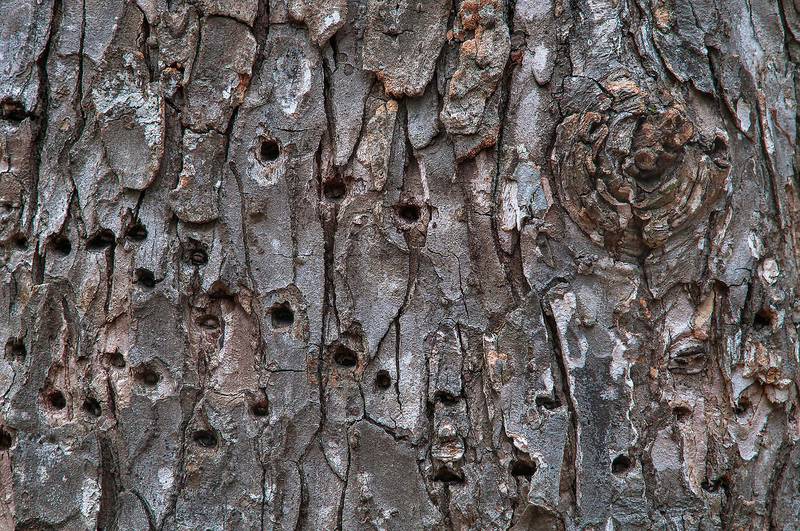

Tree with sapsucker holes (sapwells) on Racoon Run Trail in Lick Creek ParkLick Creek: Background Notes. College Station, Texas


Album 1229: College Station, Texas, July 17 - 19, 2013
The image shows a tree trunk with numerous small holes scattered throughout its surface. The tree appears to be an oak or pine species, as evidenced by the rough bark texture and grayish-brown coloration.
**Key Features**
* **Tree Trunk**: The tree trunk is covered in a thick layer of grayish-brown bark that has deep grooves running vertically along it.
* **Holes (Sapwells)**: There are many small holes scattered across the surface of the tree, ranging in size from 0.5 to 2 inches in diameter. Some of these holes are shallow, while others appear to be deeper and more circular.
* **Bark Texture**: The bark texture is rough and irregular, with deep grooves running vertically along it. This suggests that the tree has been growing for some time and has developed a thick layer of bark as protection against environmental stressors.
**Analysis**
The presence of these holes on the tree trunk suggests that they were made by woodpeckers or other birds searching for insects to eat. Woodpeckers are known to excavate small holes in trees, often referred to as "sapwells," which provide access to sap and insects within the tree.
**Conclusion**
The image shows a tree with multiple small holes on its trunk that appear to have been made by woodpeckers or other birds searching for food. The rough bark texture and grayish-brown coloration suggest an oak or pine species, while the presence of these holes indicates the tree's age and potential insect activity. – AI vision
🇪🇸 Descripción en español / Spanish Description
Árbol con agujeros de picapinos (sapwells) en el sendero Racoon Run en Lick Creek Park. College Station, Texas, 17 de julio de 2013. La imagen muestra un tronco de árbol con numerosos pequeños agujeros dispersos por toda su superficie. El árbol parece ser una especie de robles o pinos, como lo demuestra la textura áspera de la corteza y la coloración parduzca grisácea. **Características clave** * **Tronco del Árbol**: el tronco del árbol está cubierto por una capa gruesa de corteza parduzca grisácea con surcos profundos que discurren verticalmente a lo largo. * **Agujeros (Sapwells)**: existen muchos pequeños agujeros dispersos en toda la superficie del árbol, midiendo de 0,5 a 2 pulgadas de diámetro aproximadamente. Algunos de estos agujeros son poco profundos, mientras que otros parecen ser más profundos y circulares. * **Textura de la Corteza**: la textura de la corteza es rugosa e irregular con surcos profundos que discurren verticalmente a lo largo. Esto sugiere que el árbol ha estado creciendo durante algún tiempo y ha desarrollado una gruesa capa de corteza como protección contra los estresores ambientales. **Análisis** La presencia de estos agujeros en el tronco del árbol sugiere que fueron hechos por picojos u otros pájaros buscando insectos para comer. Los picojos son conocidos por excavar pequeños agujeros en los árboles, a menudo denominados "sapwells," que proporcionan acceso a savia y insectos dentro del árbol. **Conclusión** La imagen muestra un árbol con múltiples pequeños agujeros en su tronco que parecen haber sido hechos por picojos u otros pájaros buscando comida. La textura áspera de la corteza y el color grisáceo parduzco sugieren una especie de robles o pinos, mientras que la presencia de estos agujeros indica la edad del árbol y la posible actividad de insectos. – Spanish translation


