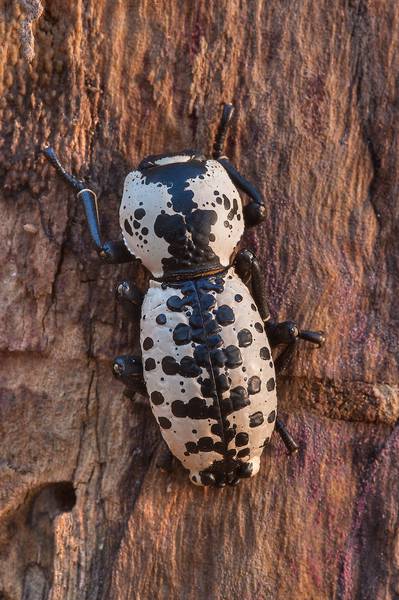

Ironclad beetle (Zopherus haldemani(?)) at sunrise on Raccoon Run Trail in Lick Creek ParkLick Creek: Background Notes. College Station, Texas


Album 1287: Washington-on-the-Brazos - Independence, Texas, October 6 - 12, 2013
The image shows a large black and white spotted insect clinging to the rough bark of a tree trunk. The beetle's body is elongated with rounded edges. Its head is broad at the top and tapers into a point towards its abdomen. There are long antennae protruding from the top of its head.
Its coloring, which features black spots on a white background, allows it to blend in with the bark of the tree. The beetle has three visible legs, but they are not fully extended; they appear to be tucked under its body for protection and stability while clinging to the trunk.
The texture of the tree's bark is rough and uneven, with deep grooves running along one side. A small hole can be seen in the bottom left corner of the image, suggesting that this may have been a fallen log or branch at some point.
The background behind the beetle appears blurry and out of focus; it seems to be made up of various shades of brown and tan that blend together seamlessly. The overall effect is one of subtle contrast between the dark beetle and its lighter surroundings.
Overall, the image presents an intriguing glimpse into a unique ecosystem where insects like this ironclad beetle thrive amidst their natural habitat. – AI vision
🇪🇸 Descripción en español / Spanish Description
El escarabajo de caparazón de hierro (Zopherus haldemani(?)) al amanecer en el Raccoon Run Trail en Lick Creek Park. College Station, Texas, 7 de octubre de 2013. La imagen muestra un gran insecto con manchas negras y blancas que se aferra a la corteza rugosa de un tronco de árbol. El cuerpo del escarabajo es alargado con bordes redondeados. Su cabeza es ancha en la parte superior y se estrecha hasta una punta hacia su abdomen. Hay largas antenas que sobresalen de la parte superior de su cabeza. Su coloración, caracterizada por manchas negras sobre un fondo blanco, le permite mezclarse con la corteza del árbol. El escarabajo tiene tres patas visibles, pero no están completamente extendidas; parecen estar ocultos debajo de su cuerpo para protección y estabilidad mientras se aferran al tronco. La textura de la corteza del árbol es rugosa e irregular, con surcos profundos que corren a lo largo de un lado. Se puede ver un pequeño orificio en la esquina inferior izquierda de la imagen, lo que sugiere que podría tratarse de un tronco o rama caído en algún momento. El fondo detrás del escarabajo parece borroso y desenfocado; parece estar compuesto por varios tonos de marrón y beige que se mezclan sin problemas. El efecto general es uno de contraste sutil entre el escarabajo oscuro y sus alrededores más claros. En general, la imagen presenta un vistazo intrigante a un ecosistema único donde los insectos como este escarabajo con caparazón de hierro prosperan en su hábitat natural. – Spanish translation