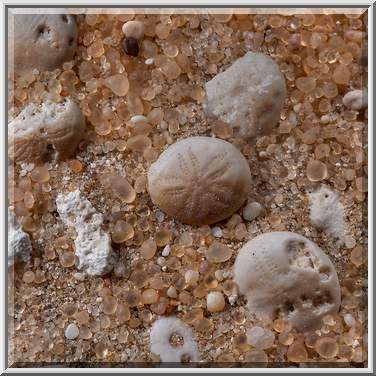


Masses of tiny fossilized echinoderms or sea urchins in Fibularia damensis outcrop in coastal area in south-western Qatar


Album 1336: Fossil tour in south-western Qatar, February 7, 2014
The image shows a close-up view of a large rock or stone, with numerous small holes and depressions scattered across its surface. The rock appears to be composed of many layers, with different shades of brown and tan visible throughout. Some areas are lighter than others, suggesting variations in texture or composition.
Upon closer inspection, it becomes clear that the holes and depressions are not just random cavities but rather contain tiny fossilized echinoderms or sea urchins. These fossils are rounded and smooth, with some exhibiting small ridges or bumps on their surfaces. They vary in size, ranging from a few millimeters to about 1 centimeter in diameter.
The background of the image is not visible due to the close-up nature of the photograph. However, based on the context provided by the caption, it can be inferred that the rock was discovered in a coastal area in south-western Qatar during February 2014. The presence of fossils suggests that this region may have been underwater at some point in the past, allowing these marine organisms to become embedded in the rock over time.
Overall, the image provides a fascinating glimpse into the geological history of the area and offers insights into the processes that shaped our planet's surface over millions of years. – AI vision


