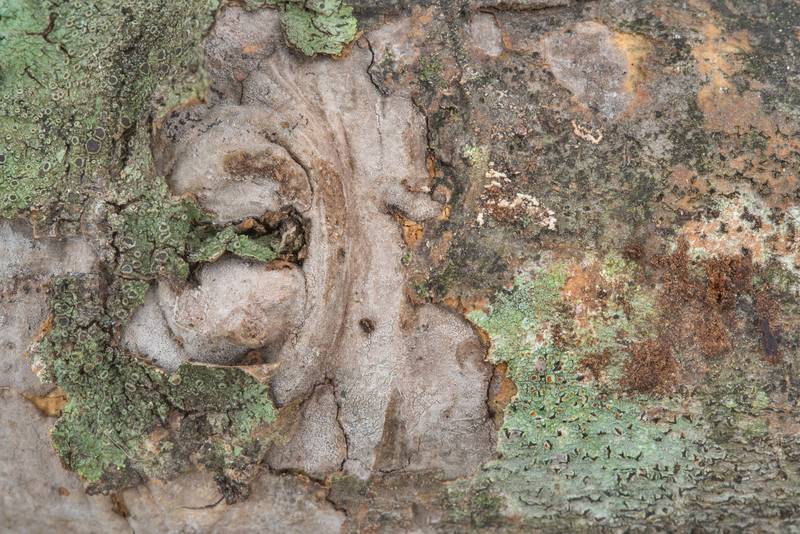

Tan crust fungus on a tree branch in Wolf Pen Creek Park. College Station, Texas


Album 2233: College Station, Texas, March 4, 2018
The image depicts a close-up view of a tree branch covered with lichen and fungi.
* The main focus of the image is a thick, grayish-brown crust that covers much of the branch.
* This crust appears to be composed of a mixture of lichens and fungi, which are often found growing on trees in this environment.
* The texture of the crust is rough and uneven, with some areas appearing more dense than others.
* In addition to the main crust, there are several other types of lichen and fungi visible on the branch.
* Some of these appear as small, greenish-gray patches, while others resemble tiny, white or yellowish growths.
* These organisms likely play an important role in breaking down organic matter and recycling nutrients within the ecosystem.
* The overall color palette of the image is dominated by shades of gray, brown, and green, which are typical colors associated with lichens and fungi.
* However, there are also some hints of yellow and orange visible in certain areas, possibly indicating the presence of other microorganisms or substances.
In summary, this image provides a detailed view of the complex relationships between lichens, fungi, and trees. The diverse range of organisms present on the branch highlights the importance of these microscopic communities in maintaining ecological balance and promoting nutrient cycling within forest ecosystems. – AI vision
🇪🇸 Descripción en español / Spanish Description
Un hongo en costra sobre una rama de un árbol en el Wolf Pen Creek Park, College Station, Texas, el 4 de marzo de 2018. La imagen muestra una vista detallada de una rama cubierta con líquenes y hongos. * El principal foco de la imagen es una costra marrón grisácea gruesa que recubre gran parte de la rama. * Esta costra parece estar compuesta por una mezcla de líquenes y hongos, que se suelen encontrar creciendo en árboles en este entorno. * La textura de la costra es áspera e irregular, con algunas zonas que parecen más densas que otras. * Además de la costra principal, hay varios tipos diferentes de líquenes y hongos visibles sobre la rama. * Algunos de ellos aparecen como manchas pequeñas y grisáceas, mientras que otros se asemejan a pequeños crecimientos blancos o amarillentos. * Es probable que estos organismos desempeñen un papel importante en la descomposición de la materia orgánica y el reciclaje de nutrientes dentro del ecosistema. * La paleta de colores general de la imagen está dominada por tonos grises, marrones y verdes, que son colores típicos asociados con líquenes y hongos. * Sin embargo, también hay algunas pinceladas de amarillo y naranja visibles en ciertas áreas, posiblemente indicando la presencia de otros microorganismos o sustancias. En resumen, esta imagen proporciona una vista detallada de las complejas relaciones entre líquenes, hongos y árboles. La variedad de organismos presentes en la rama pone de manifiesto la importancia de estas comunidades microscópicas en el mantenimiento del equilibrio ecológico y la promoción del reciclaje de nutrientes dentro de los ecosistemas forestales. – Spanish translation