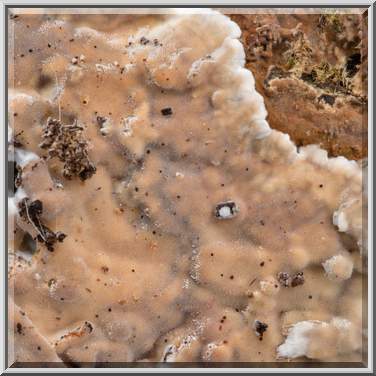
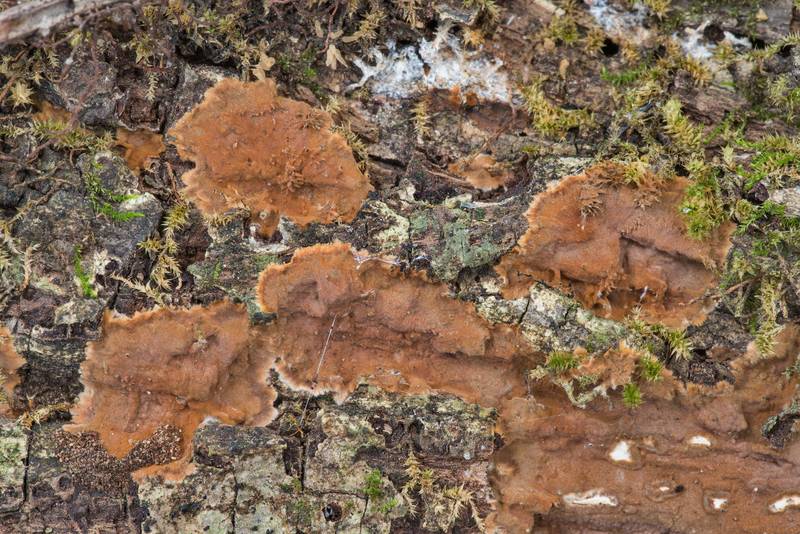
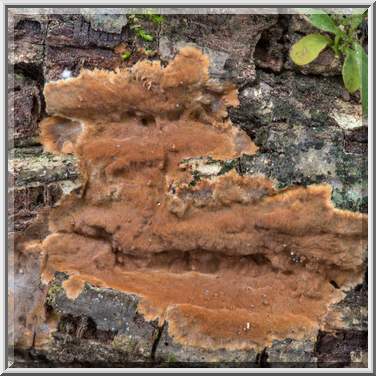
Crust fungus Hymenochaete on a fallen branch of a pecan tree in Lick Creek ParkLick Creek: Background Notes. College Station, Texas


Album 3316: Mushrooms in Lick Creek Park, College Station, Texas, January 2, 2023
The image shows a close-up of a fallen branch of a pecan tree, covered with various types of fungi and lichen. The surface is rough and weathered, indicating that it has been exposed to the elements for some time.
**Fungal Growth**
There are several patches of orange-brown fungus growing on the surface of the branch. These appear to be crust fungi, which are a type of bracket fungus that grows in layers or crusts on the surfaces of dead trees and other decaying organic matter. The largest patch is roughly circular in shape and measures about 2-3 inches (5-7.5 cm) in diameter.
**Lichen Growth**
In addition to the fungal growth, there are also several patches of greenish-yellow lichen growing on the surface of the branch. Lichens are composite organisms made up of fungi and algae or cyanobacteria that live together in a symbiotic relationship. They are often found growing on rocks, trees, and other surfaces where they can absorb moisture and nutrients.
**Branch Characteristics**
The branch itself appears to be quite old and weathered, with visible cracks and fissures running along its length. It is likely that this branch has been lying on the ground for some time, providing a suitable substrate for the growth of fungi and lichen.
**Color Palette**
The overall color palette of the image is muted, with shades of brown, beige, and green dominating the scene. The orange-brown color of the fungus provides a pop of contrast against the more subdued tones of the branch and surrounding environment.
**Background**
There does not appear to be any significant background or context beyond the fallen branch itself. This suggests that the image may have been taken in a natural setting, such as a forest or woodland area, where the branch has been left to decay over time.
Overall, this image provides a detailed view of the types of organisms that can colonize dead wood and contribute to decomposition processes in ecosystems. It also highlights the importance of preserving these natural environments and allowing them to function without human interference. – AI vision
🇪🇸 Descripción en español / Spanish Description
Hongo corteza Hymenochaete sobre una rama caída de un árbol de pacana en el Lick Creek Park. College Station, Texas, 2 de enero de 2023. La imagen muestra un primer plano de una rama caída de un árbol de pacana cubierta con varios tipos de hongos y líquenes. La superficie es rugosa y desgastada, lo que indica que ha estado expuesta a los elementos durante algún tiempo. **Crecimiento Fúngico** Hay varias manchas de hongo naranja-marrón creciendo sobre la superficie de la rama. Estos parecen ser hongos de corteza, que son un tipo de hongo en forma de casquete que crece en capas o costras sobre las superficies de árboles muertos y otros materiales en descomposición. La mancha más grande es de forma aproximadamente circular y mide alrededor de 2-3 pulgadas (5-7,5 cm) de diámetro. **Crecimiento Lichenico** Además del crecimiento fúngico, hay también varias manchas de líquenes verde-amarillentos que crecen sobre la superficie de la rama. Los líquenes son organismos compuestos formados por hongos y algas o cianobacterias que viven juntos en una relación simbiótica. Se encuentran a menudo creciendo en rocas, árboles y otras superficies donde pueden absorber humedad y nutrientes. **Características de la rama** La rama en sí parece ser bastante vieja y desgastada, con grietas visibles que recorren su longitud. Es probable que esta rama haya estado tendida sobre el suelo durante algún tiempo, proporcionando un sustrato adecuado para el crecimiento de hongos y líquenes. **Paleta de colores** La paleta de colores general del cuadro está atenuada, con tonos marrones, beige y verde dominando la escena. El color naranja-marrón del hongo proporciona un contraste en contraste con los tonos más suaves de la rama y el entorno circundante. **Antecedentes** No parece haber antecedentes o contexto significativos más allá de la rama caída en sí. Esto sugiere que la imagen puede haberse tomado en un entorno natural, como un bosque o área arbolada, donde la rama ha sido dejada a descomponerse con el tiempo. **Global** En general, esta imagen proporciona una vista detallada de los tipos de organismos que pueden colonizar maderas muertas y contribuir a procesos de descomposición en ecosistemas. También destaca la importancia de preservar estos entornos naturales y permitirles funcionar sin interferencia humana. – Spanish translation


