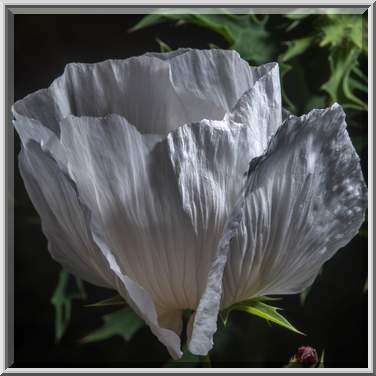
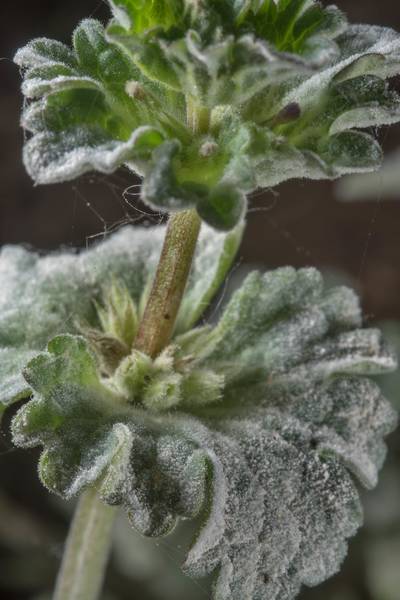

Powdery mint mildew caused by fungus Neoerysiphe galeopsidis on henbit leaves near a pond in Washington-on-the-Brazos State Historic Site. Washington, Texas


Album 2248: Washington-on-the-Brazos - Navasota, Texas, April 21, 2018
The image presents a close-up view of a plant with powdery mildew fungus affecting its leaves, as indicated by the caption. The plant's leaves are covered in white powder, likely caused by the fungal infection.
**Key Features:**
* **Plant Leaves:** The leaves exhibit a powdery appearance due to the presence of fungal spores.
* **Fungal Infection:** The image suggests that the plant is infected with Neoerysiphe galeopsidis, a type of powdery mildew fungus commonly found on henbit plants.
**Context:**
* **Location:** The image was taken near a pond in Washington-on-the-Brazos State Historic Site, Texas.
* **Date:** The photo was captured on April 21, 2018.
In summary, the image depicts a henbit plant infected with powdery mildew fungus, specifically Neoerysiphe galeopsidis. The infection is characterized by the white powder covering the leaves of the plant. – AI vision
🇪🇸 Descripción en español / Spanish Description
El mildiú polvoriento de la menta es causado por el hongo Neoerysiphe galeopsidis en las hojas del henbit cerca de un estanque en el sitio histórico estatal de Washington-on-the-Brazos. Washington, Texas, 21 de abril de 2018. La imagen presenta una vista cercana a una planta con mildiú polvoriento que afecta sus hojas, como se indica en el subtítulo. Las hojas de la planta están cubiertas con polvo blanco, probablemente causado por la infección fúngica. **Características clave:** * **Hojas de la planta:** Las hojas presentan un aspecto pulverulento debido a la presencia de esporas del hongo. * **Infección fúngica:** La imagen sugiere que la planta está infectada con Neoerysiphe galeopsidis, un tipo de mildiú polvoriento comúnmente encontrado en plantas henbit. **Contexto:** * **Lugar:** La imagen fue tomada cerca de un estanque en el sitio histórico estatal de Washington-on-the-Brazos, Texas. * **Fecha:** La foto fue capturada el 21 de abril de 2018. En resumen, la imagen muestra una planta henbit infectada con mildiú polvoriento, específicamente Neoerysiphe galeopsidis. La infección se caracteriza por el polvo blanco que cubre las hojas de la planta. – Spanish translation


