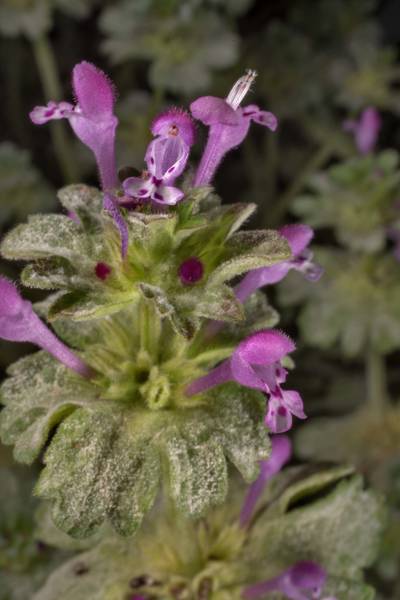
Powdery mint mildew caused by fungus Neoerysiphe galeopsidis on clasping henbit (Lamium amplexicaule) in TAMU Holistic Garden in Texas A&M University. College Station, Texas

🎞️ #2892-22

The image showcases a close-up view of a plant with green leaves and purple flowers, likely infected by powdery mildew caused by the fungus Neoerysiphe galeopsidis on clasping henbit (Lamium amplexicaule).

**Plant Characteristics**

* The plant's leaves are covered in a white, powdery coating, which is a characteristic symptom of powdery mildew.
* Purple flowers with long stamen protruding from the top of the plant are visible.

**Background and Context**

* The background is blurred, but appears to be other plants in the same garden.
* The image was captured in TAMU Holistic Garden in Texas A&M University's College Station, Texas on March 27, 2021. – AI vision

🇪🇸 Descripción en español / Spanish Description

El mildiu polvoriento de la menta causado por el hongo Neoerysiphe galeopsidis en la henbit que se agarra (Lamium amplexicaule) en el Jardín Holístico TAMU en Texas A&M University. College Station, Texas, 27 de marzo de 2021. La imagen muestra una vista cercana de una planta con hojas verdes y flores moradas, probablemente infectada por mildiu polvoriento causado por el hongo Neoerysiphe galeopsidis en la henbit que se agarra (Lamium amplexicaule). **Características de la planta** * Las hojas de la planta están cubiertas con un recubrimiento blanco y polvorienta, lo que es un síntoma característico del mildiu polvoriento. * Son visibles las flores moradas con largos estambres sobresaliendo de la parte superior de la planta. **Antecedentes y contexto** * El fondo está borroso, pero parece haber otras plantas en el mismo jardín. * La imagen se capturó en el Jardín Holístico TAMU en Texas A&M University's College Station, Texas el 27 de marzo de 2021. – Spanish translation

Similar Find pictures that are similar to this picture

Thumbnail of picture 2892-21: Clasping henbit (henbit deadnettle, Lamium amplexicaule) with powdery ... University. College Station, Texas, March 27, 2021 Similar(1): Clasping henbit (henbit deadnettle, Lamium amplexicaule) with powdery ... University. College Station, Texas, March 27, 2021 Thumbnail of picture 3121-18: Conidia of powdery mint mildew caused by fungus Neoerysiphe ... Creek Park. College Station, Texas, March 25, 2022 Similar(2): Conidia of powdery mint mildew caused by fungus Neoerysiphe ... Creek Park. College Station, Texas, March 25, 2022 Thumbnail of picture 3121-19: Conidia of powdery mint mildew caused by fungus Neoerysiphe ... Creek Park. College Station, Texas, March 25, 2022 Similar(3): Conidia of powdery mint mildew caused by fungus Neoerysiphe ... Creek Park. College Station, Texas, March 25, 2022 Thumbnail of picture 2892-07: Powdery mint mildew caused by fungus Neoerysiphe galeopsidis on henbit ... University. College Station, Texas, March 27, 2021 Similar(4): Powdery mint mildew caused by fungus Neoerysiphe galeopsidis on henbit ... University. College Station, Texas, March 27, 2021 Thumbnail of picture 2248-09: Powdery mint mildew caused by fungus Neoerysiphe galeopsidis on henbit ... Historic Site. Washington, Texas, April 21, 2018 Similar(5): Powdery mint mildew caused by fungus Neoerysiphe galeopsidis on henbit ... Historic Site. Washington, Texas, April 21, 2018 Thumbnail of picture 697-06: Green lynx spider on clasping henbit (henbit deadnettle, Lamium ... College Station, Texas, December 31, 2008 Similar(6): Green lynx spider on clasping henbit (henbit deadnettle, Lamium ... College Station, Texas, December 31, 2008 Thumbnail of picture 703-01: Purple tubular flowers of clasping henbit (henbit deadnettle, Lamium ... College Station, Texas, January 24, 2009 Similar(7): Purple tubular flowers of clasping henbit (henbit deadnettle, Lamium ... College Station, Texas, January 24, 2009 Thumbnail of picture 2232-18: Clasping henbit (henbit deadnettle, Lamium amplexicaule) taken from Bee Creek Park. College Station, Texas, March 3, 2018 Similar(8): Clasping henbit (henbit deadnettle, Lamium amplexicaule) taken from Bee Creek Park. College Station, Texas, March 3, 2018