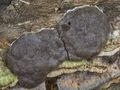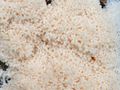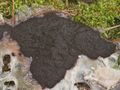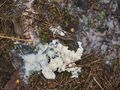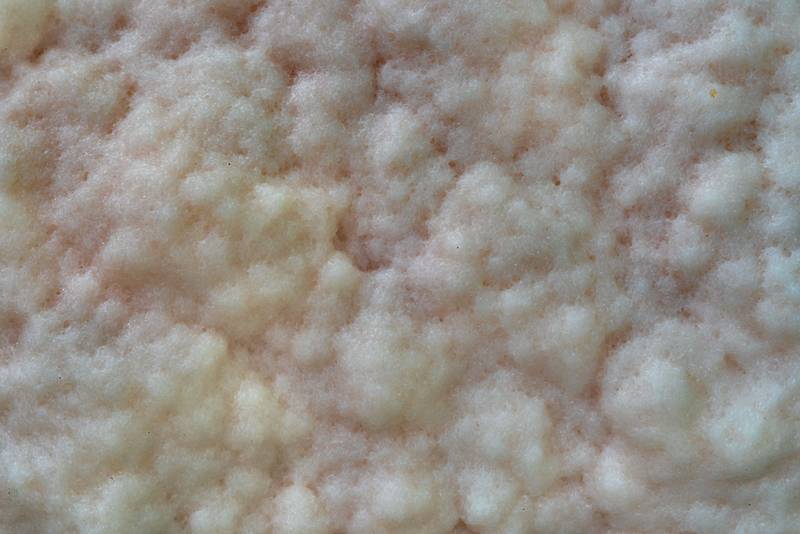

Close up of Tapioca slime mold (Brefeldia maxima)(?) in Lick Creek ParkLick Creek: Background Notes. College Station, Texas


Album 2257: College Station, Texas, May 7, 2018
The image presents a close-up view of what appears to be a type of fungus or slime mold. The subject's texture resembles small, roundish, and somewhat irregularly shaped objects clustered together.
**Observations:**
* **Color:** The dominant color is white, with subtle hints of light brown scattered throughout.
* **Shape and Size:** Each object within the cluster appears to be roughly spherical in shape, varying in size but generally uniform.
* **Texture:** The surface texture seems smooth and slightly translucent.
* **Composition:** It's unclear whether this is a single organism or multiple organisms clustered together.
**Conclusion:**
Based on these observations, it's possible that the subject could be an unknown type of slime mold or fungus. However, without additional information about its habitat, growth conditions, and other characteristics, it's challenging to provide a definitive identification.
The image provides valuable insights into the appearance and structure of this organism but may require further study for accurate classification.
Answer: Based on the provided image description, the subject appears to be an unknown type of slime mold or fungus with a smooth, translucent texture and spherical shape. – AI vision
🇪🇸 Descripción en español / Spanish Description
Close up de moho de tapioque (Brefeldia maxima) en Lick Creek Park. College Station, Texas, 7 de mayo de 2018. La imagen presenta una vista detallada de lo que parece ser un tipo de hongo u moho esponjoso. La textura del sujeto se asemeja a objetos pequeños, redondos e irregularmente conformados agrupados juntos. **Observaciones:** * **Color:** El color dominante es blanco, con matices claros de marrón dispersados por toda la imagen. * **Forma y tamaño:** Cada objeto dentro del grupo parece ser aproximadamente esférico en forma, variando en tamaño pero generalmente uniforme. * **Textura:** La superficie parece suave y ligeramente translúcida. * **Composición:** No se puede determinar si este es un solo organismo o múltiples organismos agrupados juntos. **Conclusión:** En base a estas observaciones, cabe la posibilidad de que el sujeto sea un tipo desconocido de hongo u moho esponjoso. Sin embargo, sin más información acerca de su hábitat, condiciones de crecimiento y otras características, resulta complicado proporcionar una identificación concluyente. La imagen brinda datos valiosos sobre la apariencia y estructura de este organismo, pero puede requerir un estudio adicional para su clasificación precisa. Respuesta: En base a la descripción proporcionada, el sujeto parece ser un tipo desconocido de hongo u moho esponjoso con una superficie lisa y translúcida y una forma esférica. – Spanish translation