
Some Agaricus mushroom in Lick Creek ParkLick Creek: Background Notes. College Station, Texas


Album 2259: College Station, Texas, May 13 - 14, 2018
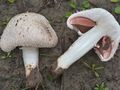
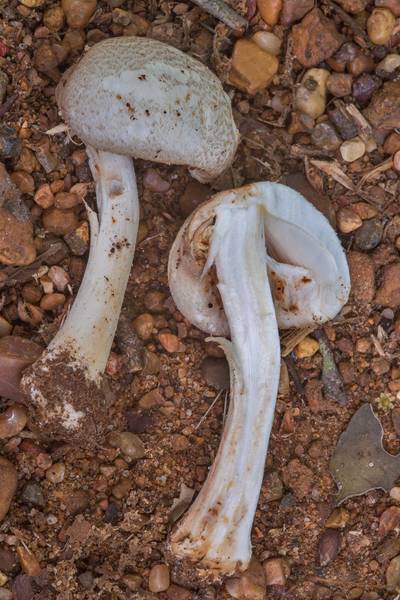
The image presents a close-up view of two mushrooms situated on a bed of brown pebbles and dirt within Lick Creek Park in College Station, Texas. The mushrooms are positioned centrally in the frame, with one lying flat against the ground and the other standing upright. A small portion of what appears to be another mushroom is visible at the bottom-right corner.
Both mushrooms display white caps that have become discolored or stained by mud, which has accumulated on their surfaces. Their stems appear pale compared to the darker coloration observed in the lower part of the photograph. The surrounding area is characterized by a mix of brown pebbles and dirt, with small twigs and leaves visible among them.
The mushrooms are likely Agaricus bisporus, commonly referred to as button mushrooms, which are widely cultivated for consumption. These mushrooms are typically found growing in clusters or groups near trees and shrubs in temperate climates across the Northern Hemisphere. They are prized for their mild flavor and soft texture when cooked.
In terms of size, it is difficult to determine the exact dimensions of these particular mushrooms from the image alone. However, button mushrooms generally range in size from 2-5 cm (0.8-2 inches) in diameter and 3-10 cm (1.2-4 inches) tall. The caps are typically rounded or bell-shaped, ranging from white to light brown in color.
The image appears to have been captured during the spring season, as indicated by the presence of small twigs and leaves scattered throughout the area. This suggests that the mushrooms may be actively growing and producing fruiting bodies at this time. Overall, the photograph provides a detailed view of these common yet fascinating organisms, highlighting their unique characteristics and habitats. – AI vision
🇪🇸 Descripción en español / Spanish Description
Algunos hongos Agaricus en Lick Creek Park. College Station, Texas, 13 de mayo de 2018. La imagen presenta una vista detallada de dos hongos ubicados en una base de guijarros marrones y tierra dentro del parque Lick Creek en College Station, Texas. Los hongos están situados centralmente en el cuadro, con uno acostado contra el suelo y el otro de pie erecto. Una pequeña porción de lo que parece ser otro hongo es visible en la esquina inferior derecha. Ambos hongos muestran sombreros blancos que se han decolorado o manchado con barro, que se ha acumulado sobre sus superficies. Sus tallos parecen pálidos en comparación con la coloración más oscura observada en la parte inferior de la fotografía. El área circundante está caracterizada por una mezcla de guijarros marrones y tierra, con ramitas y hojas pequeñas visibles entre ellos. Es probable que los hongos sean Agaricus bisporus, comúnmente denominados setas de botón, que se cultivan ampliamente para consumo. Estos hongos se encuentran típicamente creciendo en grupos o agrupaciones cerca de árboles y arbustos en climas templados del hemisferio norte. Se valoran por su sabor suave y textura blanda cuando se cocinan. En términos de tamaño, es difícil determinar las dimensiones exactas de estos hongos particulares a partir de la imagen sola. Sin embargo, los hongos de botón oscilan en general entre 2-5 cm (0.8-2 pulgadas) de diámetro y 3-10 cm (1.2-4 pulgadas) de altura. Los sombreros son típicamente redondos o con forma de campana, que oscilan entre blanco y marrón claro en color. La imagen parece haberse capturado durante la temporada de primavera, como indica la presencia de ramitas y hojas dispersadas por toda el área. Esto sugiere que los hongos pueden estar activamente creciendo y producir cuerpos fructíferos en este momento. En general, la fotografía proporciona una vista detallada de estos organismos comunes pero fascinantes, resaltando sus características únicas y hábitats. – Spanish translation