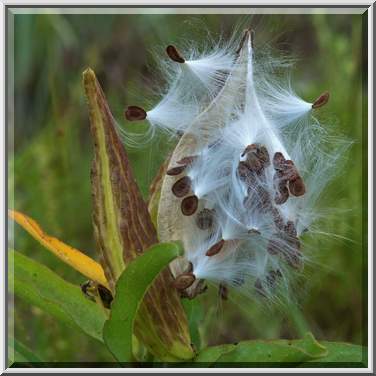
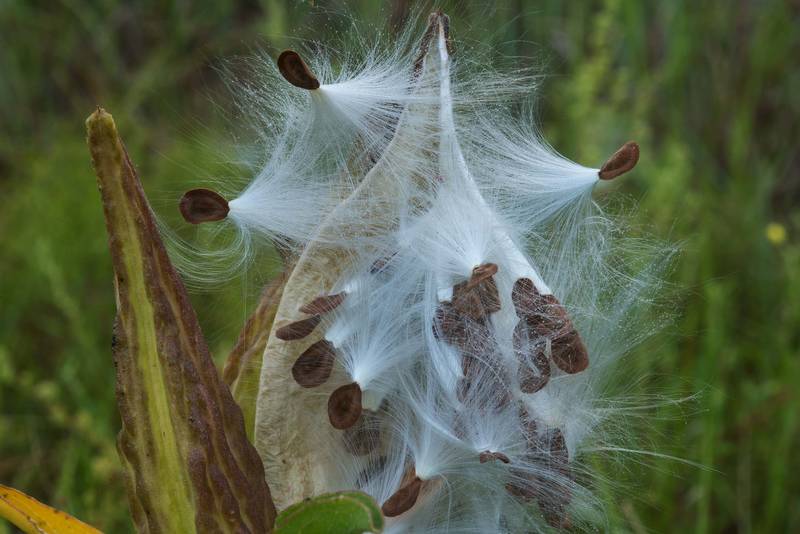
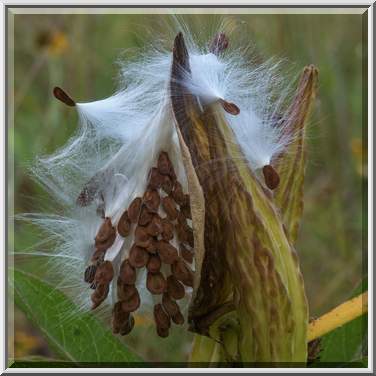
Seed head of Antelope horns milkweed (Asclepias viridis) in Lick Creek ParkLick Creek: Background Notes. College Station, Texas


Album 2261: College Station, Texas, May 17, 2018
The image shows a seed head of Antelope horns milkweed (Asclepias viridis) in Lick Creek Park. The seed head is composed of several long, thin white threads that resemble hair or fibers. These threads are attached to small brown seeds at their ends.
* **Seed Head:**
* The seed head is the part of the plant that produces seeds.
* It is typically found at the top of the stem and can be quite large.
* In this image, the seed head appears to be dry and brittle, suggesting that it has gone to seed.
* **White Threads:**
* The white threads are likely made up of cotton or other fibrous material.
* They are attached to the seeds at their ends and help to disperse them in the wind.
* The threads can be quite long, allowing the seeds to travel significant distances from the parent plant.
* **Brown Seeds:**
* The brown seeds are the reproductive structures of the plant.
* They contain the embryo of a new plant and are designed to disperse them in the wind.
* The seeds are attached to the white threads at their ends, which helps them to travel further away from the parent plant.
Overall, the image shows a seed head of Antelope horns milkweed that has gone to seed. The seed head is composed of long white threads that are attached to small brown seeds. These threads help to disperse the seeds in the wind, allowing them to grow into new plants in other locations. – AI vision
🇪🇸 Descripción en español / Spanish Description
Cabeza de semilla del galiste de cuernos de antílope (Asclepias viridis) en Lick Creek Park. College Station, Texas, 17 de mayo de 2018. La imagen muestra una cabeza de semillas del galiste de cuernos de antílope (Asclepias viridis) en Lick Creek Park. La cabeza de semillas está compuesta por varios hilos blancos largos y delgados que se asemejan a cabellos o fibras. Estos hilos están unidos a pequeñas semillas marrones en sus extremos.
**Cabeza de Semillas:**
La cabeza de semillas es la parte de la planta que produce las semillas. Normalmente se encuentra en la parte superior del tallo y puede ser bastante grande. En esta imagen, la cabeza de semillas parece seca y quebradiza, lo que sugiere que ha llegado a semilla.
**Hilos Blancos:**
Los hilos blancos probablemente estén hechos de algodón u otro material fibroso. Están unidos a las semillas en sus extremos y ayudan a dispersarlas con el viento. Los hilos pueden ser bastante largos, permitiendo que las semillas se desplacen una distancia considerable desde la planta madre.
**Semillas Marrones:**
Las semillas marrones son las estructuras reproductivas de la planta. Contienen el embrión de una nueva planta y están diseñadas para dispersarlos con el viento. Las semillas están unidas a los hilos blancos en sus extremos, lo que les permite desplazarse más lejos desde la planta madre.
En general, la imagen muestra una cabeza de semillas del galiste de cuernos de antílope que ha llegado a semilla. La cabeza de semillas está compuesta por largos hilos blancos unidos a pequeñas semillas marrones. Estos hilos ayudan a dispersar las semillas con el viento, permitiendo que crezcan en nuevas plantas en otros lugares. – Spanish translation


