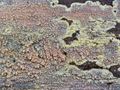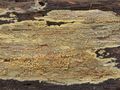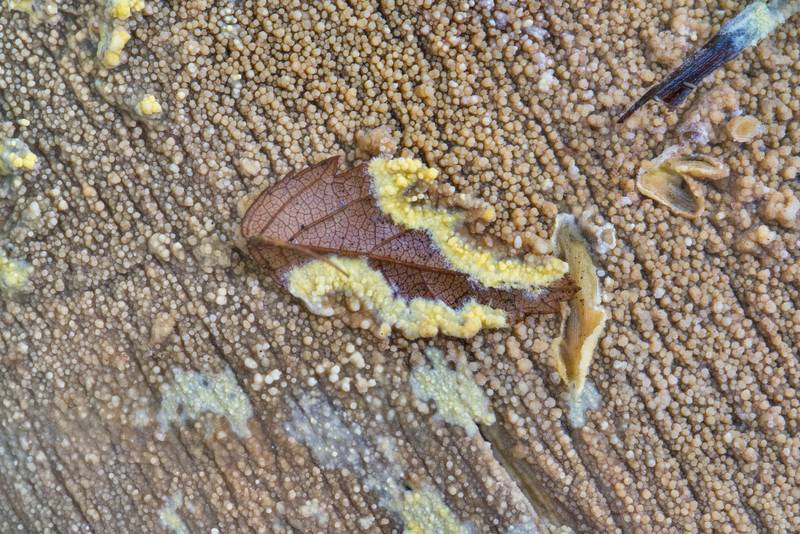
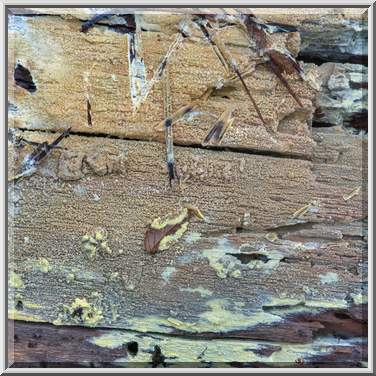
Corticioid fungus Resinicium bicolor(?) on a large fallen pine on Little Lake Creek Loop Trail in Sam Houston National Forest. Richards, Texas


Album 2264: College Station - Sam Houston Forest, Texas, May 22 - 23, 2018
The image shows a close-up view of a Corticioid fungus Resinicium bicolor(? growing on a large fallen pine tree trunk. The fungus has grown over the entire surface of the trunk and appears to be covering all other features that were once visible.
**Fungal Characteristics**
* **Color:** Yellowish-brown
* **Texture:** Irregularly shaped, with some areas appearing more densely packed than others.
* **Size:** Small, ranging from a few millimeters to several centimeters in diameter.
The fungus appears to be growing on top of the pine tree's bark, rather than underneath it. The surface is covered in small, yellowish-brown bumps that are likely the fruiting bodies of the fungus. These bumps are irregularly shaped and vary in size, with some being larger than others.
**Bark Characteristics**
* **Color:** Brown
* **Texture:** Smooth to rough, depending on the area.
* **Pattern:** Scaly or flaky pattern visible in some areas.
The bark of the pine tree is brown and has a smooth to rough texture. In some areas, it appears to have a scaly or flaky pattern, which may be due to the fungus growing on top of it. The bark also has some cracks and crevices that could provide habitat for other organisms.
**Overall Appearance**
* **Color:** Predominantly yellowish-brown, with some brown areas visible.
* **Texture:** Irregularly shaped bumps covering the entire surface.
* **Pattern:** Scaly or flaky pattern visible in some areas.
The overall appearance of the image suggests that the fungus has completely covered the pine tree trunk, leaving no other features visible. The yellowish-brown color and irregularly shaped bumps give the impression of a dense growth of fungal material. – AI vision
🇪🇸 Descripción en español / Spanish Description
Hongo corticial Resinicium bicolor (?) en un gran pino caído del Little Lake Creek Loop Trail en el bosque nacional Sam Houston, Richards, Texas, el 23 de mayo de 2018. La imagen muestra una vista detallada de un hongo corticial Resinicium bicolor(? que crece en un gran tronco de pino caído. El hongo ha crecido por toda la superficie del tronco y parece estar cubriendo todas las otras características que solían ser visibles. **Características del hongo** * **Color:** Parduzco amarillento * **Textura:** Con forma irregular, con algunas áreas que aparecen más densamente empaquetadas que otras. * **Tamaño:** pequeña, variando de unos pocos milímetros a varios centímetros de diámetro. El hongo parece estar creciendo sobre la corteza del árbol de pino, en lugar de debajo de ella. La superficie está cubierta con pequeñas protuberancias parduzcas amarillentas que son probablemente los cuerpos fructíferos del hongo. Estas protuberancias tienen una forma irregular y varían en tamaño, siendo algunas más grandes que otras. **Características de la corteza** * **Color:** Marrón * **Textura:** Desde suave a áspera, dependiendo del área. * **Patrón:** Patrón escamoso o descamativo visible en algunas áreas. La corteza del árbol de pino es marrón y tiene una textura de suave a áspera. En algunas áreas, parece tener un patrón escamoso o descamativo, lo que podría deberse al hongo creciendo encima. La corteza también tiene grietas y hendiduras que podrían proporcionar hábitat a otros organismos. **Apariencia general** * **Color:** Predominantemente parduzco amarillento, con algunas áreas marrones visibles. * **Textura:** Con protuberancias de forma irregular que cubren toda la superficie. * **Patrón:** Patrón escamoso o descamativo visible en algunas áreas. La apariencia general de la imagen sugiere que el hongo ha cubierto por completo el tronco del árbol de pino, dejando sin ver otras características. El color parduzco amarillento y las protuberancias irregulares dan la impresión de un crecimiento denso de material fúngico. – Spanish translation