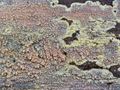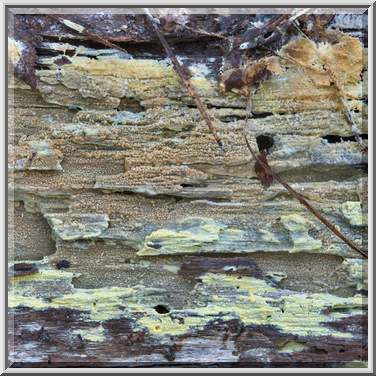
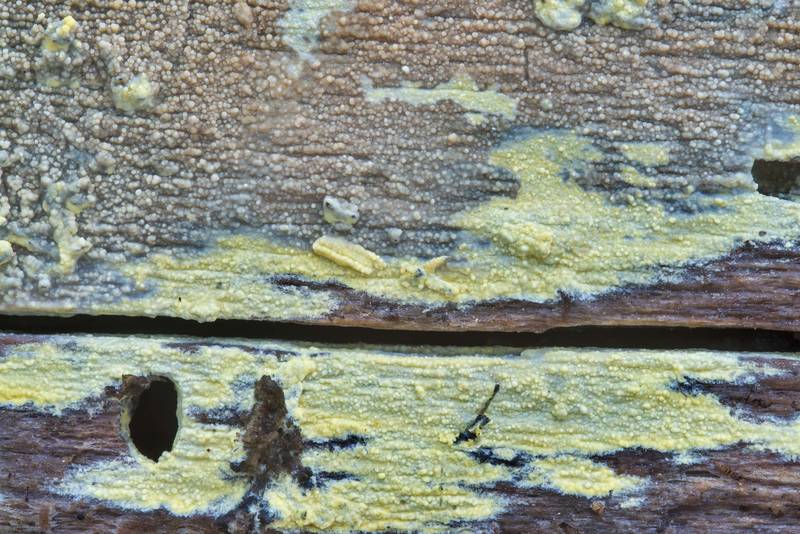

Details of corticioid fungus Resinicium bicolor(?) on a large fallen pine on Little Lake Creek Loop Trail in Sam Houston National Forest. Richards, Texas


Album 2264: College Station - Sam Houston Forest, Texas, May 22 - 23, 2018
The image presents a close-up view of a corticioid fungus, specifically Resinicium bicolor(?) growing on the surface of a large fallen pine tree located along Little Lake Creek Loop Trail in Sam Houston National Forest, Texas. The photograph was taken by an amateur mycologist on May 23, 2018.
**Key Observations:**
* **Fungus Appearance:** The fungus exhibits a pale yellowish color and is characterized by a spongy texture.
* **Growth Pattern:** It appears to be growing in patches or irregularly distributed across the surface of the tree. Some areas display a more uniform growth pattern, while others are less dense.
* **Tree Surface Features:** The tree's bark features two deep cracks that run parallel to each other, with the fungus visible within and between these cracks.
* **Background:** The background of the image shows more of the tree's surface, including small twigs or branches embedded in the bark.
**Contextual Information:**
* **Location:** Sam Houston National Forest, Texas
* **Date:** May 23, 2018
* **Photographer:** Amateur mycologist
The image provides a detailed view of Resinicium bicolor(?) growth on a fallen pine tree in a national forest setting. The fungus's appearance and growth pattern are notable features of the image. – AI vision
🇪🇸 Descripción en español / Spanish Description
Detalles del hongo corticioide Resinicium bicolor (?) sobre un pino grande caído en el Little Lake Creek Loop Trail en la Sam Houston National Forest. Richards, Texas, 23 de mayo de 2018. La imagen presenta una vista cercana de un hongo corticioide, específicamente Resinicium bicolor (?) creciendo sobre la superficie de un pino grande caído ubicado a lo largo del Little Lake Creek Loop Trail en Sam Houston National Forest, Texas. La fotografía fue tomada por un micólogo aficionado el 23 de mayo de 2018. **Observaciones clave:** * **Apariencia del hongo:** El hongo exhibe un color amarillento pálido y se caracteriza por una textura esponjosa. * **Patrón de crecimiento:** Parece estar creciendo en parches o distribuido irregularmente a lo largo de la superficie del árbol. Algunas áreas presentan un patrón de crecimiento más uniforme, mientras que otras son menos densas. * **Características de la superficie del árbol:** La corteza del árbol cuenta con dos grietas profundas que corren paralelas entre sí, siendo visible el hongo en ellas y entre las mismas. * **Contexto:** El fondo de la imagen muestra más de la superficie del árbol, incluyendo pequeños ramales o ramitas incrustados en la corteza. **Información contextual:** * **Ubicación:** Sam Houston National Forest, Texas * **Fecha:** 23 de mayo de 2018 * **Fotógrafo:** Micólogo aficionado La imagen muestra una vista detallada del crecimiento de Resinicium bicolor (?) en un pino grande caído en un bosque nacional. La apariencia y el patrón de crecimiento del hongo son características notables de la imagen. – Spanish translation