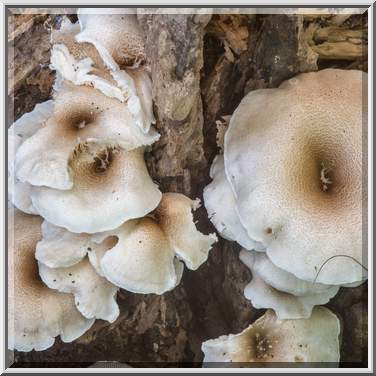
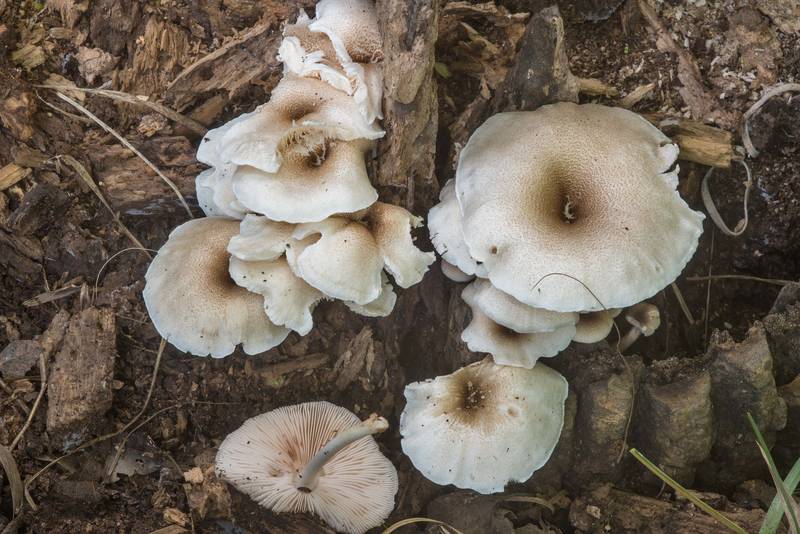

Group of tiger sawgill mushrooms (Lentinus tigrinus) and an upturned Pluteus on a rotting stump in Lick Creek ParkLick Creek: Background Notes. College Station, Texas


Album 2273: Mushrooms in Lick Creek Park, College Station, Texas, May 28, 2018
The image presents a close-up view of various mushrooms growing on a rotting stump, with several prominent species visible.
**Mushroom Identification**
* **Tiger Sawgill Mushrooms (Lentinus tigrinus)**: The largest mushrooms in the foreground exhibit distinctive brownish-gray caps and stems. Their caps are characterized by their light tan to cream color, often featuring darker brown or grayish-brown patches or zones. The stems are typically pale-colored.
* **Pluteus**: A smaller mushroom with a white cap is partially visible at the bottom of the image. It features a lighter-colored stem and lacks the brownish-gray tones seen in the Tiger Sawgill Mushrooms.
**Background**
The background consists of rotting wood debris, including twigs and leaves. The overall atmosphere suggests a damp, humid environment conducive to fungal growth.
**Conclusion**
In summary, the image showcases a diverse array of mushrooms thriving on a decaying stump in Lick Creek Park. Two prominent species are identified: Tiger Sawgill Mushrooms (Lentinus tigrinus) and Pluteus. The background features rotting wood debris, indicating a humid environment supportive of fungal growth. – AI vision
🇪🇸 Descripción en español / Spanish Description
Un grupo de hongos de dientes de tigre (Lentinus tigrinus) y un Pluteus boca arriba en un tronco podrido en Lick Creek Park. College Station, Texas, 28 de mayo de 2018. La imagen presenta una vista cercana de varios hongos creciendo en un tronco podrido, con varias especies prominentes visibles. **Identificación de Hongos** * **Hongos de dientes de tigre (Lentinus tigrinus)**: Los hongos más grandes en primer plano presentan sombreros y tallos parduscos-grisáceos distintivos. Sus sombreros se caracterizan por su color tostado claro a crema, a menudo con parches o zonas marrones oscuras o grisáceas. Los tallos son típicamente de color pálido. * **Pluteus**: Un hongo más pequeño con un sombrero blanco es parcialmente visible en la parte inferior de la imagen. Tiene un tallo de color más claro y carece de tonos marrones oscuros o grisáceos presentes en los Hongos de dientes de tigre. **Antecedentes** El fondo consta de restos de madera podrida, incluidas ramitas y hojas. La atmósfera general sugiere un entorno húmedo y húmedo propicio para el crecimiento fúngico. **Conclusión** En resumen, la imagen muestra una diversidad de hongos que prosperan en un tronco podrido en Lick Creek Park. Se identifican dos especies prominentes: Hongos de dientes de tigre (Lentinus tigrinus) y Pluteus. El fondo presenta restos de madera podrida, lo que indica un entorno húmedo propicio para el crecimiento fúngico. – Spanish translation