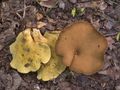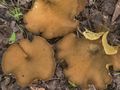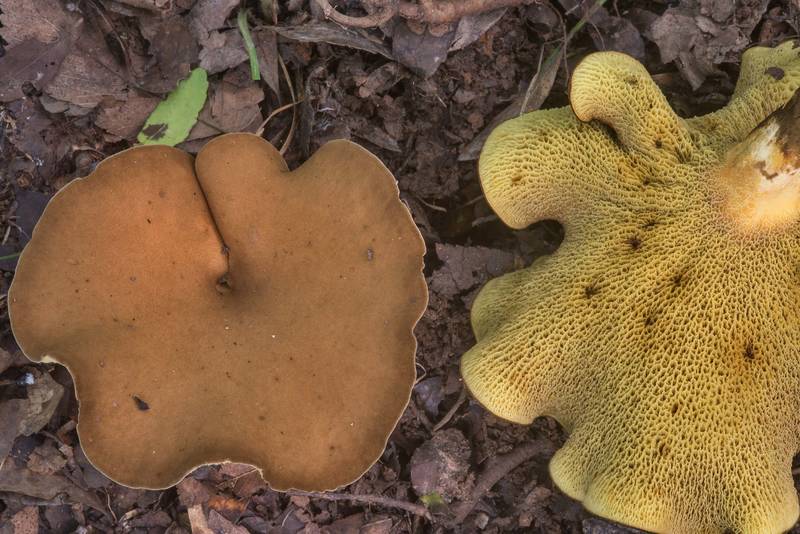

Ash-tree bolete mushrooms (Boletinellus merulioides) in Lick Creek ParkLick Creek: Background Notes. College Station, Texas


Album 2274: College Station, Texas, May 30, 2018
The image presents a close-up view of two mushrooms situated on the ground amidst fallen leaves and twigs. The mushroom positioned at the center is characterized by its dark brown cap, which features a somewhat irregular shape with slightly wavy edges. The stem appears to be shorter than the cap, and it is not visible in this particular shot.
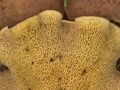
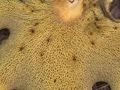
Upon closer inspection, the upper surface of the cap exhibits small pores that are arranged in an intricate pattern. This pattern consists of numerous tiny holes, each surrounded by an outer layer of tissue that contributes to the overall structure of the mushroom.
The lower part of the mushroom's body is covered with a dense network of fibers, which resembles a fine mesh or lace-like material. These fibers are likely responsible for absorbing nutrients from the surrounding environment and supporting the growth of the fungus.
In addition to the mushrooms, the image reveals an assortment of dry leaves and twigs scattered about. Some of these leaves appear to be partially covered by the cap of one of the mushrooms, suggesting that they may have been recently disturbed or uprooted.
Overall, this photograph provides a detailed glimpse into the intricate details of these fascinating organisms, showcasing their unique characteristics and adaptations for survival in their natural habitat. – AI vision
🇪🇸 Descripción en español / Spanish Description
Los hongos de la corteza del sauce (Boletinellus merulioides) en Lick Creek Park. College Station, Texas, May 30, 2018. La imagen presenta una vista detallada de dos hongos situados en el suelo entre las hojas caídas y los trozos de ramas. El hongo posicionado en el centro se caracteriza por su sombrero marrón oscuro, que tiene una forma algo irregular con bordes ligeramente ondulados. El tallo parece ser más corto que el sombrero, y no es visible en esta toma particular. Al inspeccionarlo de cerca, la superficie superior del sombrero muestra pequeños poros dispuestos en un patrón complejo. Este patrón consiste en numerosos orificios pequeños, cada uno rodeado por una capa externa de tejido que contribuye a la estructura general del hongo. La parte inferior del cuerpo del hongo está cubierta con una densa red de fibras, que se asemeja a una malla fina o un material similar al encaje. Es probable que estas fibras sean responsables de absorber los nutrientes del entorno circundante y soportar el crecimiento del hongo. Además de los hongos, la imagen muestra una variedad de hojas secas y trozos de ramas dispersados. Algunas de estas hojas parecen estar parcialmente cubiertas por la parte superior de uno de los hongos, lo que sugiere que pueden haber sido recientemente perturbadas o arrancadas. En general, esta fotografía proporciona una vista detallada de los complejos detalles de estos fascinantes organismos, mostrando sus características únicas y adaptaciones para la supervivencia en su hábitat natural. – Spanish translation