
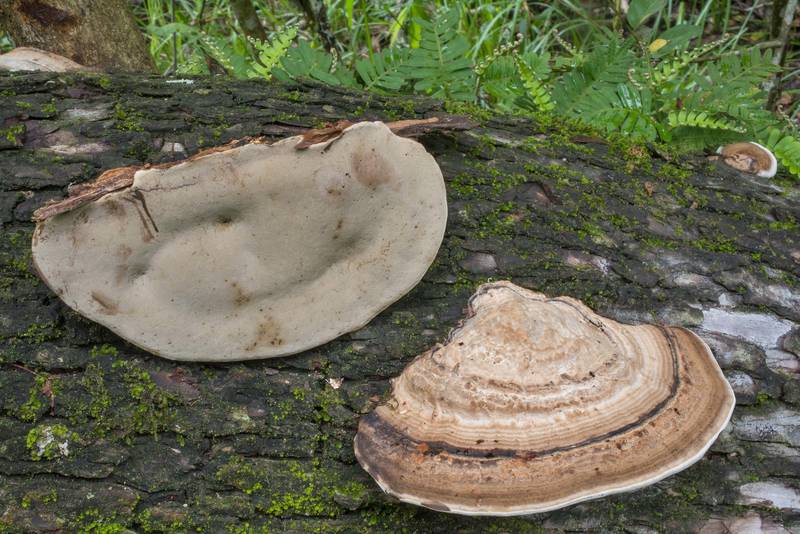

Underside of a polypore mushroom Fomes fasciatus on a fallen oak in Lick Creek ParkLick Creek: Background Notes. College Station, Texas


Album 2282: College Station, Texas, June 4, 2018
The image presents a detailed view of a polypore mushroom, specifically Fomes fasciatus, growing on the underside of a fallen oak tree in Lick Creek Park, College Station, Texas. The photograph captures various aspects of the mushroom's growth and its interaction with the surrounding environment.
**Mushroom Growth**
* **Underside**: The underside of the mushroom is visible in the image, showcasing its white to light gray coloration.
* **Shape**: The shape of the mushroom resembles a shield or fan, with a broad base that tapers towards the top.
* **Size**: The size of the mushroom is not explicitly stated but appears to be relatively large compared to other mushrooms.
**Tree and Environment**
* **Oak Tree**: The mushroom is growing on the underside of a fallen oak tree, which has been lying on the ground for some time. The bark of the tree is rough and weathered, indicating that it has been exposed to the elements.
* **Lichen and Moss**: Lichens and moss are visible on the surface of the tree trunk, suggesting a humid environment with adequate moisture levels.
* **Grasses and Ferns**: In the background, various grasses and ferns can be seen growing around the base of the fallen oak. These plants appear to be healthy and well-established.
**Other Details**
* **Texture**: The texture of the mushroom is smooth and even, with no visible ridges or bumps.
* **Coloration**: In addition to the white to light gray coloration on the underside, the top surface of the mushroom has a brownish-red hue.
* **Stem**: There is no visible stem connecting the mushroom to the tree. This suggests that the mushroom may have grown directly from the surface of the tree.
**Conclusion**
In conclusion, the image provides a detailed view of a polypore mushroom growing on the underside of a fallen oak tree in Lick Creek Park. The mushroom's unique shape and coloration are evident, as well as its interaction with the surrounding environment. Overall, the image offers valuable insights into the life cycle and ecology of this particular species of fungus. – AI vision
🇪🇸 Descripción en español / Spanish Description
El lado inferior de un hongo poliporo Fomes fasciatus en un roble caído en Lick Creek Park. College Station, Texas, 4 de junio de 2018. La imagen presenta una vista detallada de un hongo poliporo, específicamente el Fomes fasciatus, que crece en la parte inferior de un roble caído en Lick Creek Park, College Station, Texas. La fotografía captura varios aspectos del crecimiento del hongo y su interacción con el entorno circundante. **Crecimiento del hongo** * **Parte Inferior**: En la imagen se puede ver la parte inferior del hongo, que muestra su coloración blanca a gris claro. * **Forma**: La forma del hongo recuerda a un escudo o a un abanico, con una base ancha que se estrecha hacia arriba. * **Tamaño**: El tamaño del hongo no se indica explícitamente, pero parece ser relativamente grande en comparación con otros hongos. **Árbol y entorno** * **Roble**: El hongo crece en la parte inferior de un roble caído, que ha estado tendido en el suelo durante algún tiempo. La corteza del árbol es áspera y desgastada, lo que indica que se ha expuesto a los elementos. * **Lichens y musgo**: En la superficie del tronco del árbol son visibles lichens y musgo, sugerido un entorno húmedo con niveles de humedad adecuados. * **Hierbas y helechos**: Al fondo se pueden ver varias hierbas y helechos creciendo alrededor de la base del roble caído. Las plantas parecen sanas y establecidas. **Otros detalles** * **Textura**: La textura del hongo es lisa e uniforme, sin arrugas ni bultos visibles. * **Coloración**: Además de la coloración blanca a gris claro en la parte inferior, la superficie superior del hongo tiene un tono marrón rojizo. * **Tallo**: No se observa tallo que conecte el hongo al árbol. Esto sugiere que el hongo podría haber crecido directamente desde la superficie del árbol. **Conclusión** En conclusión, la imagen proporciona una vista detallada de un hongo poliporo creciendo en la parte inferior de un roble caído en Lick Creek Park. La forma y coloración únicas del hongo son evidentes, así como su interacción con el entorno circundante. En general, la imagen ofrece información valiosa sobre el ciclo vital y la ecología de esta especie particular de hongo. – Spanish translation


