
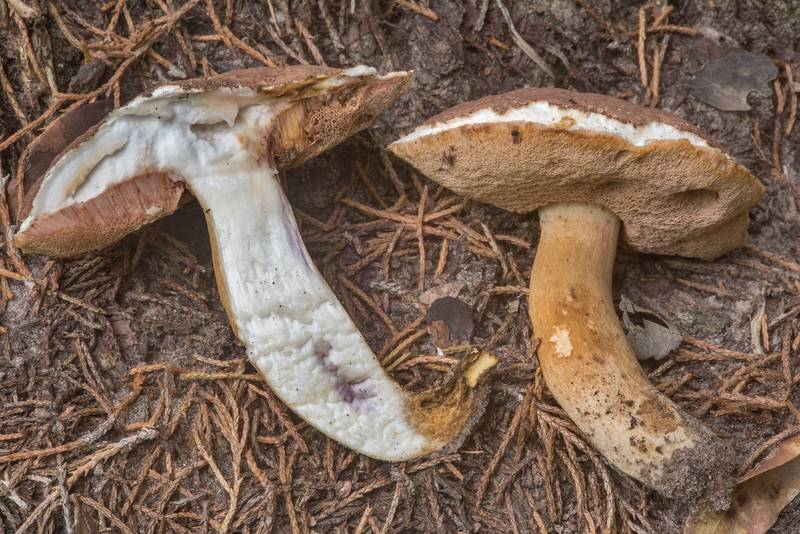

Dissected brown bitter bolete mushroom (Tylopilus) in Lick Creek ParkLick Creek: Background Notes. College Station, Texas


Album 2286: Mushrooms in Lick Creek Park, College Station, Texas, June 10, 2018
The image shows a dissected brown bitter bolete mushroom, specifically Tylopilus. The mushroom has been cut open to reveal its internal structure and coloration.
**Key Features:**
* **Cap:** The cap is brown with white spots on top.
* **Stem:** The stem is light brown with darker brown rings near the base.
* **Gills:** The gills are white, crowded, and free from attachment to the stem.
* **Spores:** The spores are dark brown and elliptical in shape.
**Internal Structure:**
* **Pore Surface:** The pore surface of the mushroom is covered with small, rounded pores that are white or light-colored.
* **Flesh:** The flesh of the mushroom is firm and fibrous, with a slightly bitter taste when raw.
**Habitat:**
* **Forest Floor:** The mushroom grows on the forest floor in association with coniferous trees.
* **Deciduous Trees:** It can also be found growing near deciduous trees, particularly oak and beech.
**Ecological Role:**
* **Saprotrophic:** The brown bitter bolete is a saprotrophic fungus that obtains its nutrients by breaking down organic matter in the soil.
* **Nutrient Cycle:** It plays an important role in decomposing organic matter and recycling nutrients back into the ecosystem.
**Culinary Use:**
* **Edibility:** The mushroom is considered edible, but it has a bitter taste when raw.
* **Cooking Methods:** It can be cooked to reduce its bitterness and make it more palatable.
* **Traditional Medicine:** In some cultures, the brown bitter bolete is used in traditional medicine for its supposed health benefits.
Overall, the brown bitter bolete is an interesting species that plays an important role in the ecosystem. Its unique characteristics and ecological niche make it a valuable component of the forest floor. – AI vision
🇪🇸 Descripción en español / Spanish Description
Cogió un hongo Tylopilus en el Parque Lick Creek. College Station, Texas, el 10 de junio del 2018. La imagen muestra un hongo Tylopilus seccionado, específicamente. El hongo ha sido abierto para mostrar su estructura interna y coloración. **Características Clave:** * **Sombrero:** El sombrero es marrón con manchas blancas en la parte superior. * **Tallo:** El tallo es de color marrón claro con anillos más oscuros cerca de la base. * **Poros:** Los poros son de color blanco, apiñados y no están unidos al tallo. * **Esporas:** Las esporas son de color marrón oscuro y de forma elíptica. **Estructura Interna:** * **Superficie Porencéntrica:** La superficie poréncetrica del hongo está cubierta con poros pequeños y redondos que son de color blanco o claro. * **Carne:** La carne del hongo es firme y fibrosa, con un sabor ligeramente amargo cuando cruda. **Hábitat:** * **Suelo del Bosque:** El hongo crece en el suelo del bosque en asociación con árboles de coníferas. * **Árboles de Hoja Caduca:** También puede encontrarse creciendo cerca de árboles de hoja caduca, particularmente roble y hayas. **Papel Ecológico:** * **Saprotrofo:** El hongo marrón amargo es un saprotrofo que obtiene sus nutrientes al descomponer la materia orgánica en el suelo. * **Ciclo de Nutrientes:** Juega un papel importante en la descomposición de la materia orgánica y en reciclar los nutrientes hacia el ecosistema. **Uso Culinario:** * **Comestibilidad:** El hongo es comestible, pero tiene un sabor amargo cuando crudo. * **Métodos de cocción:** Puede cocinarse para reducir su amargor y hacerlo más palatable. * **Medicina Tradicional:** En algunas culturas, el hongo marrón amargo se utiliza en la medicina tradicional por sus supuestos beneficios para la salud. En general, el hongo marrón amargo es una especie interesante que desempeña un papel importante en el ecosistema. Sus características únicas y su nicho ecológico lo convierten en un componente valioso del suelo del bosque. – Spanish translation


