Cutting of resupinate polypore mushrooms in Lick Creek ParkLick Creek: Background Notes. College Station, Texas


Album 2301: College Station, Texas, July 2 - 6, 2018
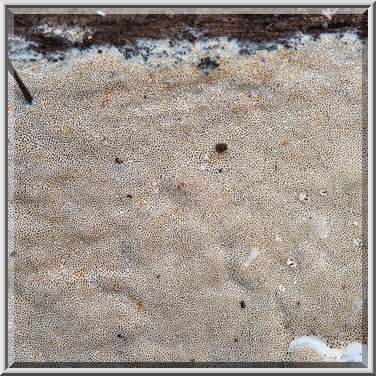
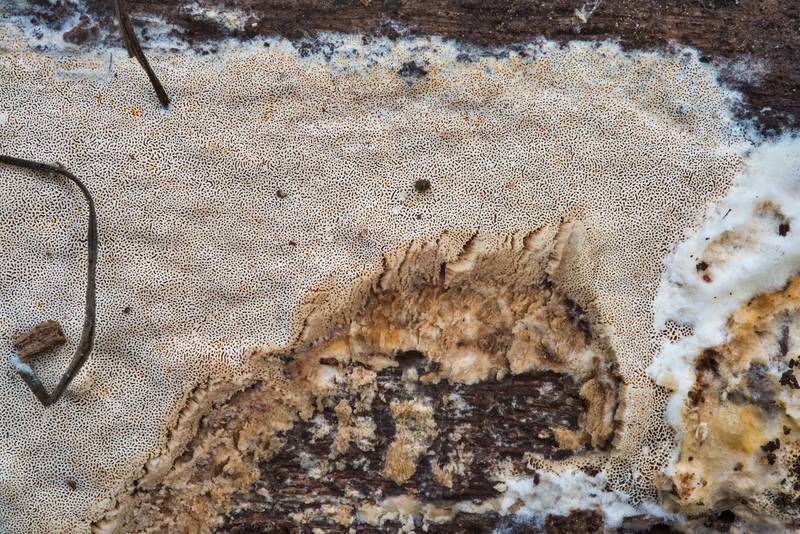
The image presents a detailed view of a cutting from a resupinate polypore mushroom growing on a tree trunk or log in Lick Creek Park, College Station, Texas. The photograph was taken by Dr. Matt Kasson, an Associate Professor at Texas A&M University.
**Key Features:**
* **Mushroom Type:** Resupinate polypores are characterized by their flat, shelf-like growth habit on the underside of logs or tree trunks. They do not form fruiting bodies above ground but instead produce spores on the undersurface of their sporophore.
* **Growth Medium:** The mushroom is growing on a decaying log or tree trunk, which provides it with the necessary nutrients for its development. Resupinate polypores are typically found in humid environments and can be associated with various types of wood decay.
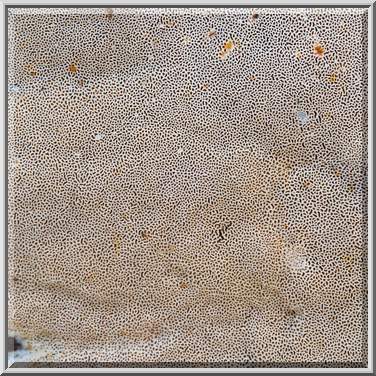
* **Spore Production:** The underside of the sporophore is covered with tiny holes or pores that release spores into the air. This process allows the fungus to disperse its genetic material and propagate itself.
* **Texture and Color:** The surface of the mushroom exhibits a soft, spongy texture and features irregularly shaped brownish patches with small white spots scattered throughout. The overall coloration is primarily light brown with hints of darker brown tones.
**Conclusion:**
This image provides a fascinating glimpse into the life cycle of resupinate polypore mushrooms. By understanding their unique characteristics and growth habits, we can appreciate the intricate relationships between fungi and their environments. – AI vision
🇪🇸 Descripción en español / Spanish Description
Cortando hongos poliporos resupinados en Lick Creek Park. College Station, Texas, 6 de julio de 2018. La imagen presenta una vista detallada de un corte de un hongo poliporo resupinado que crece sobre el tronco o la raíz de un árbol en Lick Creek Park, College Station, Texas. La fotografía fue tomada por el Dr. Matt Kasson, profesor asociado de la Universidad A&M de Texas. **Características clave:** * **Tipo de hongo:** Los poliporos resupinados se caracterizan por su hábitat de crecimiento plano, parecido a estantes, en el lado inferior de troncos o raíces de árboles. No forman cuerpos fructíferos por encima del suelo, sino que producen esporas en la parte inferior de su esporóforo. * **Medio de crecimiento:** El hongo está creciendo sobre una raíz o tronco en descomposición, lo que le proporciona los nutrientes necesarios para su desarrollo. Los poliporos resupinados se encuentran normalmente en entornos húmedos y pueden estar asociados con diversos tipos de descomposición de la madera. * **Producción de esporas:** El lado inferior del esporóforo está cubierto por pequeños agujeros o poros que liberan esporas al aire. Este proceso permite que el hongo disperse su material genético y se reproduzca. * **Textura y color:** La superficie del hongo presenta una textura blanda y esponjosa y cuenta con manchas marrones irregularmente formadas con pequeñas manchas blancas dispersas por todo el mismo. El color predominante es pardo claro, con matices más oscuros de pardo. **Conclusión:** Esta imagen ofrece una visión fascinante del ciclo vital de los hongos poliporos resupinados. Al comprender sus características y hábitats únicos, podemos apreciar las relaciones intrincadas entre los hongos y su entorno. – Spanish translation