
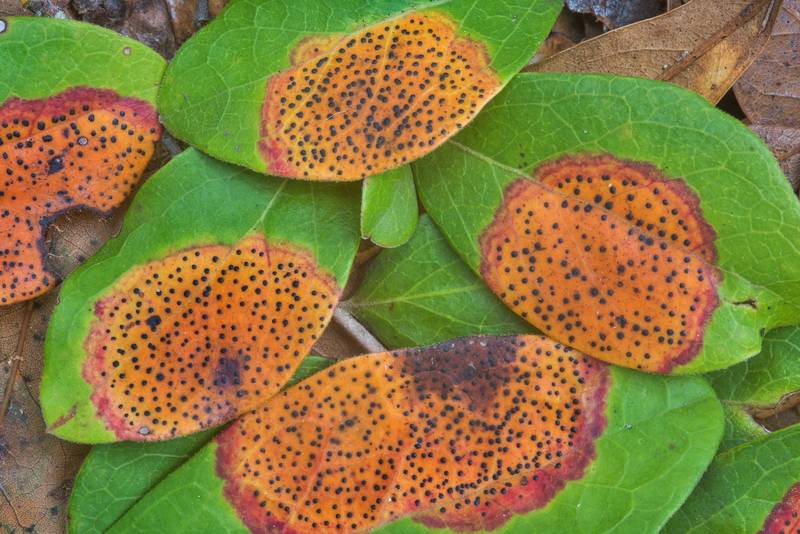

Blister-like fruiting structures of fungus Ophiodothella vaccinii on infected leaves of farkleberry (Vaccinium arboreum) in Lick Creek ParkLick Creek: Background Notes. College Station, Texas


Album 2378: College Station, Texas, October 9, 2018
The image presents a close-up view of several green leaves, partially covered with orange and red spots. These spots are characterized by black dots arranged in a circular pattern, resembling blister-like fruiting structures of the fungus Ophiodothella vaccinii. The infected leaves exhibit a predominantly green coloration, with some areas displaying reddish hues.
Upon closer inspection, it becomes apparent that the fungus has formed small blisters on the leaf surface, which are likely responsible for the orange and red discolorations. These blisters contain black dots that resemble fungal spores or reproductive structures.
The leaves appear to be arranged in a natural setting, possibly on the ground or attached to a branch. The surrounding environment is not clearly visible, but it appears to be outdoors, given the presence of fallen leaves and the foliage's coloration.
The image provides a detailed view of the fungus Ophiodothella vaccinii infecting farkleberry (Vaccinium arboreum) leaves in Lick Creek Park. The close-up perspective allows for an examination of the fungus's effects on the plant, including the formation of blisters and discoloration.
Overall, the image offers a unique glimpse into the interaction between the fungus Ophiodothella vaccinii and its host plant, farkleberry, highlighting the potential impacts of fungal infections on plant health. – AI vision
🇪🇸 Descripción en español / Spanish Description
Las estructuras de frutos parecidas a ampollas del hongo Ophiodothella vaccinii en las hojas infectadas de arándano (Vaccinium arboreum) en Lick Creek Park. College Station, Texas, el 9 de octubre de 2018. La imagen presenta una vista cercana de varias hojas verdes, parcialmente cubiertas con manchas naranjas y rojas. Estas manchas se caracterizan por puntos negros dispuestos en un patrón circular, que recuerdan a las estructuras fúngicas parecidas a ampollas del hongo Ophiodothella vaccinii. Las hojas infectadas muestran una coloración predominantemente verde, con algunas áreas que presentan matices rojizos. Al inspeccionarlas más de cerca, resulta evidente que el hongo ha formado pequeñas ampollas en la superficie de las hojas, lo que es probablemente responsable de las decoloraciones naranjas y rojas. Estas ampollas contienen puntos negros que se asemejan a esporas fúngicas o estructuras reproductivas. Las hojas parecen estar dispuestas en un entorno natural, posiblemente en el suelo o unidas a un ramal. El entorno circundante no es claramente visible, pero parece estar al aire libre, dado la presencia de hojas caídas y la coloración del follaje. La imagen proporciona una vista detallada del hongo Ophiodothella vaccinii infectando hojas de arándano (Vaccinium arboreum) en Lick Creek Park. La perspectiva cercana permite un examen de los efectos del hongo sobre la planta, incluyendo la formación de ampollas y decoloraciones. En general, la imagen ofrece una visión única de la interacción entre el hongo Ophiodothella vaccinii y su planta huésped, el arándano, destacando los posibles impactos de las infecciones fúngicas en la salud de las plantas. – Spanish translation


