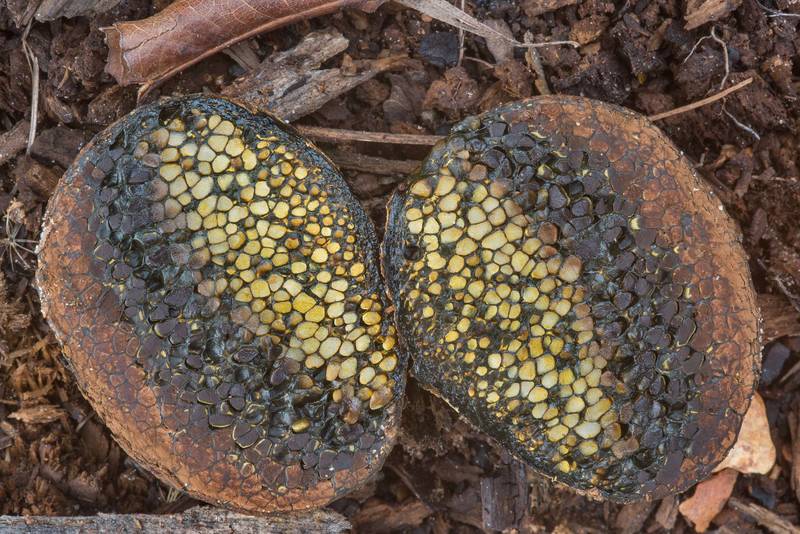

Dyeball mushroom (Pisolithus arhizus, Pisolithus tinctorius) in Bastrop State Park. Bastrop, Texas


Album 2381: Bastrop State Park, Texas, October 14, 2018
The image showcases a close-up view of two Dyeball mushrooms (Pisolithus arhizus and Pisolithus tinctorius) situated on the ground. The mushrooms are characterized by their distinctive appearance, featuring:
* A dark brown to black outer layer that resembles a cracked shell or a thick skin
* Small holes scattered across the surface, giving it a somewhat rough texture
The interior of the mushroom is notable for its unique coloration and structure. It has a white to pale yellow hue with darker spots, resembling an egg yolk. The interior also exhibits small pores or tiny holes that are visible through the outer layer.
In the background, there appears to be some twigs and dry leaves scattered about, suggesting that the mushrooms are growing in a wooded area or forest floor. The overall atmosphere of the image conveys a sense of autumnal decay and the beginning of winter, as indicated by the presence of dead plant material on the ground.
The Dyeball mushroom is an unusual species known for its distinctive appearance and unique properties. It has been used historically for dyeing fabrics and other materials due to its ability to produce a range of colors when exposed to water or heat. The mushroom's ability to change color in response to environmental conditions makes it a fascinating subject for study and observation.
Overall, the image provides a detailed look at this intriguing fungus, highlighting its unique characteristics and natural habitat. – AI vision
🇪🇸 Descripción en español / Spanish Description
Hongo teñidor (Pisolithus arhizus, Pisolithus tinctorius) en el Parque Estatal de Bastrop. Bastrop, Texas, octubre 14, 2018. La imagen presenta una vista de cerca de dos hongos teñidores (Pisolithus arhizus y Pisolithus tinctorius) situados en el suelo. Los hongos se caracterizan por su apariencia distintiva, que presenta: * Una capa externa marrón oscuro a negro que recuerda una cáscara agrietada o una piel gruesa * Pequeños orificios dispersados en la superficie, lo que le da una textura un poco rugosa El interior del hongo es notable por su coloración y estructura únicas. Tiene un tono de blanco a amarillo pálido con manchas más oscuras, parecido al yema de un huevo. El interior también presenta pequeños poros u orificios visibles a través de la capa externa. En el fondo, parecen estar dispersos algunos vástagos y hojas secas, lo que sugiere que los hongos crecen en un área boscosa o en el suelo del bosque. La atmósfera general de la imagen transmite una sensación de descomposición otoñal y el comienzo del invierno, tal como indica la presencia de material vegetal muerto en el suelo. El hongo teñidor es una especie inusual conocida por su apariencia distintiva y propiedades únicas. Ha sido utilizado históricamente para teñir telas y otros materiales debido a su capacidad de producir un rango de colores cuando se expone al agua o al calor. La habilidad del hongo de cambiar de color en respuesta a las condiciones ambientales lo convierte en un objeto fascinante para estudiar y observar. En general, la imagen proporciona una mirada detallada a este hongo intrigante, destacando sus características únicas y su hábitat natural. – Spanish translation