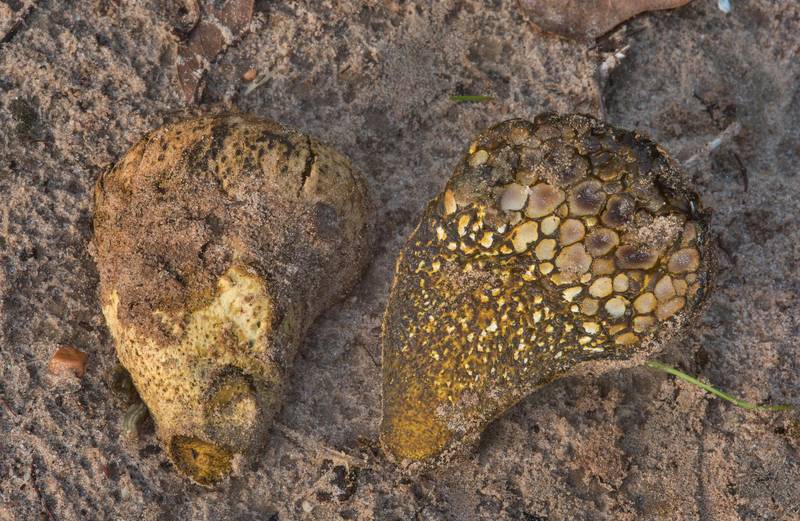

Dyeball mushroom (Pisolithus arhizus, Pisolithus tinctorius) on a sandy lawn in Lick Creek ParkLick Creek: Background Notes. College Station, Texas


Album 2359: College Station, Texas, September 17 - 18, 2018
The image depicts three large, irregularly shaped mushrooms lying on the ground. The mushroom at the top left is brown with yellow and dark spots, while the one at the bottom right has a golden hue with black spots. The mushroom to the right of the other two appears to be in a more advanced stage of decay.
The background of the image consists of sandy soil, suggesting that it was taken in a park or natural area. The overall appearance of the mushrooms and their surroundings implies that they are growing in a relatively dry environment, possibly due to the sandy soil conditions.
Based on the information provided by the caption, the mushrooms appear to be Dyeball mushrooms (Pisolithus arhizus or Pisolithus tinctorius). This species is known for its unique appearance and ability to thrive in various environments. The image provides a clear view of the mushroom's shape, coloration, and surroundings, making it an informative visual representation of this particular species.
The mention of Lick Creek Park and College Station, Texas, suggests that the image was taken on September 18, 2018, during a specific time of year when these mushrooms are likely to be found in the area. The combination of geographical information and temporal context adds depth to the image, allowing viewers to better understand the environmental conditions under which the Dyeball mushroom grows. – AI vision
🇪🇸 Descripción en español / Spanish Description
Hongo tintorero (Pisolithus arhizus, Pisolithus tinctorius) en un prado arenoso en el parque Lick Creek. College Station, Texas, 18 de septiembre de 2018. La imagen muestra tres hongos grandes y con formas irregulares que yacen sobre el suelo. El seta en la esquina superior izquierda es marrón con manchas amarillas y oscuras, mientras que la que se encuentra en la esquina inferior derecha tiene un tono dorado con manchas negras. La seta a la derecha de las otras dos parece encontrarse en una etapa más avanzada de descomposición. El fondo de la imagen consta de suelo arenoso, lo que sugiere que fue tomada en un parque o área natural. La apariencia general de los hongos y sus alrededores indica que crecen en un entorno relativamente seco, posiblemente debido a las condiciones del suelo arenoso. En base a la información proporcionada por la leyenda, los hongos parecen ser hongos tintoreros (Pisolithus arhizus o Pisolithus tinctorius). Esta especie es conocida por su apariencia única y su capacidad para prosperar en diferentes entornos. La imagen proporciona una vista clara de la forma, coloración y los alrededores del hongo, lo que lo convierte en una representación visual informativa de esta especie particular. La mención de Lick Creek Park y College Station, Texas sugiere que la imagen fue tomada el 18 de septiembre de 2018, durante un momento determinado del año cuando es probable encontrar estos hongos en la zona. La combinación de información geográfica y contexto temporal agrega profundidad a la imagen, permitiendo a los espectadores entender mejor las condiciones ambientales bajo las cuales crece el hongo tintorero. – Spanish translation