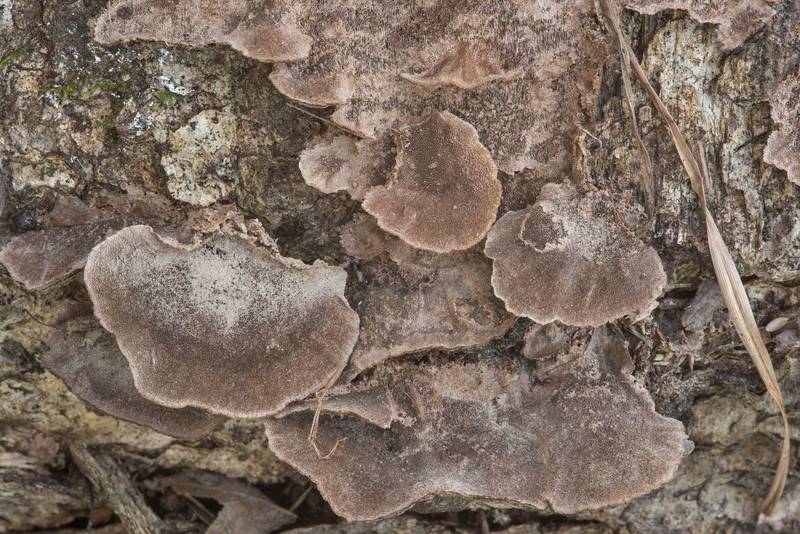
Polypore mushrooms Trichaptum sector on a fallen river birch in Lick Creek ParkLick Creek: Background Notes. College Station, Texas


Album 2418: College Station - Enchanted Rock, Texas, December 24 - 25, 2018
The image features a cluster of brown polypore mushrooms growing on the trunk of a fallen river birch tree in Lick Creek Park, College Station, Texas. The fungi have flat, round caps that are approximately the same size as other clusters in the image. They appear to be growing out of a crack or crevice in the bark of the tree. The brown coloration is likely due to their age and exposure to environmental factors.
The polypore mushrooms are characterized by their large, fan-shaped fruiting bodies with wavy edges. This distinctive shape sets them apart from other types of fungi. The caps of these mushrooms have a velvety texture, which contributes to their unique appearance.
In the background, the fallen river birch tree provides a natural habitat for the polypore mushrooms. The bark of the tree is rough and weathered, with visible cracks and crevices where the mushrooms are growing. This suggests that the tree has been dead or dying for some time, allowing the fungi to colonize its surface.
Overall, the image captures a moment in the life cycle of these polypore mushrooms, highlighting their unique characteristics and their ability to thrive in challenging environments. – AI vision
🇪🇸 Descripción en español / Spanish Description
Hongos Poliporales Trichaptum sector en un abedul caído en Lick Creek Park. College Station, Texas, 24 de diciembre de 2018. La imagen muestra una agrupación de hongos poliporales marrones que crecen en el tronco de un árbol abatido de abedul en Lick Creek Park, College Station, Texas. Los hongos tienen tapas planas y redondas del mismo tamaño que otras agrupaciones en la imagen. Parece que están creciendo fuera de una grieta o hendidura en la corteza del árbol. La coloración marrón se debe probablemente a su edad y exposición a factores ambientales. Los hongos poliporales se caracterizan por sus grandes cuerpos fructíferos en forma de abanico con bordes ondulados. Esta forma distintiva los diferencia de otros tipos de hongos. Las tapas de estos hongos tienen una textura de terciopelo, lo que contribuye a su aspecto único. En segundo plano, el abedul caído proporciona un hábitat natural para los hongos poliporales. La corteza del árbol es áspera y weathered, con grietas y hendiduras donde crecen los hongos. Esto sugiere que el árbol ha estado muerto o muriendo durante algún tiempo, permitiendo que los hongos colonicen su superficie. En general, la imagen captura un momento en el ciclo de vida de estos hongos poliporales, destacando sus características únicas y su capacidad para prosperar en entornos desafiantes. – Spanish translation


