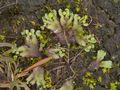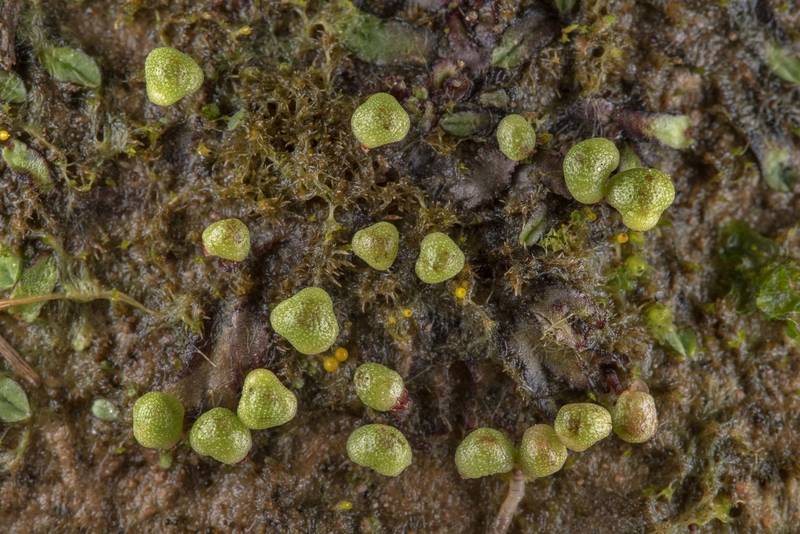
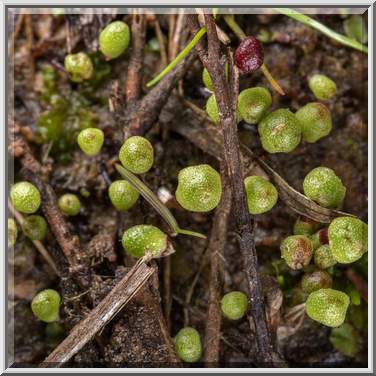
Liverwort Reboulia hemisphaerica on Post Oak Trail in Lick Creek ParkLick Creek: Background Notes. College Station, Texas


Album 2453: College Station, Texas, February 24 - 26, 2019
**Step 1: Identify the subject of the image**
The image shows a close-up view of a plant species called Reboulia hemisphaerica, commonly known as the northern hemisphere liverwort. It is a type of bryophyte that belongs to the family Rebouliaceae.
**Step 2: Analyze the habitat**
The background of the image appears to be damp soil with some small twigs and leaves scattered around. This suggests that the plant is growing in its natural habitat, likely in a forest or woodland area with moist soil conditions.
**Step 3: Observe the plant's structure**
Upon closer inspection, it can be seen that the Reboulia hemisphaerica has a distinctive rounded shape, with a flat top and a short stem. The leaves are small and oval-shaped, measuring approximately 0.5-1 cm in length.
**Step 4: Note any notable features or characteristics**
One notable feature of this plant is its ability to survive in areas with poor soil quality. Liverworts like Reboulia hemisphaerica can thrive on rocks, logs, and other surfaces that are not suitable for most plants.
**Conclusion:**
In conclusion, the image depicts a close-up view of Reboulia hemisphaerica growing in its natural habitat, demonstrating its unique characteristics and ability to adapt to challenging environments. – AI vision
🇪🇸 Descripción en español / Spanish Description
El hepático Reboulia hemisphaerica en el Post Oak Trail en Lick Creek Park. College Station, Texas, 24 de febrero del 2019. **Paso 1: Identificar el tema de la imagen** La imagen muestra una vista cercana de una especie de planta llamada Reboulia hemisphaerica, comúnmente conocida como hepático del hemisferio norte. Es un tipo de briofita que pertenece a la familia Rebouliaceae. **Paso 2: Analizar el hábitat** El fondo de la imagen parece ser suelo húmedo con algunos pequeños ramitos y hojas esparcidas alrededor. Esto sugiere que la planta está creciendo en su hábitat natural, probablemente en un bosque o área boscosa con condiciones de suelo húmedo. **Paso 3: Observar la estructura de la planta** Con una inspección más detallada, puede observarse que el Reboulia hemisphaerica tiene una forma redondeada distintiva, con una parte superior plana y un tallo corto. Las hojas son pequeñas y ovaladas, midiendo aproximadamente 0.5-1 cm de largo. **Paso 4: Observar cualquier característica o rasgo notable** Una característica notable de esta planta es su capacidad para sobrevivir en áreas con baja calidad del suelo. Los hepáticos como Reboulia hemisphaerica pueden prosperar en rocas, troncos y otras superficies que no son adecuadas para la mayoría de las plantas. **Conclusión:** En conclusión, la imagen muestra una vista cercana del Reboulia hemisphaerica creciendo en su hábitat natural, demostrando sus características únicas y capacidad para adaptarse a entornos desafiantes. – Spanish translation