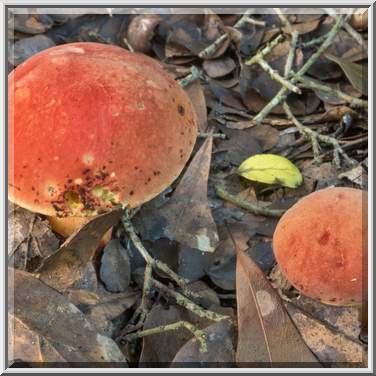
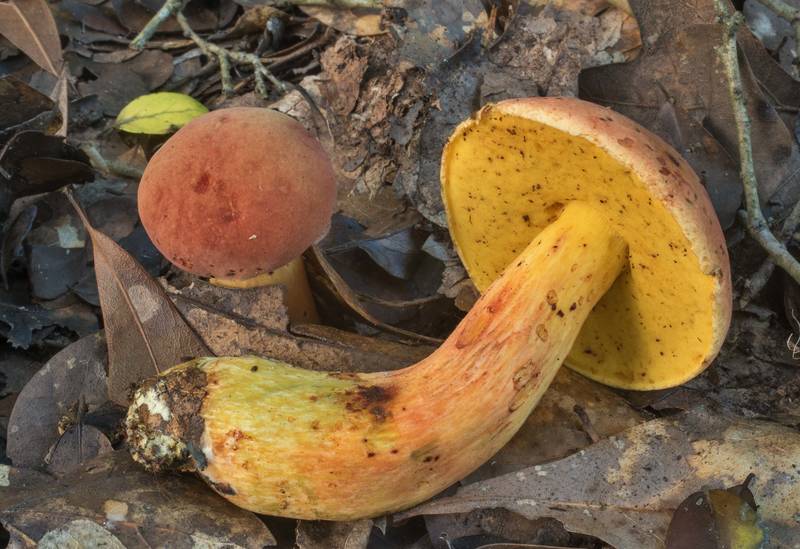
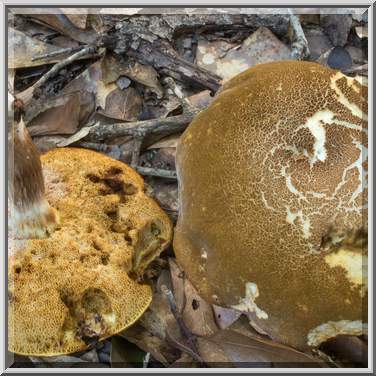
Underside of bolete mushrooms Pulchroboletus rubricitrinus (Boletus rubricitrinus) in Lick Creek ParkLick Creek: Background Notes. College Station, Texas


Album 2548: College Station, Texas, July 5, 2019
The image presents a close-up view of two bolete mushrooms, Pulchroboletus rubricitrinus (Boletus rubricitrinus), situated on the forest floor. The mushroom in the foreground is oriented vertically, with its underside facing upwards, revealing a bright yellow cap and stem base. Its gills are not visible, as they are hidden by the cap.
In contrast, the mushroom in the background appears to be lying horizontally, with its underside partially obscured by a fallen leaf. This mushroom also boasts a vibrant yellow cap and stem base, although some of its gills are visible through an opening at the base of the cap.
The mushrooms' caps are characterized by their reddish-brown coloration, which is typical of this species. The stems of both mushrooms are slender and pale in hue. The surrounding environment is composed of fallen leaves, twigs, and other forest debris, providing a natural setting for these wild mushrooms to thrive.
Overall, the image offers a detailed glimpse into the characteristics and habitat of Pulchroboletus rubricitrinus bolete mushrooms, showcasing their distinctive features and the conditions in which they grow. – AI vision
🇪🇸 Descripción en español / Spanish Description
El lado inferior de los hongos Bolete Pulchroboletus rubricitrinus (Boletus rubricitrinus) en Lick Creek Park. College Station, Texas, 5 de julio de 2019. La imagen presenta una vista cercana de dos hongos Bolete, Pulchroboletus rubricitrinus (Boletus rubricitrinus), situados sobre el suelo del bosque. El hongo en primer plano está orientado verticalmente, con su lado inferior mirando hacia arriba, revelando una tapa amarilla brillante y la base del tallo. Sus láminas no son visibles, ya que están ocultas por la tapa. Por el contrario, el hongo en segundo plano parece estar tendido horizontalmente, con su lado inferior parcialmente oculta por una hoja caída. Este hongo también ostenta una vibrante tapa amarilla y base del tallo, aunque algunas de sus láminas son visibles a través de una abertura en la base de la tapa. Las tapas de los hongos se caracterizan por su coloración parda rojiza, que es típica de esta especie. Los tallos de ambos hongos son delgados y de tonalidad pálida. El entorno circundante está compuesto por hojas caídas, ramitas y otros restos forestales, lo que proporciona un entorno natural para el crecimiento y la prosperidad de estos hongos silvestres. En general, la imagen ofrece una vista detallada de las características y el hábitat de los hongos Bolete Pulchroboletus rubricitrinus, mostrando sus rasgos distintivos y las condiciones en las que crecen. – Spanish translation