
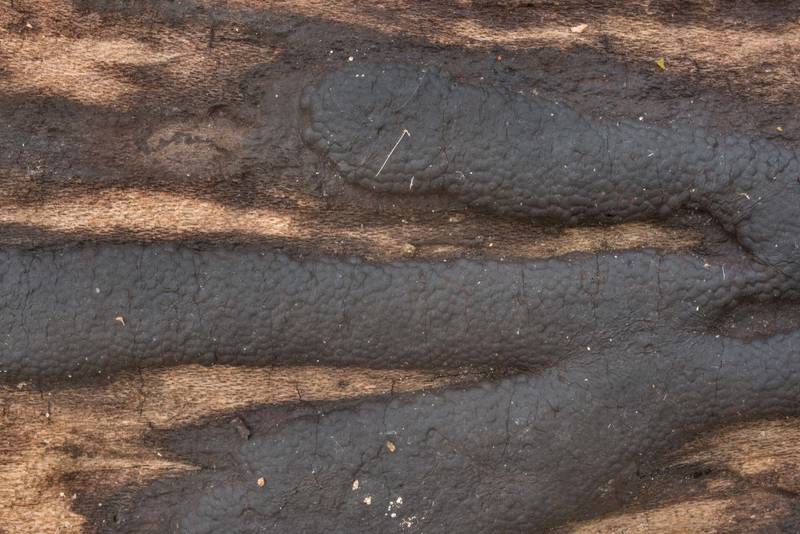

Black crust of Hypoxylon fungus on a tree branch on Winters Bayou Trail in Sam Houston National Forest. Cleveland, Texas


Album 2574: Sam Houston Forest near Cleveland, Texas, October 12, 2019
The image shows an up-close view of a black crust that has grown on a tree branch in the Sam Houston National Forest in Cleveland, Texas. The fungus is identified as Hypoxylon, which grows on dead or dying trees and can be harmful to them.
**Image Description**
* **Background**: The background of the image is a light brown color, likely representing the bark of the tree.
* **Foreground**: In the foreground, there are several black crusts that have grown on the surface of the tree branch. These crusts appear to be irregularly shaped and vary in size.
* **Fungus Growth Pattern**: The fungus growth pattern is characterized by a series of small, rounded bumps or nodules that cover much of the surface area. This suggests that the fungus has colonized the tree extensively.
* **Coloration**: The coloration of the image is primarily brown and black, with some lighter areas visible on the surface of the tree.
* **Overall Appearance**: The overall appearance of the image suggests that the tree branch is dead or dying, and the Hypoxylon fungus has taken advantage of this by colonizing it.
**Conclusion**
The image provides a detailed view of the Hypoxylon fungus growth pattern on a tree branch in the Sam Houston National Forest. The extensive colonization of the tree suggests that the fungus is causing damage to the tree, which may ultimately lead to its death. – AI vision
🇪🇸 Descripción en español / Spanish Description
Procédeme el favor de traducir el siguiente texto del inglés al español:
Corteza negra del hongo Hypoxylon en una rama de un árbol en Winters Bayou Trail en Sam Houston National Forest. Cleveland, Texas, 12 de octubre de 2019. La imagen muestra una vista detallada de una costra negra que ha crecido en una rama del árbol en el bosque nacional Sam Houston en Cleveland, Texas. El hongo se identifica como Hypoxylon, que crece en árboles muertos o moribundos y puede ser perjudicial para ellos. **Descripción de la imagen** * **Fondo**: El fondo de la imagen es de color marrón claro, probablemente representando la corteza del árbol. * **Primer plano**: En primer plano, hay varias costras negras que han crecido en la superficie de la rama del árbol. Estas costras parecen tener forma irregular y varían de tamaño. * **Patrón de crecimiento del hongo**: El patrón de crecimiento del hongo se caracteriza por una serie de pequeños resaltes o nódulos redondeados que cubren gran parte de la superficie del área. Esto sugiere que el hongo ha colonizado extensivamente el árbol. * **Coloración**: La coloración de la imagen es principalmente marrón y negro, con algunas áreas más claras visibles en la superficie del árbol. * **Aspetto generale**: El aspecto general de la imagen sugiere que la rama del árbol está muerta o moribunda, y el hongo Hypoxylon ha aprovechado esta situación colonizándolo. **Conclusión** La imagen proporciona una vista detallada del patrón de crecimiento del hongo Hypoxylon en una rama de un árbol en el bosque nacional Sam Houston. La extensa colonización del árbol sugiere que el hongo está causando daño al árbol, lo que puede conducir finalmente a su muerte. – Spanish translation


