
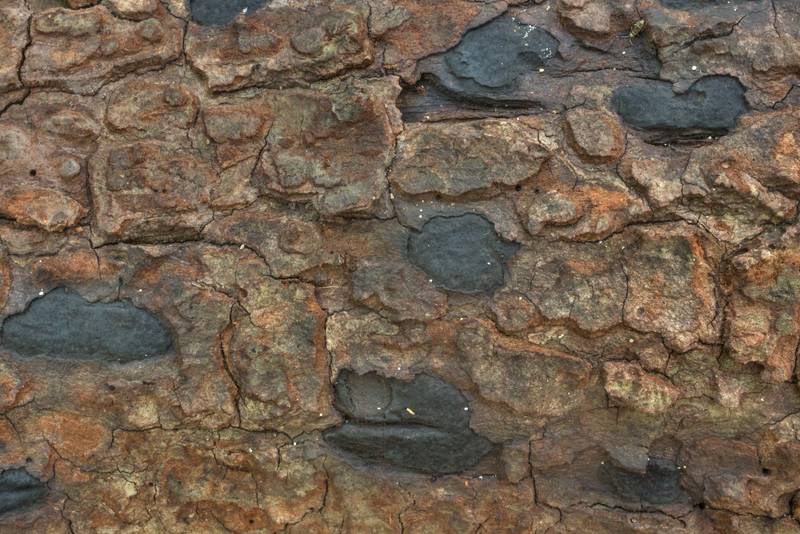

Black crust fungus Biscogniauxia on a fallen tree on Winters Bayou Trail in Sam Houston National Forest. Cleveland, Texas


Album 2575: Winters Bayou in Sam Houston Forest near Cleveland, Texas, October 12, 2019
The image depicts a close-up view of a fallen tree trunk situated on the Winters Bayou Trail within Sam Houston National Forest. The tree's surface is characterized by numerous dark spots, which are likely the result of black crust fungus (Biscogniauxia) growth.
Upon closer inspection, it becomes apparent that these dark spots are actually circular patches with slightly raised edges, measuring approximately 1-2 inches in diameter. These patches exhibit a smooth, flat texture and appear to be firmly attached to the tree's surface. Although the surrounding bark appears somewhat cracked and weathered, there is no visible evidence of recent damage or decay.
The overall appearance of the tree suggests that it has been lying on the ground for an extended period, potentially several years given its worn and weathered state. The presence of black crust fungus indicates that the environment surrounding the tree is conducive to the growth of this type of organism, which thrives in damp, humid conditions.
In conclusion, the image presents a detailed view of a fallen tree trunk covered with dark spots caused by the growth of black crust fungus. The tree's surface exhibits signs of weathering and decay, while the patches themselves appear firm and well-attached to the surrounding bark. – AI vision
🇪🇸 Descripción en español / Spanish Description
El hongo de costra negra Biscogniauxia en un árbol caído en el Winters Bayou Trail en la Sam Houston National Forest. Cleveland, Texas, 12 de octubre de 2019. La imagen muestra una vista cercana al tronco de un árbol caído ubicado en el Winters Bayou Trail dentro del bosque nacional de Sam Houston. La superficie del árbol está caracterizada por numerosas manchas oscuras, lo que es probablemente el resultado del crecimiento de hongos de costra negra (Biscogniauxia). Al inspeccionar más de cerca, se vuelve evidente que estas manchas oscuras son en realidad parches circulares con bordes ligeramente elevados, midiendo aproximadamente 1-2 pulgadas de diámetro. Estos parches presentan una textura suave y plana y parecen estar firmemente unidos a la superficie del árbol. Aunque la corteza circundante aparece algo agrietada y desgastada, no hay evidencia visible de daño o deterioro reciente. El aspecto general del árbol sugiere que ha estado tendido en el suelo durante un período prolongado, potencialmente varios años, dado su estado gastado y desgastado. La presencia de hongos de costra negra indica que el entorno que rodea al árbol es propicio para el crecimiento de este tipo de organismo, que prospera en condiciones húmedas y húmedas. En conclusión, la imagen presenta una vista detallada del tronco de un árbol caído cubierto con manchas oscuras causadas por el crecimiento de hongos de costra negra. La superficie del árbol exhibe signos de desgaste y deterioro, mientras que los parches en sí parecen firmes y bien unidos a la corteza circundante. – Spanish translation


