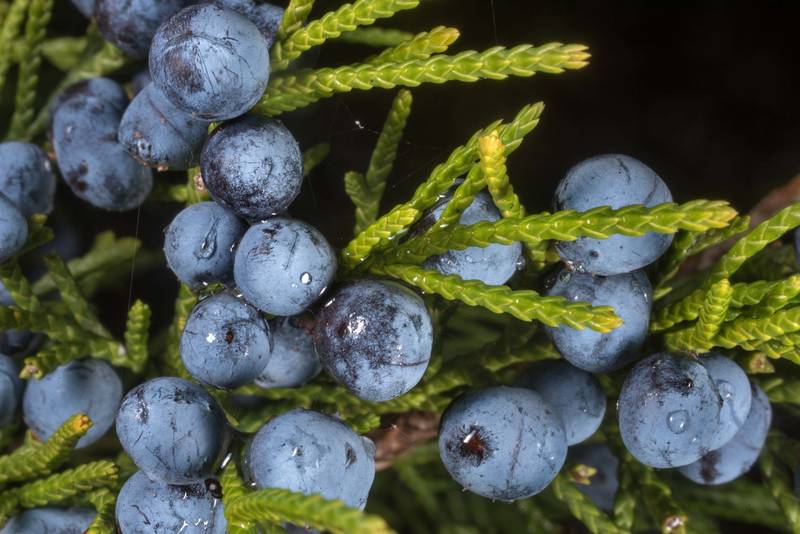
Berries of red cedar (juniper) at Lake Somerville Trailway near Birch Creek Unit of Somerville Lake State Park. Texas


Album 2615: Lake Somerville, Texas, December 21, 2019
The image presents a close-up view of juniper berries against a dark background, showcasing their vibrant blue color and distinctive shape.
* **Juniper Berries**
* The berries are small to medium-sized, with a diameter of approximately 0.5-1 inch (1.3-2.5 cm).
* They have a round or oval shape, often slightly elongated.
* The color is predominantly blue, ranging from light sky blue to deep indigo.
* Some berries exhibit slight variations in color, including purple or reddish undertones.
* **Juniper Branches**
* The juniper branches are visible around the berries, providing a natural setting for the fruit.
* The branches are thin and wiry, with a light green to yellowish-green hue.
* They have a feathery or scale-like appearance, characteristic of juniper foliage.
* **Background**
* The background is dark and indistinct, suggesting that it may be a shadow or a solid surface.
* This creates a sense of depth and dimensionality in the image, drawing attention to the berries and branches.
In summary, the image provides a detailed view of juniper berries on their natural branch, highlighting their unique characteristics and coloration. The dark background serves to emphasize the berries' vibrant blue hue and adds depth to the overall composition. – AI vision
🇪🇸 Descripción en español / Spanish Description
Berros de cedro rojo (enebro) en el Lake Somerville Trailway cerca de Birch Creek Unidad del Somerville Lake State Park, Texas, 21 de diciembre de 2019. La imagen presenta una vista detallada de las bayas de enebro contra un fondo oscuro, mostrando su vibrante color azul y forma distintiva. **Bayas de enebro** * Las bayas son de tamaño pequeño a mediano, con un diámetro de aproximadamente 0,5-1 pulgada (1,3-2,5 cm). * Tienen una forma redonda u ovalada, a menudo ligeramente alargada. * El color es predominantemente azul, que oscila desde un ligero azul cielo hasta un índigo profundo. * Algunas bayas muestran ligeras variaciones en el color, incluyendo tonalidades púrpura o rojizas. **Ramitas de enebro** * Las ramitas de enebro son visibles alrededor de las bayas, proporcionando un entorno natural para la fruta. * Las ramitas son delgadas y ásperas, con un tono de verde claro a amarillo-verdoso. * Tienen una apariencia plumosa o escamosa, característica del follaje del enebro. **Contexto** * El fondo es oscuro e indistinto, lo que sugiere que puede tratarse de una sombra o una superficie sólida. * Esto crea una sensación de profundidad y dimensionalidad en la imagen, llamando la atención sobre las bayas y ramitas. En resumen, la imagen proporciona una vista detallada de las bayas de enebro en su rama natural, destacando sus características únicas y coloración. El fondo oscuro sirve para enfatizar el vibrante tono azul de las bayas y agrega profundidad a la composición general. – Spanish translation