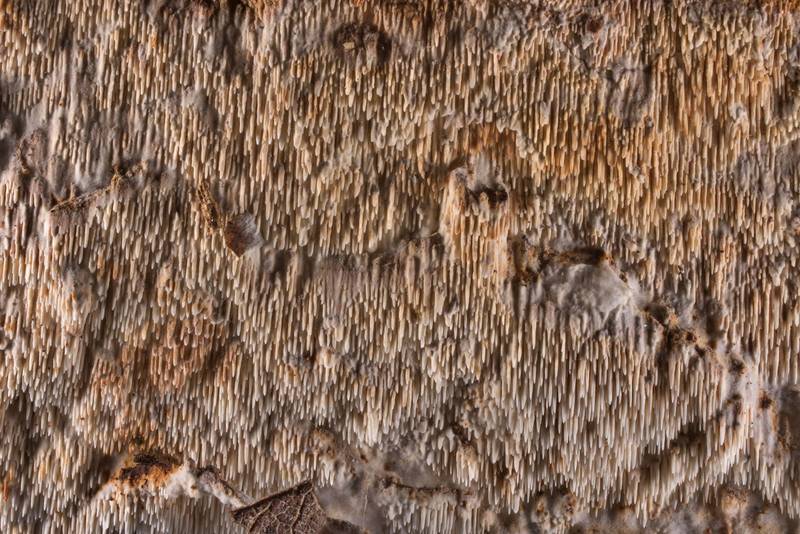

Common tooth fungus on a recently dried oak at Lake Somerville Trailway near Birch Creek Unit of Somerville Lake State Park. Texas


Album 2616: Mushrooms at Lake Somerville, Texas, December 21, 2019
The image depicts a close-up view of a fungal growth on a piece of wood, likely from an oak tree. The fungus is characterized by its distinctive tooth-like appearance, with numerous small, white to yellowish projections resembling teeth or icicles. These projections are densely packed and cover the majority of the surface area.
In the center-left portion of the image, a brownish leaf or twig appears to be embedded in the wood, possibly providing a substrate for the fungus to grow on.
The background of the image is not visible due to the close-up nature of the photograph. However, based on the caption and the presence of oak wood, it can be inferred that the scene was captured at Lake Somerville Trailway near Birch Creek Unit of Somerville Lake State Park in Texas. The fact that the fungus is described as "common" suggests that it may not be a rare or unusual species.
Overall, the image provides a detailed view of a specific type of fungal growth on wood, highlighting its unique characteristics and texture. – AI vision
🇪🇸 Descripción en español / Spanish Description
Hongo dental común en un roble recientemente seco en Lake Somerville Trailway cerca de Birch Creek Unit de Somerville Lake State Park, Texas, el 21 de diciembre de 2019. La imagen muestra una vista cercana a un crecimiento fúngico sobre un trozo de madera, probablemente de un roble. El hongo se caracteriza por su aspecto distintivo similar a un diente, con numerosas proyecciones pequeñas, blancas o amarillentas que recuerdan a dientes o icopor. Estas proyecciones están densamente empaquetadas y cubren la mayor parte de la superficie. En la porción superior izquierda de la imagen, parece haber una hoja parduzca o un trozo de ramita incrustado en la madera, posiblemente sirviendo como sustrato para el hongo que crece sobre él. El fondo de la imagen no es visible debido a la naturaleza cercana de la fotografía. Sin embargo, se puede inferir que la escena fue capturada en Lake Somerville Trailway cerca de Birch Creek Unit of Somerville Lake State Park en Texas según el pie de foto y la presencia de madera de roble. El hecho de que el hongo se describa como "común" sugiere que puede no ser una especie rara o inusual. En general, la imagen proporciona una vista detallada de un tipo específico de crecimiento fúngico sobre madera, destacando sus características y textura únicas. – Spanish translation